Artwork
The princess discovers the dead bodies, with heads severed, of her husband and his Brahman friend, from a Tuti-nama (Tales of a Parrot): Thirty-fourth Night
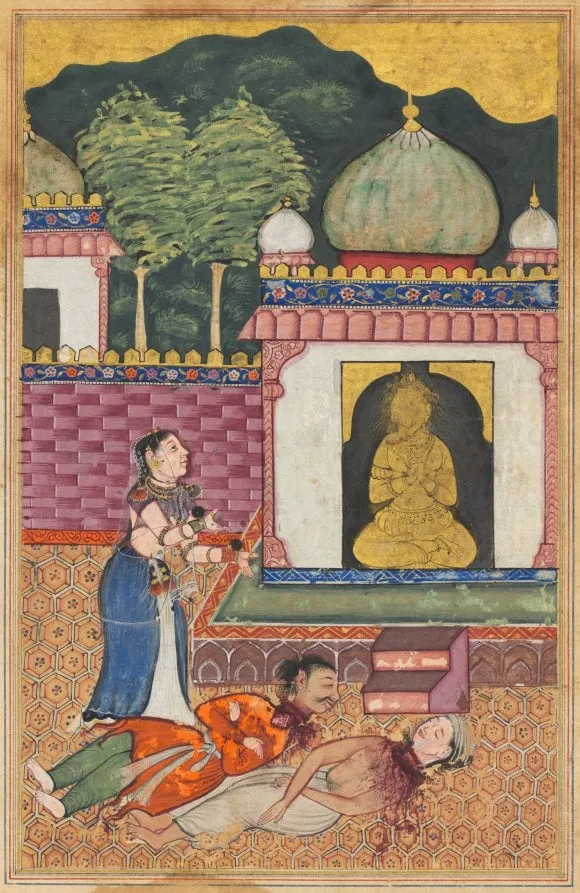
The princess discovers the dead bodies, with heads severed, of her husband and his Brahman friend, from a Tuti-nama (Tales of a Parrot): Thirty-fourth Night is an unspecified painting by the Mughal Painting artist Unknown. It dates from 1560 and is held in the collection of the Cleveland Museum of Art.
About this work
To see more paintings like this, look up mughal india, court of akbar (reigned 1556–1605).
A princess in a blue robe stands over two headless men. One wears orange, the other white. Blood pools on the floor. Their heads lie nearby, eyes still open.
The story says the men killed themselves over her. Later, she puts their heads back—but on the wrong bodies. When they wake, they argue over who’s her real husband. It’s a strange mix of horror and magic.
To see more paintings like this, look up mughal india, court of akbar (reigned 1556–1605).
Overview
The painting depicts a distressed princess standing beside two decapitated figures, one clothed in orange and the other in white, their severed heads placed nearby. Blood stains the floor, and the princess, dressed in blue, appears poised to restore the heads to the bodies, an act that will trigger a supernatural reversal of death.
Subject & Meaning
The scene illustrates a moment from the Tuti‑nama, a collection of moral tales, where the princess discovers her husband and his Brahman companion dead by suicide. By reattaching each head to the wrong corpse, she inadvertently causes both men to revive, leading them to contest their claim as her legitimate spouse—a narrative that blends tragedy, magical realism, and commentary on desire.
Technique & Style
Rendered in the Mughal court aesthetic of the late 16th century, the work combines precise linear drawing with rich, saturated pigments characteristic of Akbar’s atelier. The contrast between the vivid orange and white garments and the cool blue of the princess’s robe highlights the dramatic tension, while the realistic depiction of blood and dismembered forms reflects the period’s attention to detail.
History & Provenance
The painting originates from the Mughal artistic tradition flourishing under Emperor Akbar (1556–1605), whose court patronized illustrated manuscripts such as the Tuti‑nama. Though the exact commission is unknown, the work likely formed part of a deluxe manuscript copy, circulating among elite patrons before entering modern collections.
Context
Set within the broader framework of Mughal narrative painting, the image exemplifies the empire’s synthesis of Persian literary themes and Indian visual conventions. The tale’s moral ambiguity and supernatural elements align with contemporary courtly interests in storytelling that conveyed ethical lessons through vivid, sometimes unsettling, imagery.
Artist & collection

 Domestic Scene
 Giacomo and Cardinal Marco, investing Andrea, Abbot of San Zeno, with his Benefice
 The Nymph of Fontainebleau
 Portrait of a Woman
 Madonna and Child with Saints in the Enclosed Garden
 Venus and Minerva
 Family Group of Four on Sofa
 Wall painting from Room H of the Villa of P. Fannius Synistor at Boscoreale
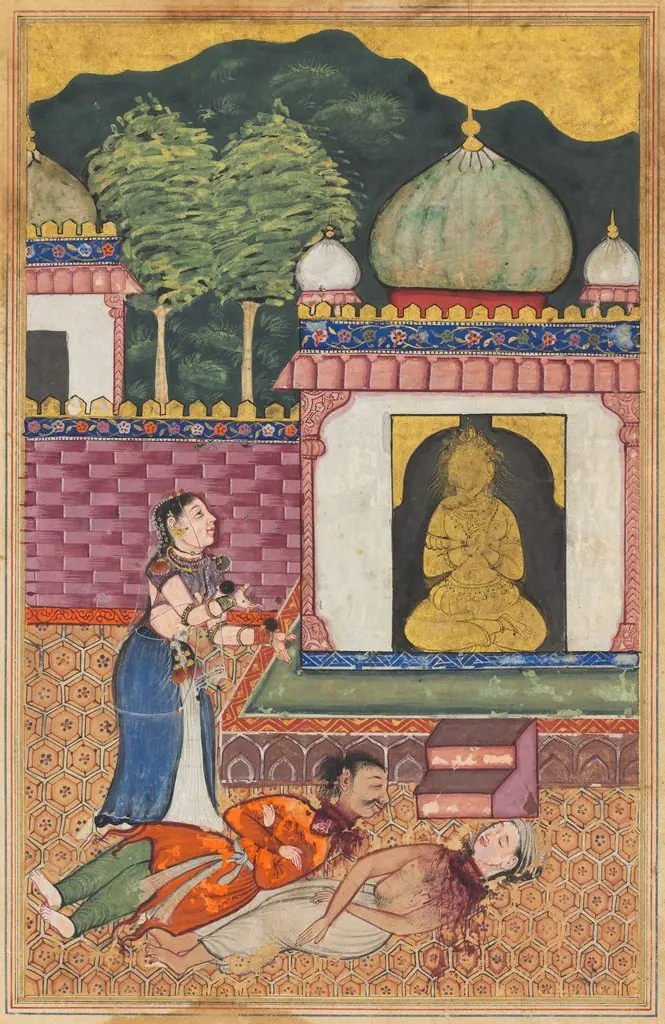 The princess discovers the dead bodies, with heads severed, of her husband and his Brahman friend, from a Tuti-nama (Tales of a Parrot): Thirty-fourth Night
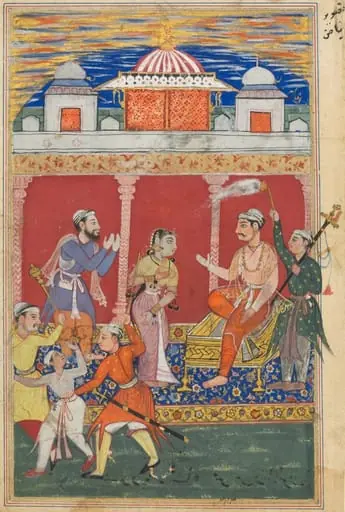 The prince’s ordeal continues, he is ordered away to be executed for the fifth time, from a Tuti-nama (Tales of a Parrot): Eighth Night
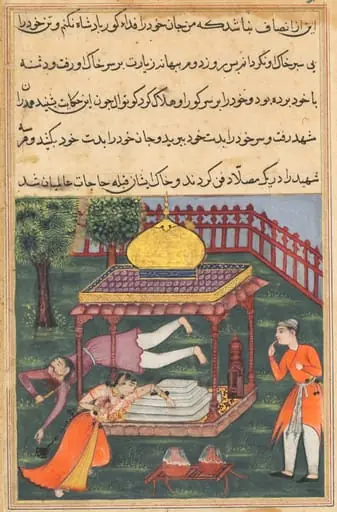 Mahrusa kills herself at the tomb of the king of Zabul, and her husband does likewise, from a Tuti-nama (Tales of a Parrot): Thirty-sixth Night
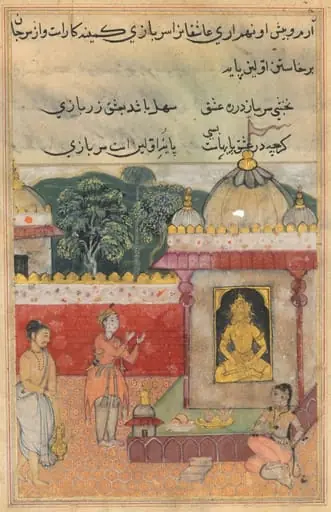 The Raja’s son vows to sever his head and offer it to the image if he is united with the princess he has seen in the temple, from a Tuti-nama (Tales of a Parrot): Thirty-fourth Night
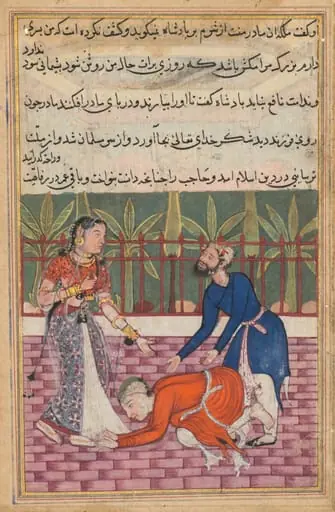 The guard restores the son who falls at his mother’s feet, from a Tuti-nama (Tales of a Parrot): Fiftieth Night
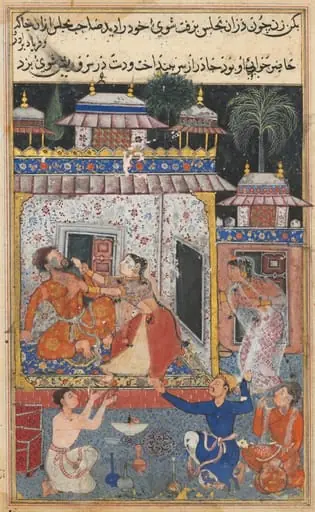 The deceitful wife assaults her erring husband, from a Tuti-nama (Tales of a Parrot): Eighth Night
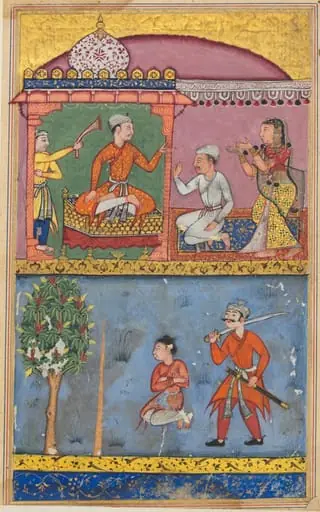 The handmaiden appeals for justice and the prince is taken to the execution site for the fourth time, from a Tuti-nama (Tales of a Parrot): Eighth Night
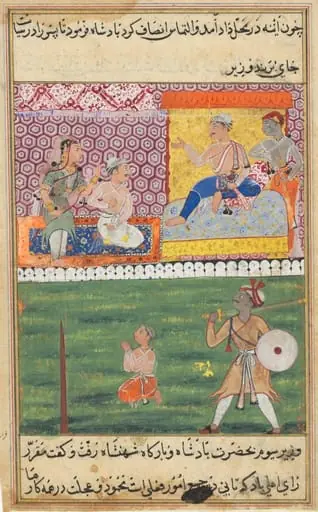 The handmaiden again appeals for justice and the prince is led to the place of execution for the third time, from a Tuti-nama (Tales of a Parrot): Eighth Night
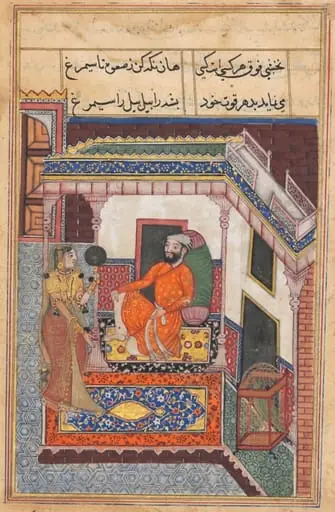 The parrot laughs on hearing the Raja of Ujjain’s wife admire her beauty in a mirror, from a Tuti-nama (Tales of a Parrot: Forty-sixth Night
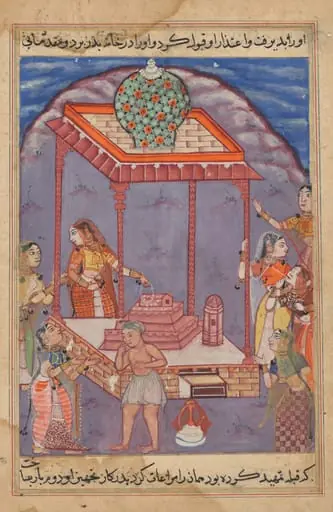 The destitute Mukhtar meets his wife Maimuna at a holy shrine, from a Tuti-nama (Tales of a Parrot): Twenty-fifth Night
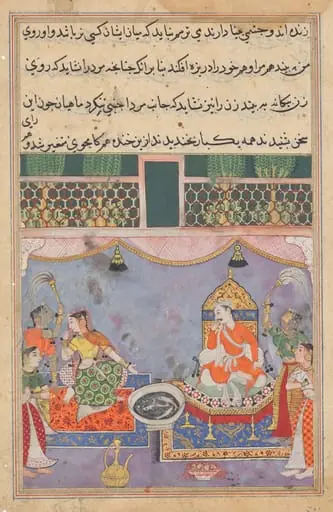 Kamjuy, the wife of the Raja, averts her face from the fishes, from a Tuti-nama (Tales of a Parrot): Twenty-third Night