Artwork
The snake, hidden in a basket of flowers, reveals himself to the Raja who has just sent away his wife, from a Tuti-nama (Tales of a Parrot): Forty-third Night
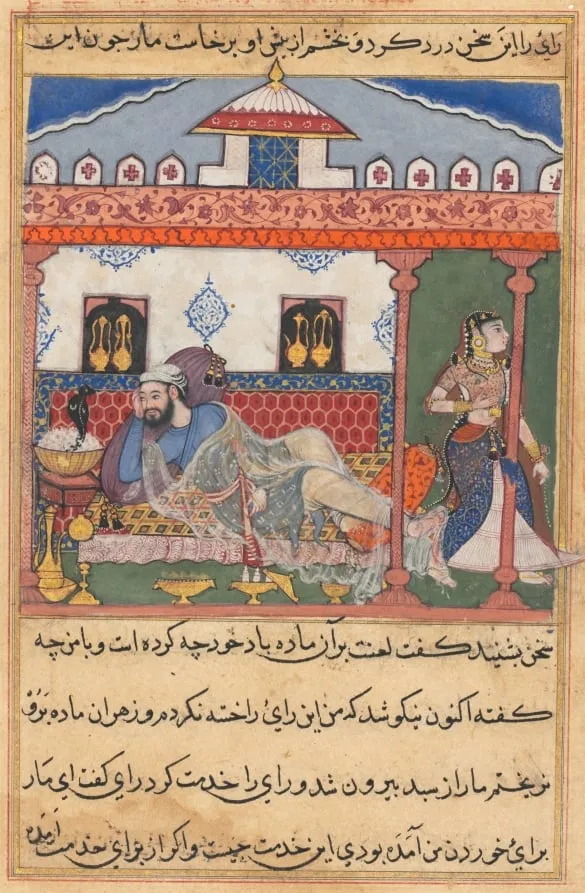
The snake, hidden in a basket of flowers, reveals himself to the Raja who has just sent away his wife, from a Tuti-nama (Tales of a Parrot): Forty-third Night is an unspecified painting by the Mughal Painting artist Unknown. It dates from 1560 and is held in the collection of the Cleveland Museum of Art. The painting depicts a richly attired ruler seated in a palace chamber, his gaze fixed on a black cobra coiled at the foot of his bed.
About this work
The snake is there to kill the king—but when the king explains why he hurt the snake’s wife, the snake spares him and gives him a gift instead.
You see a richly dressed king in a palace, staring at a black cobra coiled beside his bed while a basket of flowers tips over.
This painting comes from a book of parrot tales told to Emperor Akbar’s court. The snake is there to kill the king—but when the king explains why he hurt the snake’s wife, the snake spares him and gives him a gift instead.
To see more stories like this, look up Mughal India, court of Akbar (reigned 1556–1605).
Overview
The painting depicts a richly attired ruler seated in a palace chamber, his gaze fixed on a black cobra coiled at the foot of his bed. A basket of flowers has tipped over nearby, adding a sense of sudden movement. The scene captures a moment of tense dialogue between monarch and serpent, drawn from a narrative in a Mughal manuscript.
Subject & Meaning
The composition illustrates a tale in which the king, having harmed the cobra’s mate after suspecting infidelity, confronts the vengeful snake. By explaining his motives, the ruler persuades the cobra to spare his life. In gratitude, the serpent bestows upon the king the power to understand animal speech, underscoring themes of remorse, negotiation, and the exchange of knowledge.
Technique & Style
Executed in the miniature tradition of Mughal painting, the work combines fine brushwork with a luminous palette of reds, golds, and deep blacks. Delicate line work defines the king’s garments and the serpent’s scales, while the surrounding architecture is rendered with precise perspective, reflecting the court’s sophisticated aesthetic.
History & Provenance
The image originates from a Tuti‑nama, a collection of parrot stories compiled for the court of Emperor Akbar (1556‑1605). Such manuscripts were produced in imperial workshops, intended for elite audiences and often circulated among royal patrons.
Context
Mughal court culture prized literary and visual storytelling that blended Persian, Indian, and Islamic motifs. Tales involving animals served both entertainment and moral instruction, illustrating the ruler’s capacity for justice and the value of compassion toward all creatures.
Artist & collection

 Domestic Scene
 Giacomo and Cardinal Marco, investing Andrea, Abbot of San Zeno, with his Benefice
 The Nymph of Fontainebleau
 Portrait of a Woman
 Madonna and Child with Saints in the Enclosed Garden
 Venus and Minerva
 Family Group of Four on Sofa
 Wall painting from Room H of the Villa of P. Fannius Synistor at Boscoreale
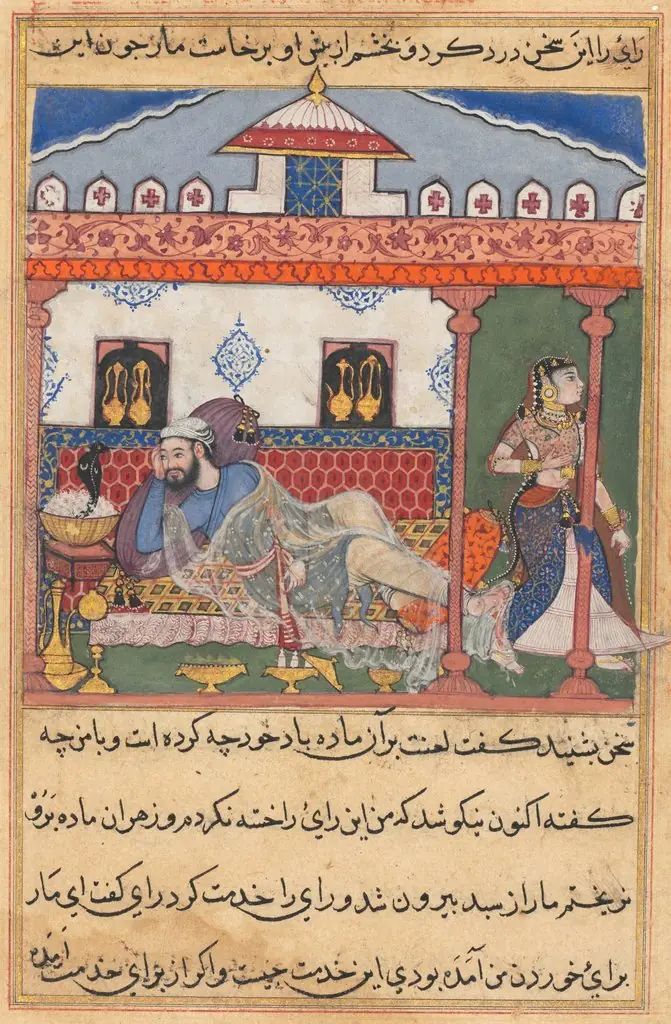 The snake, hidden in a basket of flowers, reveals himself to the Raja who has just sent away his wife, from a Tuti-nama (Tales of a Parrot): Forty-third Night
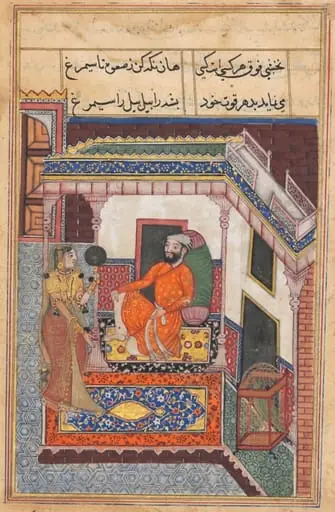 The parrot laughs on hearing the Raja of Ujjain’s wife admire her beauty in a mirror, from a Tuti-nama (Tales of a Parrot: Forty-sixth Night
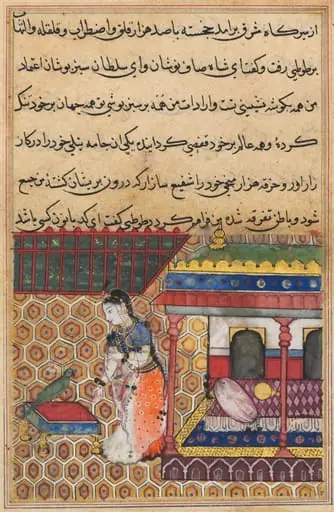 The parrot addresses Khujasta at the beginning of the thirty-eighth night, from a Tuti-nama (Tales of a Parrot)
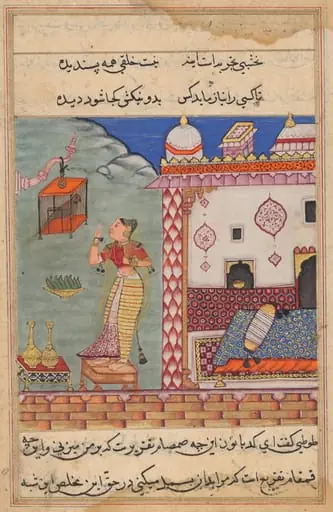 The Parrot Addresses Khujasta at the Beginning of the Twenty-seventh Night, form a Tuti-nama (Tales of a Parrot)
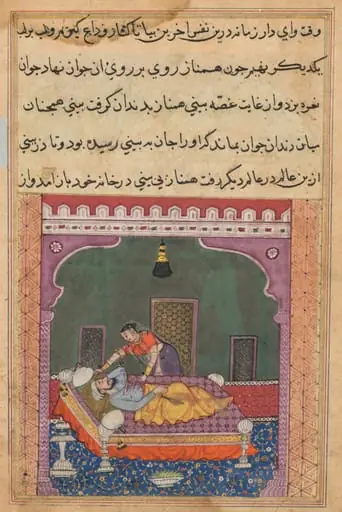 In order to falsely implicate her husband, Hamnaz places a knife by his side and lets the blood dripping from her nose stain his clothes, from a Tuti-nama (Tales of a Parrot): Twenty-fifth Night
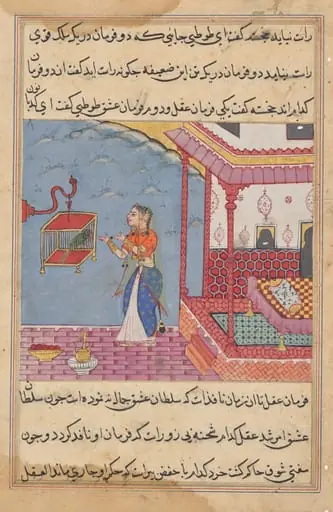 The Parrot Addresses Khujasta at the Beginning of the Twenty-Fourth Night, from a Tuti-nama (Tales of a Parrot)
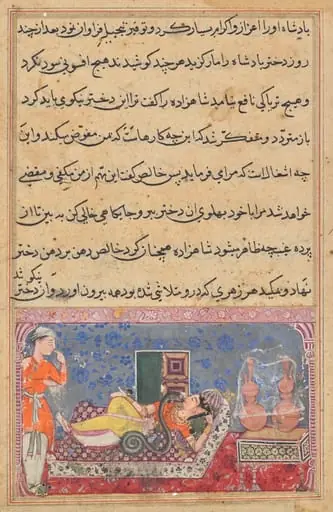 Khalis repays the prince for his kindness by changing into a snake and sucking the poison from the king’s daughter, from a Tuti-nama (Tales of a Parrot): Eighteenth Night
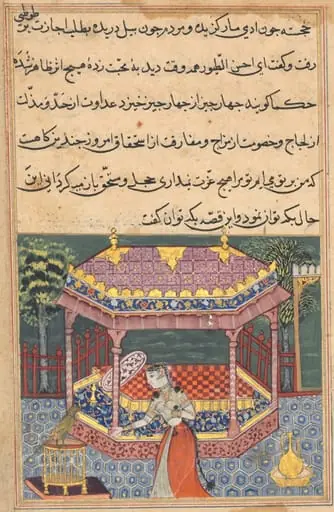 The parrot addresses Khujasta at the beginning of the thirty-seventh night, from a Tuti-nama (Tales of a Parrot)
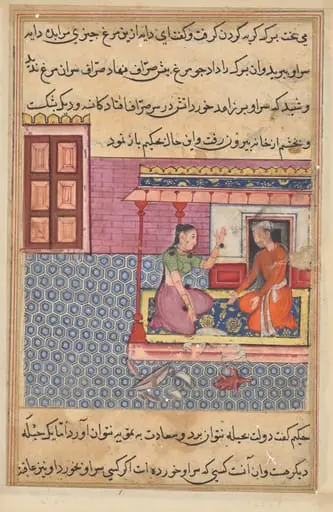 The pious man’s wife offers the seven-colored bird as food to her lover, but not finding its head, he breaks the pot and bowl in anger, from a Tuti-nama (Tales of a Parrot): Fifty-second Night
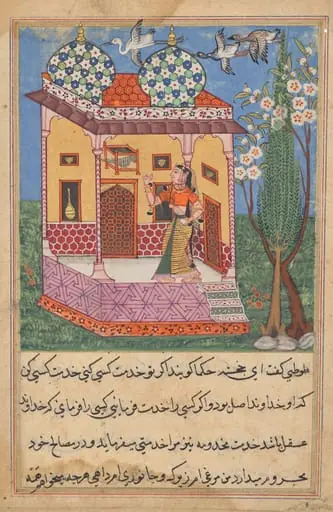 The Parrot Addresses Khujasta at the Beginning of the Twenty-sixth Night, from a Tuti-nama (Tales of a Parrot)