Artwork
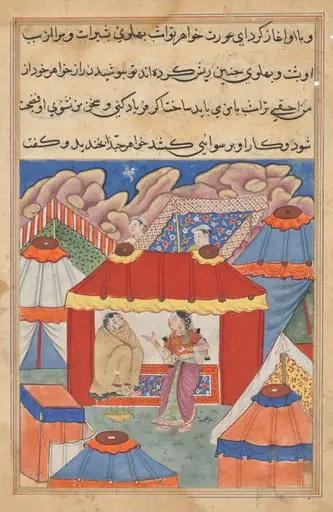
In order to falsely implicate her husband, Hamnaz places a knife by his side and lets the blood dripping from her nose stain his clothes, from a Tuti-nama (Tales of a Parrot): Twenty-fifth Night
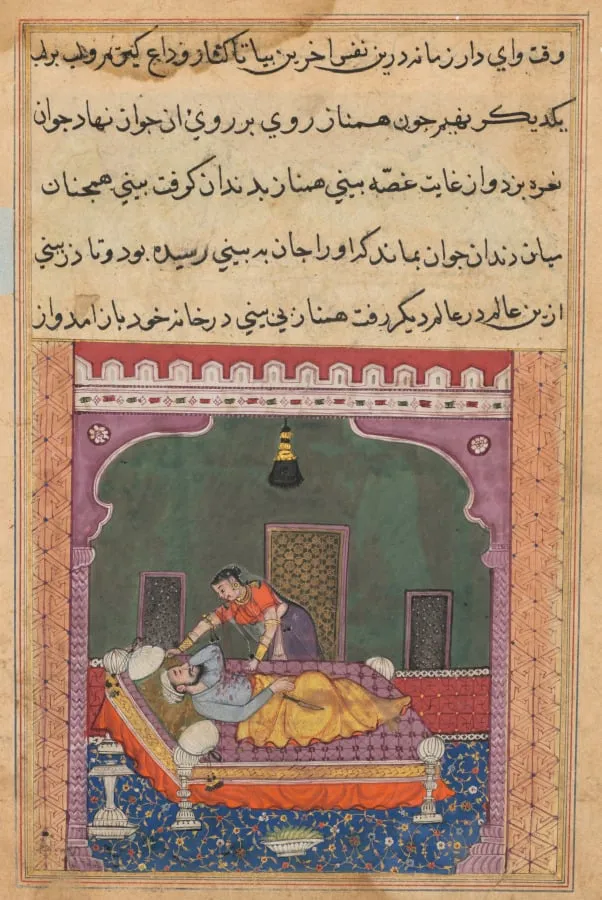
In order to falsely implicate her husband, Hamnaz places a knife by his side and lets the blood dripping from her nose stain his clothes, from a Tuti-nama (Tales of a Parrot): Twenty-fifth Night is an unspecified painting by the Mughal Painting artist Unknown. It dates from 1560 and is held in the collection of the Cleveland Museum of Art. The painting illustrates a dramatic episode from the 16th‑century Indian collection of tales known as the *Tuti‑nama* (Tales of a Parrot).
About this work
You see a woman in a red dress bending over a sleeping man, blood dripping from her nose onto his clothes.
You see a woman in a red dress bending over a sleeping man, blood dripping from her nose onto his clothes.
This painting tells a wild story from a 16th-century Indian book called the *Tuti-nama*. The woman, Hamnaz, was caught in an affair—her lover bit off her nose as he died. Now she’s trying to frame her husband for the injury. The truth comes out when they find her nose in the dead man’s mouth.
To see more stories like this, look up Mughal India, court of Akbar (reigned 1556–1605).
Overview
The painting illustrates a dramatic episode from the 16th‑century Indian collection of tales known as the *Tuti‑nama* (Tales of a Parrot). In the scene, a woman in a vivid red garment leans over a sleeping man, a stream of blood flowing from her nose onto his clothing, suggesting a violent and deceptive act.
Subject & Meaning
The figure, identified as Hamnaz, has had her nose severed by a dying lover during an illicit affair. She deliberately places the blood‑stained knife near her husband, hoping to implicate him in the injury and conceal her infidelity. The narrative resolves when the missing nose is discovered in the dead lover’s mouth, exonerating the husband.
Technique & Style
Rendered in a Mughal court aesthetic, the work combines precise linear drawing with rich, saturated pigments, especially the striking red of the woman's dress. The composition focuses on the intimate foreground, using chiaroscuro to highlight the blood and the tension between the two figures.
Context
The episode belongs to the *Tuti‑nama*, a compilation of moral and entertaining stories circulated in Akbar’s empire (1556‑1605). Such illustrations served both as visual entertainment and as didactic examples of the consequences of deceit within the sophisticated court culture of Mughal India.
Artist & collection

 Domestic Scene
 Giacomo and Cardinal Marco, investing Andrea, Abbot of San Zeno, with his Benefice
 The Nymph of Fontainebleau
 Portrait of a Woman
 Madonna and Child with Saints in the Enclosed Garden
 Venus and Minerva
 Family Group of Four on Sofa
 Wall painting from Room H of the Villa of P. Fannius Synistor at Boscoreale
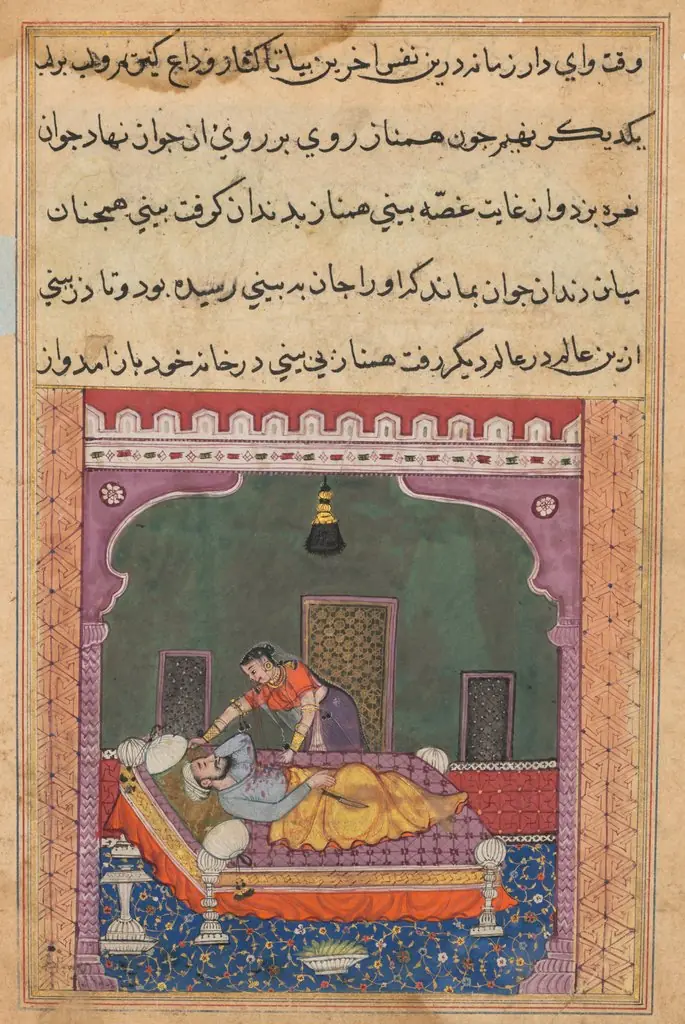 In order to falsely implicate her husband, Hamnaz places a knife by his side and lets the blood dripping from her nose stain his clothes, from a Tuti-nama (Tales of a Parrot): Twenty-fifth Night
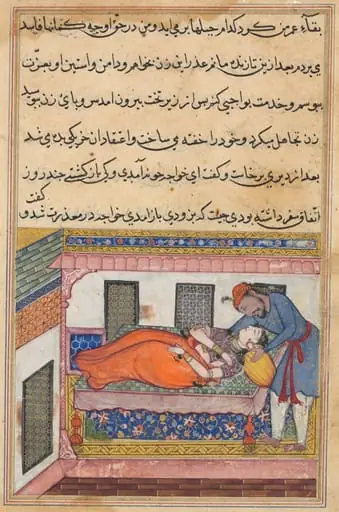 Shahr-Arai’s husband bends to kiss his wife who feigns sleep, from a Tuti-nama (Tales of a Parrot): Fortieth Night
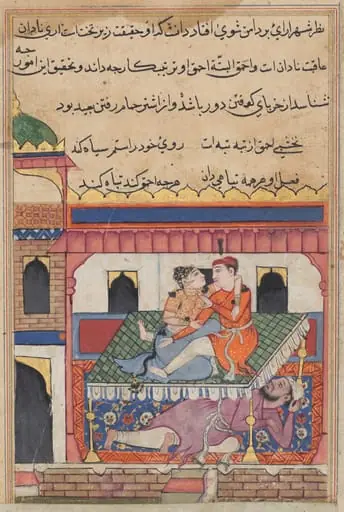 Shahr-Arai and her lover dallying on a bed beneath which is concealed her husband, from a Tuti-nama (Tales of a Parrot): Fortieth Night
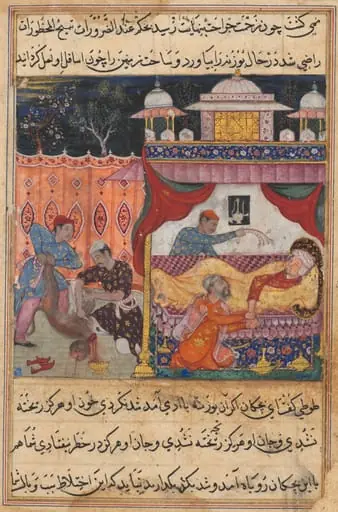 The monkey slain, his blood to be used as medicine for the ailing prince he has bitten, from a Tuti-nama (Tales of a Parrot): Fifth Night
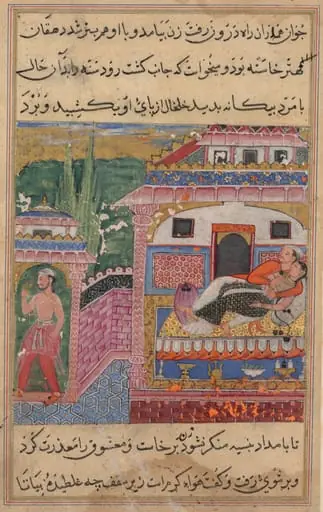 The farmer, father of the son with the deceitful wife, steals away with her anklet while she is in bed with her lover, from a Tuti-nama (Tales of a Parrot): Eighth Night
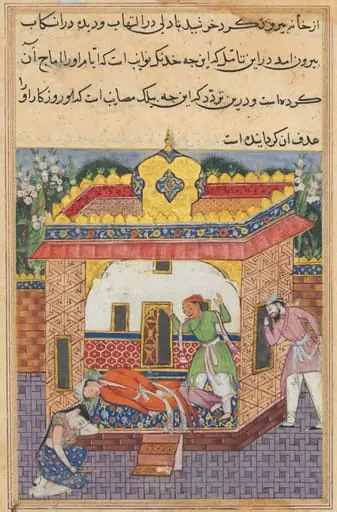 Latif, who has murdered his brother, falsely accuses Khurshid of the deed, from a Tuti-nama (Tales of a Parrot): Thirty-second Night
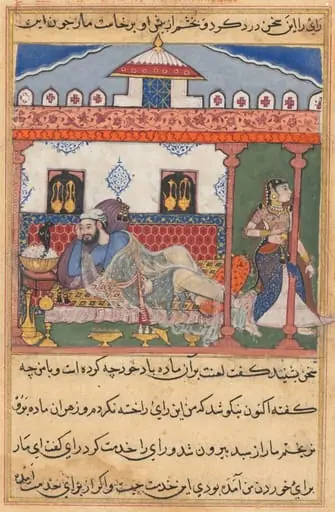 The snake, hidden in a basket of flowers, reveals himself to the Raja who has just sent away his wife, from a Tuti-nama (Tales of a Parrot): Forty-third Night
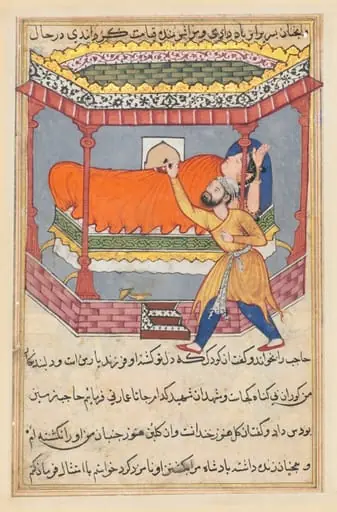 The king places the talisman on his sleeping wife, from a Tuti-nama (Tales of a Parrot): Fiftieth Night
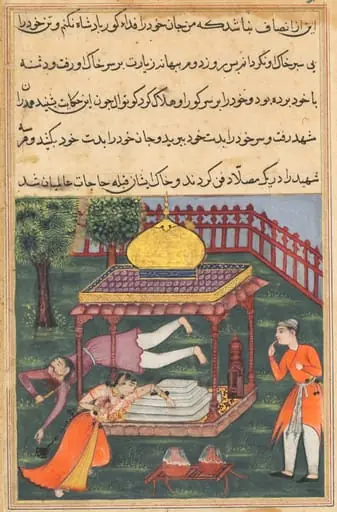 Mahrusa kills herself at the tomb of the king of Zabul, and her husband does likewise, from a Tuti-nama (Tales of a Parrot): Thirty-sixth Night
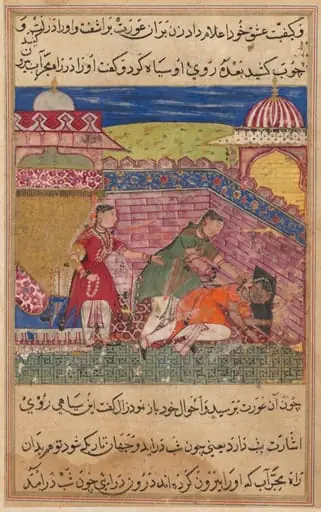 The deceitful wife ejects the procuress after blackening her face, from a Tuti-nama (Tales of a Parrot): Eighth Night
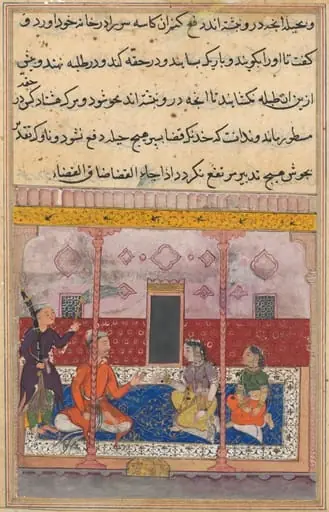 The merchant has the hateful skull ground and put into a box, from a Tuti-nama (Tales of a Parrot): Twenty-third Night
 Habbaza’s sister, who is sent to console her, discovers the disguised Arab in her place, from a Tuti-nama (Tales of a Parrot): Twenty-fourth Night