Artwork
Daishin Nankin fu no shiō|Nankin in China
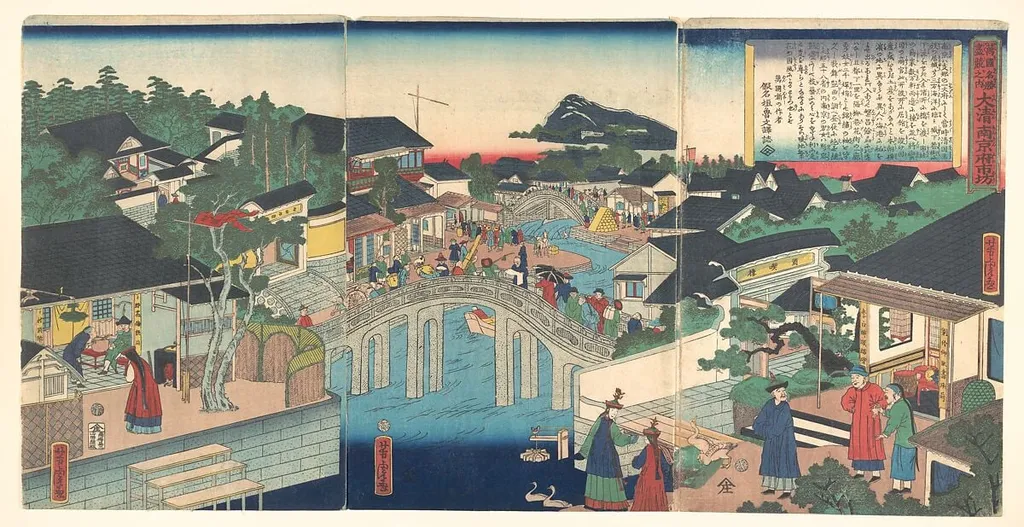
Daishin Nankin fu no shiō|Nankin in China is an ink print by the Impressionist artist Utagawa Yoshitora. It dates from 2 and is held in the collection of the Metropolitan Museum of Art.
About this work
Overview
Created in the mid-19th century, it combines ink and color on paper, arranged across three panels to form a continuous view.
This triptych woodblock print, attributed to Utagawa Yoshitora, depicts a riverside scene in Nanjing, China. Created in the mid-19th century, it combines ink and color on paper, arranged across three panels to form a continuous view. The work is part of the collection at The Metropolitan Museum of Art, where it serves as an example of Japanese artistic engagement with foreign landscapes during the Edo period.
Subject & Meaning
The scene captures the daily rhythm of a Chinese riverside town, with figures moving along a stone bridge, vendors lining the shore, and swans gliding on the water. The presence of a woman in a red robe and men gathered near a marked building suggests social activity and commerce. Though not a documentary record, the image reflects Japanese perceptions of Chinese urban life, blending observation with imaginative reconstruction.
Technique & Style
Yoshitora employed traditional ukiyo-e methods: carved woodblocks, flat areas of color, and strong outlines to define forms. The composition avoids perspective depth, instead using overlapping figures and architectural elements to suggest space. Bright pigments and dense detail characterize the work, aligning with popular print aesthetics of the time while emphasizing movement and activity across the three-panel format.
History & Provenance
The print was produced during a period when Japanese artists increasingly depicted foreign locales, often based on limited sources like travel accounts or imported illustrations. Its presence in The Metropolitan Museum of Art’s collection indicates early 20th-century acquisition, likely through private dealers or collectors interested in Japanese prints. No earlier provenance is documented, but its style aligns with Yoshitora’s known output from the 1850s–60s.
Context
In mid-19th century Japan, interest in foreign lands grew as trade restrictions eased. Artists like Yoshitora created series on distant cities, including Nanjing, often without firsthand experience. These works catered to domestic audiences fascinated by the exotic, blending factual fragments with conventional imagery. The print thus reflects Japan’s cultural curiosity rather than accurate ethnographic representation.
Legacy
Though not widely exhibited, the triptych remains a representative example of Japanese ukiyo-e’s engagement with non-Japanese subjects. It contributes to scholarly understanding of how Edo-period artists interpreted and reimagined foreign environments. Its preservation in a major museum ensures continued access for study, offering insight into cross-cultural visual exchange before widespread global travel.
Artist & collection

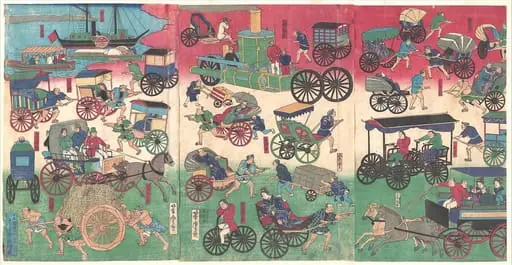 Untitled
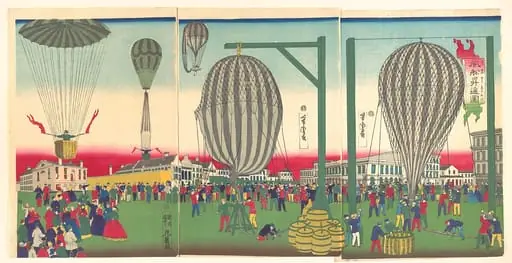 風船昇遥図|Illustration of a Balloon Ascending (Fūsen shōyō no zu)
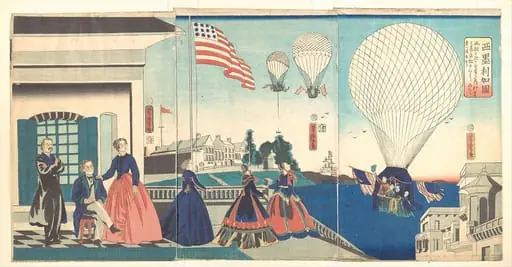 「亜墨利加國」|“America”: Enjoying Hot Air Balloons
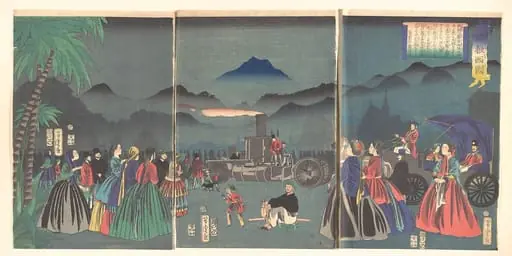 仏蘭西国|France (furansukoku)
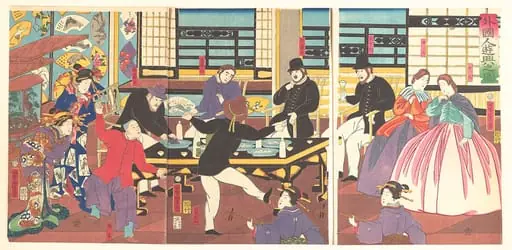 歌川義虎画 『外国人遊興之図』|Foreigners Enjoying a Party (Gaikokujin yūkyō no zu)
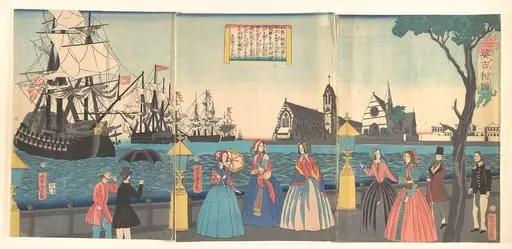 英吉利国|England (Igirisukoku)
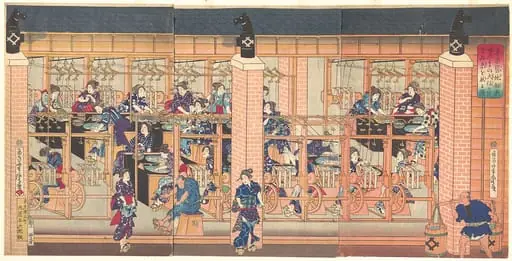 『東京築地舶来ぜんま い大仕かけきぬ糸をとる図』|Imported Silk Reeling Machine at Tsukiji in Tokyo
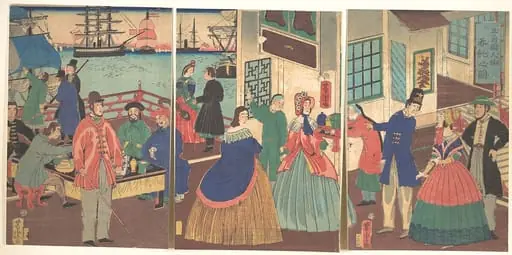 歌川芳虎画 『五箇国人物 呑飥之図』|People of the Five Nations Drinking and Eating (Gokakoku jinbutsu dontaku no zu)