Artwork
Sir Kenelm Digby
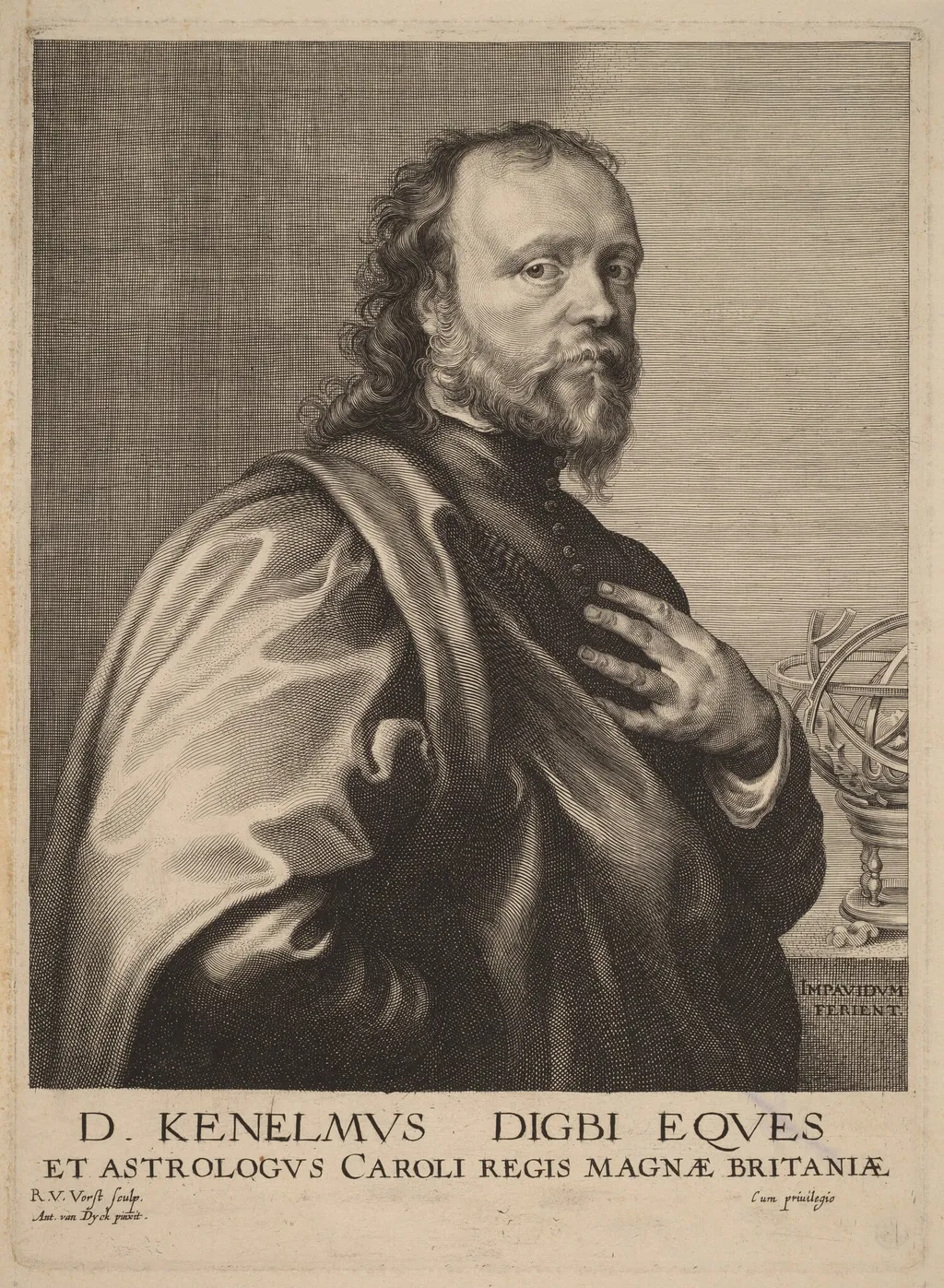
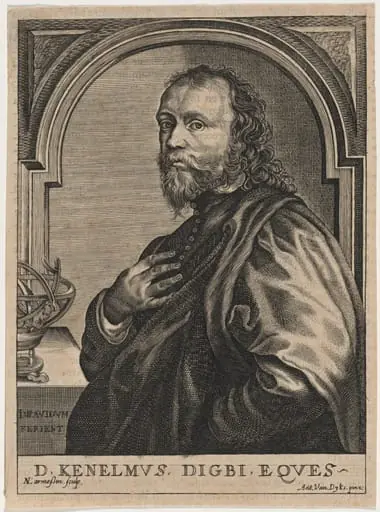
Sir Kenelm Digby is an ink print by the Baroque artist Robert van Voerst. It dates from 1631 and is held in the collection of the National Gallery of Art.
About this work
Overview
This black-and-white engraving, dated around 1631, depicts Sir Kenelm Digby as a solemn, bearded gentleman in dark attire.
This black-and-white engraving, dated around 1631, depicts Sir Kenelm Digby as a solemn, bearded gentleman in dark attire. Rendered by Dutch-born printmaker Robert van Voerst, the portrait emphasizes facial detail against a plain background. Digby is shown holding a document in one hand while the other rests on his chest, suggesting contemplation or authority. His title as knight and astrologer to King Charles I appears beneath the image, alongside the artist’s signature.
Subject & Meaning
Sir Kenelm Digby was a prominent figure in early 17th-century England: a courtier, natural philosopher, and patron of the arts. The engraving presents him not merely as a nobleman but as an intellectual—his posture and the held document imply scholarly engagement. The inclusion of 'astrologer' in the inscription reflects the era’s blending of scientific inquiry and esoteric study, aligning him with the intellectual currents of Charles I’s court.
Technique & Style
Van Voerst employed fine linear engraving to capture texture and form, particularly in Digby’s curly hair, beard, and the folds of his robe. The contrast between the detailed face and the minimal background directs focus to the subject’s expression and demeanor. The precision of the lines and the absence of tonal shading reflect the conventions of portrait engraving in early Stuart England, where clarity and dignity were prioritized over dramatic effect.
History & Provenance
The engraving was produced during Digby’s active years at the English court, likely as part of a series documenting notable figures. Van Voerst, who worked extensively in London after emigrating from the Netherlands, was known for his portraiture in print. While the original commissioning context is unrecorded, the print’s survival in multiple institutional collections suggests it circulated among educated elites as a representation of intellectual nobility.
Context
In the 1630s, portraiture in print served both commemorative and social functions, especially among the gentry and court circles. Digby’s dual identity as knight and astrologer reflects the period’s fluid boundaries between science, mysticism, and state service. Engravings like this one helped disseminate images of influential individuals beyond the elite, reinforcing their public stature through reproducible imagery.
Legacy
Though not widely known today, this engraving remains a tangible record of how intellectual authority was visually constructed in early modern England. Van Voerst’s work contributes to a broader corpus of Stuart-era portraiture that documents the intersection of science, court culture, and print media. The image continues to be referenced in studies of early modern identity and the visual culture of natural philosophy.
Artist & collection