Artwork
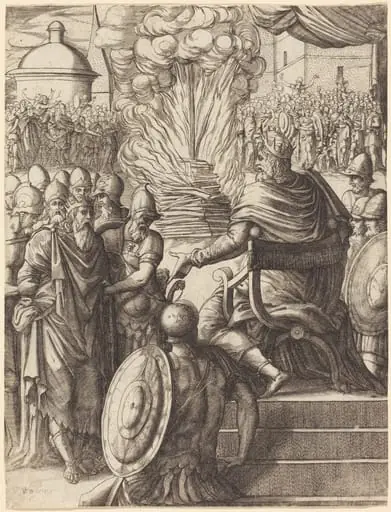
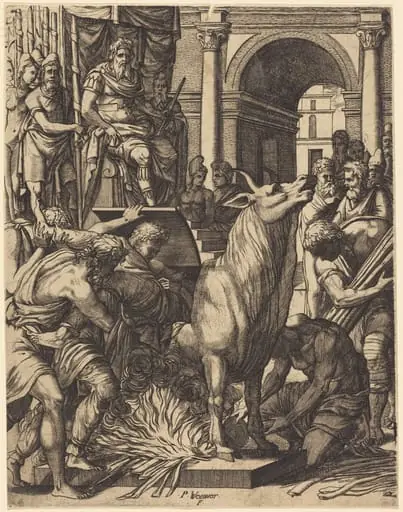
The Wife of Hasdrubal Throws Herself on the Fire
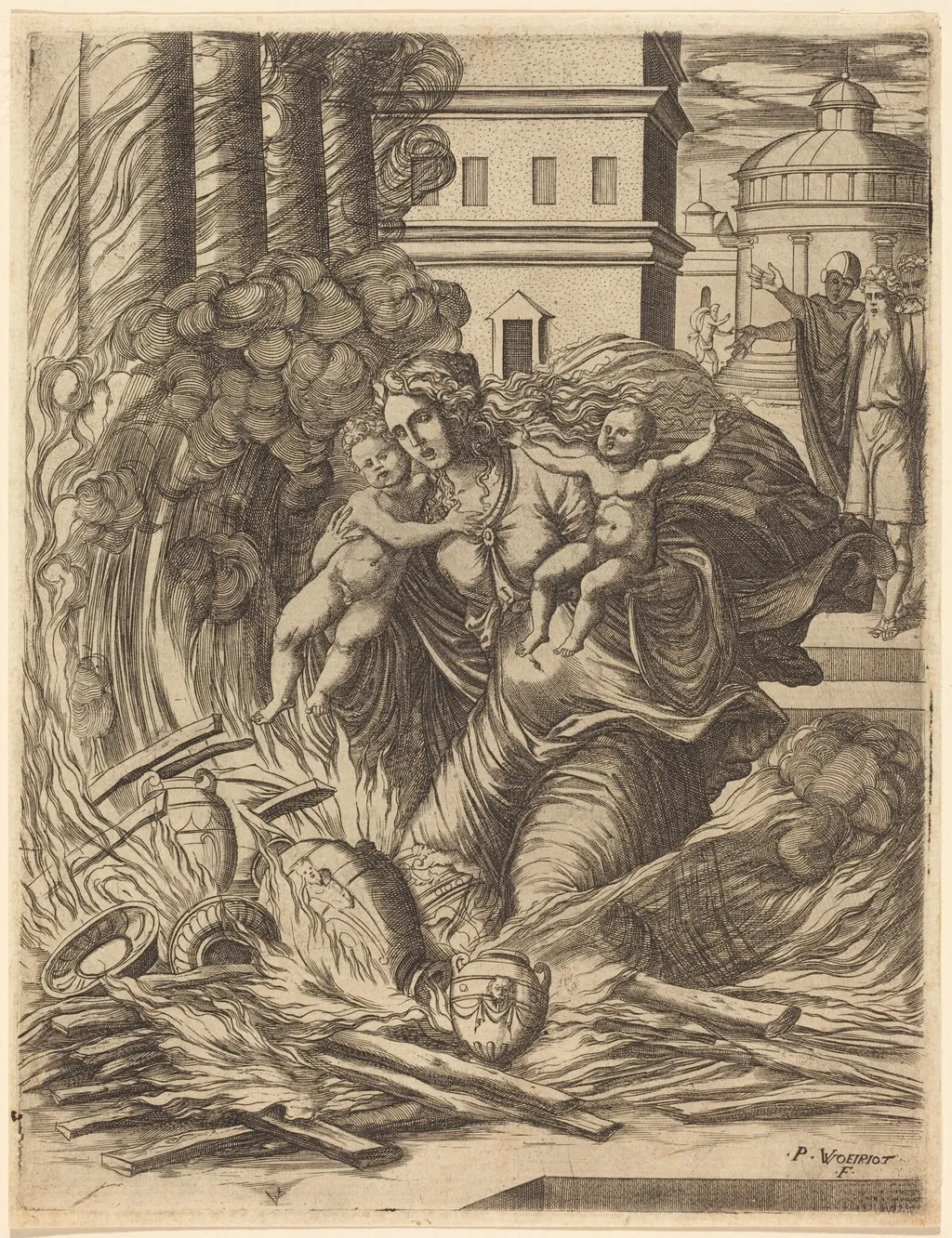
The Wife of Hasdrubal Throws Herself on the Fire is an ink print by the Renaissance artist Pierre II Woeiriot de Bouzey. It dates from 1566 and is held in the collection of the National Gallery of Art.
About this work
Overview
Woeiriot de Bouzey’s 1566 engraving, titled *The Wife of Hasdrubal Throws Herself on the Fire*, portrays a dramatic moment from the Carthaginian legend. Rendered in fine black lines, the print captures a woman in a flowing robe plunging into an open blaze, her figure illuminated by the surrounding flames.
Subject & Meaning
The scene illustrates the tragic act of Hasdrubal’s wife, who, according to ancient accounts, chose death by fire rather than surrender to the Romans. Her outstretched arms, twisted torso, and anguished expression convey both physical suffering and a resolute defiance, reflecting Renaissance interest in heroic martyrdom.
Technique & Style
Executed with meticulous cross‑hatching, the engraving achieves a rich tonal range that models the smoke, the flickering fire, and the folds of the garment. The artist’s precise line work creates a sense of depth, while the contrast between dark shadows and bright highlights enhances the dramatic intensity of the composition.
History & Provenance
Created in 1566, the print bears the name of Pierre II, a patron or possibly a collaborator linked to the workshop of Woeiriot de Bouzey, a French engraver active in the mid‑16th century. Surviving copies have appeared in several European collections, indicating the work’s circulation among collectors of mythological and historical prints.
Context
During the mid‑1500s, French printmakers frequently revisited classical and biblical narratives, using the medium to disseminate moral exempla. This engraving aligns with that trend, presenting a story of noble self‑sacrifice that resonated with contemporary notions of virtue and honor.
Legacy
While not as widely reproduced as other mythological prints of the period, de Bouzey’s rendering of Hasdrubal’s wife remains a notable example of late‑Renaissance engraving, illustrating the technical skill and narrative ambition that characterized French print culture before the rise of the Baroque.
Artist & collection