Artwork
Janissaries with soup kettles and the regimental spoon
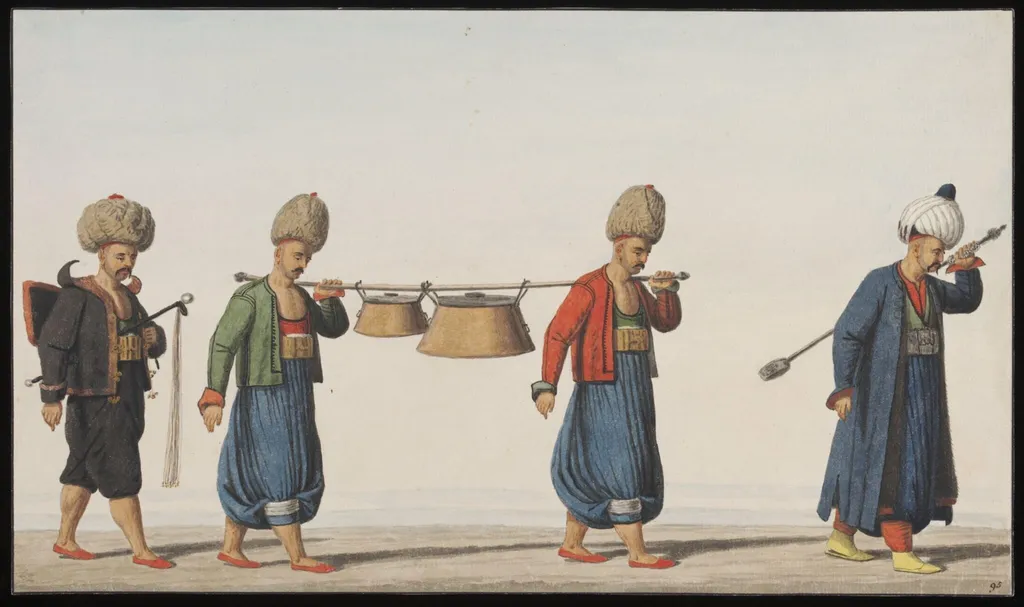
Janissaries with soup kettles and the regimental spoon is a watercolor work on paper by the Romanesque artist Anonymous Greek artist. It dates from 1809 and is held in the collection of the Victoria and Albert Museum.
About this work
This watercolor shows Janissary soldiers gathered around soup kettles. It’s part of a series made in 1809, during the Romantic era.
Soup was sacred to these fighters. Legend says their order started in the 1300s with a blessing from a dervish. Lose the giant spoon? That spelled shame. Beat the kettle and you called for mutiny.
Look up the Victoria and Albert Museum next.
Overview
The image captures a routine yet symbolically charged moment in Janissary daily life.
This watercolour, created in 1809, depicts Janissary soldiers gathered around large copper soup kettles, part of a commissioned series documenting Ottoman military life. The work was produced under the direction of British diplomat Stratford Canning, who employed a local artist—likely affiliated with Konstantin Kapidagli’s studio—to record customs and institutions during his posting in Istanbul. The image captures a routine yet symbolically charged moment in Janissary daily life.
Subject & Meaning
Soup held deep ritual significance for the Janissaries, tied to their legendary founding in the fourteenth century under the blessing of the dervish Haci Bektas. The communal meal was more than sustenance; it embodied unity and spiritual cohesion. The oversized regimental spoon functioned as a standard in battle, and its loss was considered a profound dishonor. Upturning the cauldron and striking it served as a prearranged signal for rebellion, linking the vessel to both sustenance and dissent.
Technique & Style
The watercolour employs dense, luminous layers of bodycolour characteristic of Ottoman artistic traditions, blended with European observational precision. Details are rendered with careful attention to texture and form—copper kettles, fabric folds, and ceremonial headgear—suggesting a synthesis of local techniques and Western documentary aims. The composition is orderly yet intimate, focusing on the soldiers’ interaction with their tools rather than grandeur or action.
History & Provenance
Commissioned by Stratford Canning during his early diplomatic service in Istanbul, the series was assembled between 1808 and 1809 as a visual record of Ottoman institutions. Canning, later Viscount Stratford de Redcliffe, sought to document customs beyond official channels, hiring local artists to capture scenes otherwise inaccessible to foreigners. The artist’s identity remains unconfirmed, though stylistic analysis points to the circle of Konstantin Kapidagli, a known Ottoman painter of the period.
Context
Created during the Romantic era, the work reflects European fascination with the Ottoman Empire’s perceived exoticism and institutional uniqueness. Yet it diverges from orientalist fantasy by grounding its imagery in observed detail rather than stereotype. The Janissaries, though still a formidable force in 1809, were already under political strain; this series preserves their rituals just before their eventual dissolution in 1826.
Legacy
The watercolour survives as part of a rare visual archive compiled by a foreign diplomat with unusual access and curiosity. It offers insight into Janissary culture not through propaganda or myth, but through the quiet observation of daily ritual. The series, now held in the Victoria and Albert Museum, remains a key resource for understanding the material and symbolic life of the corps in its final decades.
Artist & collection

![A Pasha travelling with his escort[?], by Anonymous Greek artist](https://artifactworldgallery.com/img/anonymous-greek-artist--a-pasha-travelling-with-his-escort--01de32b8fcf30843-w320.webp)
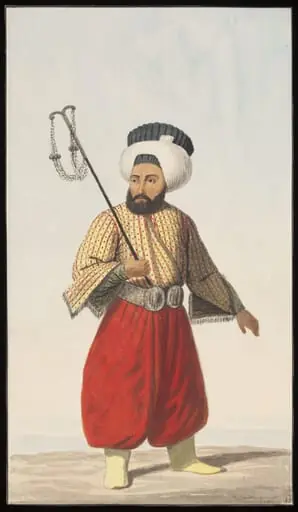
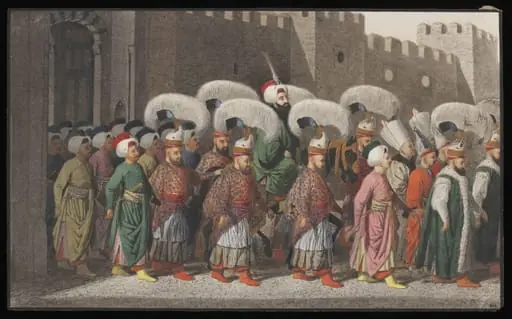
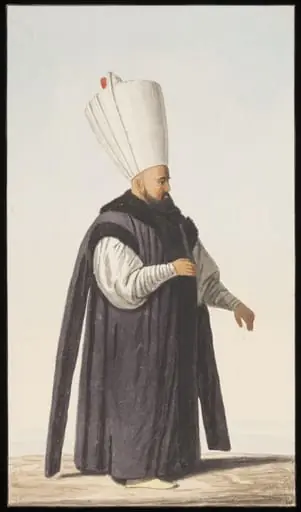
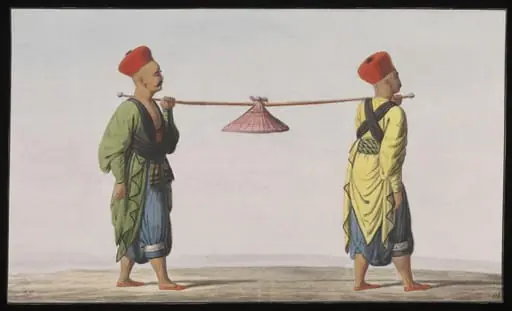 Asciler, or cooks carrying food
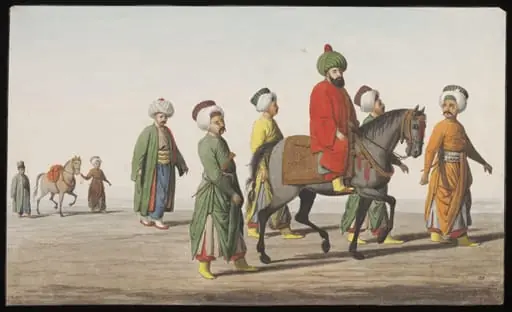 Kaymakam, or Govenor of Istanbul
![A Dervish[?], by Anonymous Greek artist](https://artifactworldgallery.com/img/anonymous-greek-artist--a-dervish--3c8916f5a95abb6a-w320.webp) A Dervish[?]
A Dervish[?]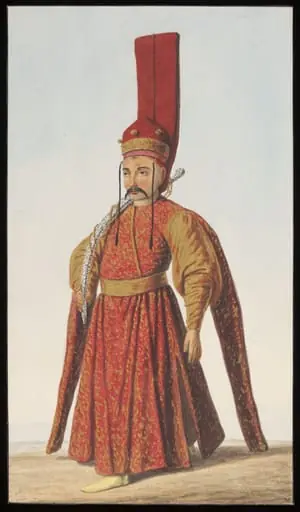 Silâhdar Aga, or sword bearer to the Sultan
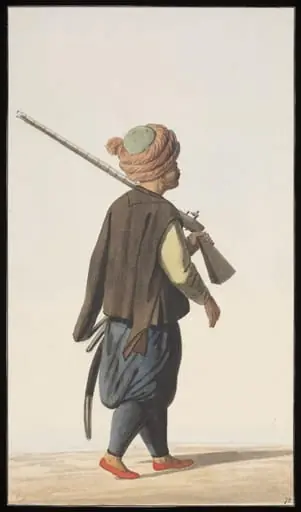 Tüfekçi, or Palace Guard armed with a musket
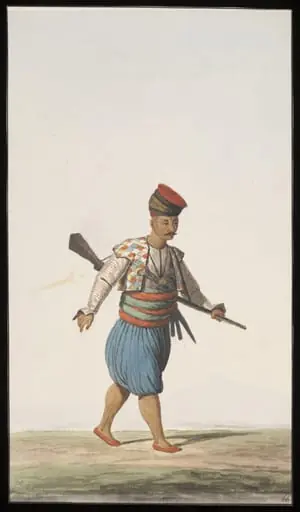 A heavily-armed man
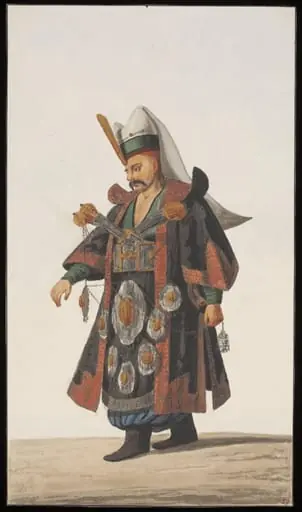 Ascibasi, or Commander of the Janisseries in ceremonial dress
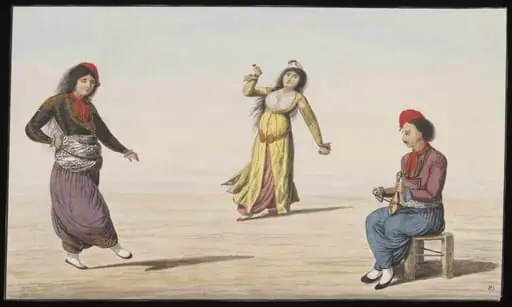 A scene of Gypsies dancing
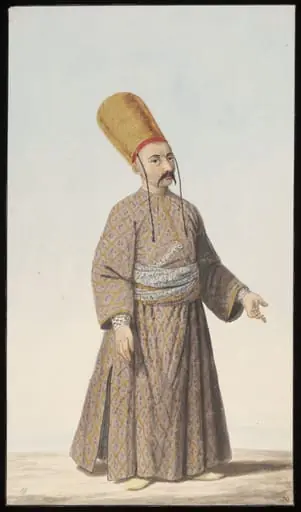 Zülüflü Baltaci, or Page of the first rank to the Sultan
 A Turkish official