Artwork
The Brazen Serpent of Moses
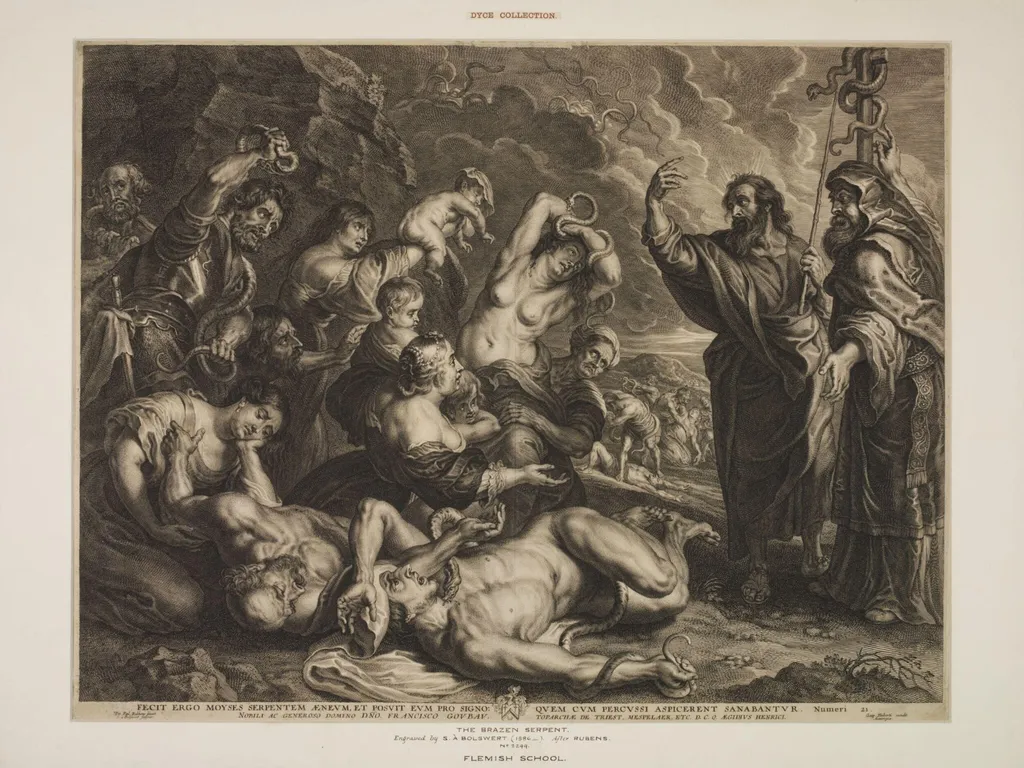
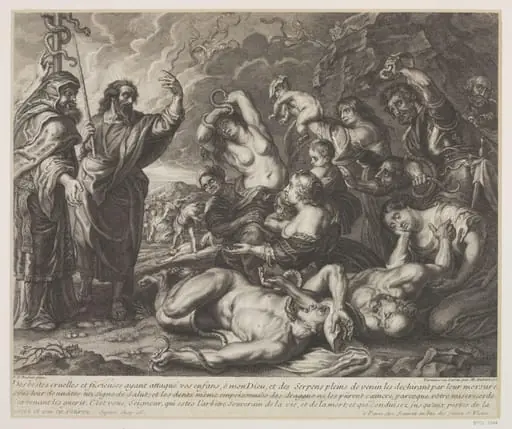
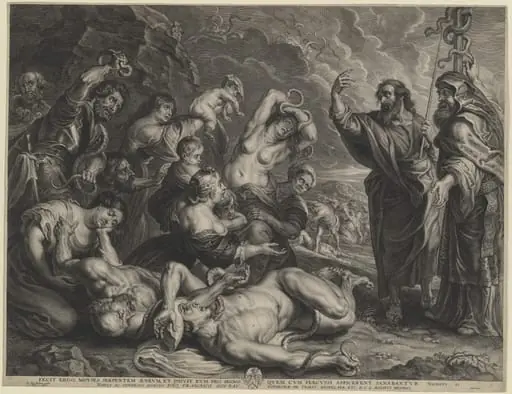
The Brazen Serpent of Moses is a print by Schelte Bolswert. It dates from 1650 and is held in the collection of the Victoria and Albert Museum. The print portrays the biblical episode in which Moses lifts a bronze serpent to cure the Israelites of a lethal plague.
About this work
Overview
The print portrays the biblical episode in which Moses lifts a bronze serpent to cure the Israelites of a lethal plague. Rendered after a composition by Peter Rubens, the engraving captures the moment of divine intervention, with the serpent suspended above a tumultuous crowd and the inscription “Fecit ergo Moyses” identifying the subject.
Subject & Meaning
The scene visualizes the Old Testament story of healing through faith: the Israelites, stricken by serpents, look upward as Moses raises the bronze creature, a symbol of salvation. The chaotic arrangement of figures—some prostrate, others reaching skyward—emphasizes collective desperation and the promise of relief offered by the lifted serpent.
Technique & Style
Executed in black‑and‑white engraving, the work employs strong chiaroscuro, with deep shadows contrasting sharply against illuminated forms. The artist’s use of dramatic lighting accentuates the twisting serpent and the contorted bodies, creating a sense of movement and emotional intensity. The composition’s swirling background further isolates the central action.
History & Provenance
The print is a reproduction of Rubens’s earlier painting, translated into the print medium for broader distribution. The inscription and added scriptural references identify the work’s devotional purpose. It is part of the print collection of the Victoria and Albert Museum, where it is catalogued among other religious engravings of the period.
Artist & collection

Artist
Schelte a Bolswert or Schelte Adamsz. Bolswert was a Frisian engraver who worked most of his career in Antwerp where he was one of the lead engravers in Rubens' workshop. He is known for his reproductive works after…