Artwork
The Temple of Augustus and Faustina, the Temple of Divus Romulus, and the Basilica of Constantine
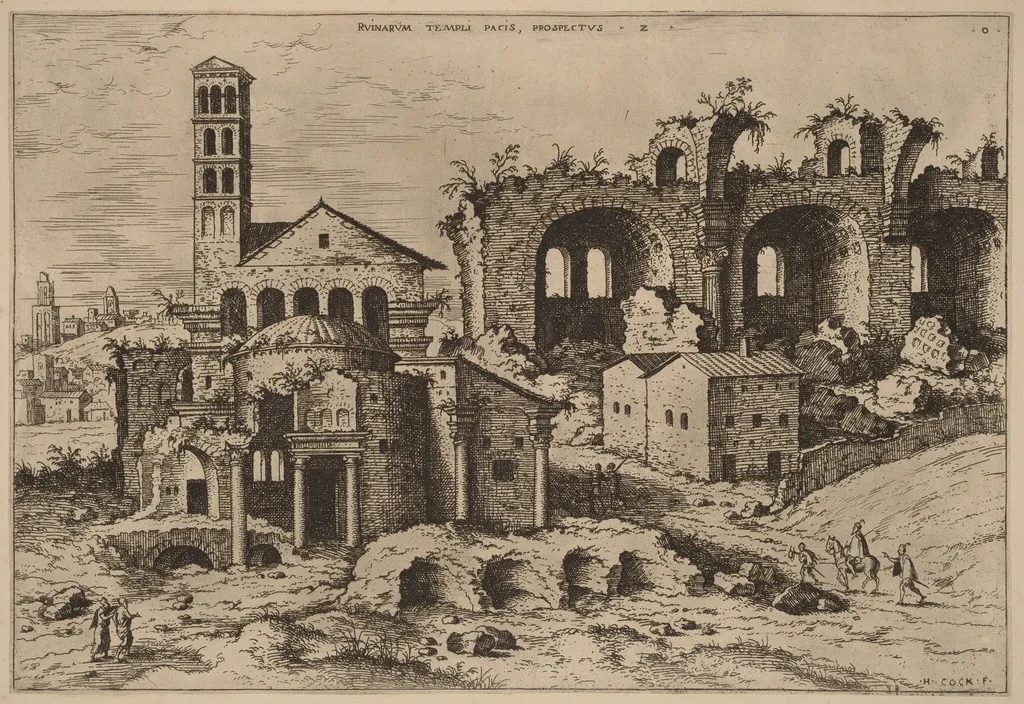
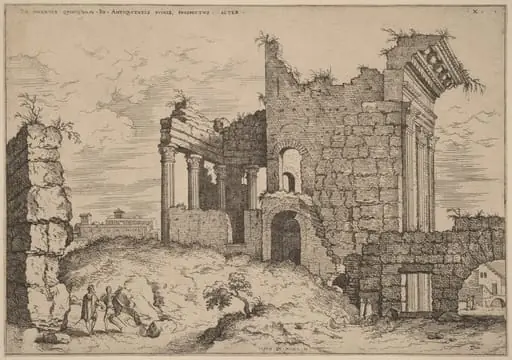
The Temple of Augustus and Faustina, the Temple of Divus Romulus, and the Basilica of Constantine is an ink print by the Renaissance artist Hieronymus Cock. It dates from 1550 and is held in the collection of the National Gallery of Art.
About this work
Overview
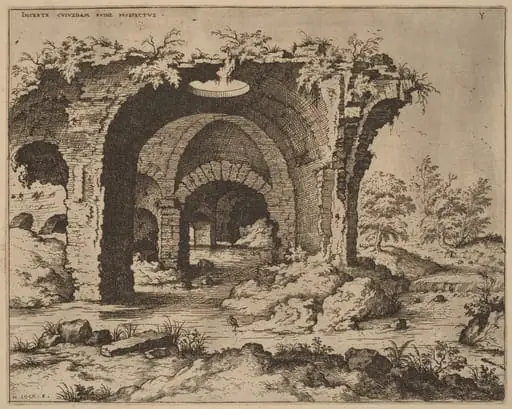
Created around 1550, this etching on laid paper presents a panoramic view of three prominent Roman structures: the Temple of Augustus and Faustia, the Temple of Divus Romulus, and the Basilica of Constantine. The composition captures the weathered stonework and fragmented arches that characterize the ancient ruins, inviting the viewer to contemplate the passage of time through a detailed, linear representation.
Subject & Meaning
The image foregrounds the decayed remnants of three once‑grand religious and civic buildings, emphasizing their architectural forms amid a landscape of broken columns and scattered debris. Human figures—some bearing tools, others simply observing—populate the scene, suggesting ongoing interaction between contemporary activity and the lingering presence of Rome’s historic monuments.
Technique & Style
Executed in fine lines etched into laid paper, the work relies on varied hatching and cross‑hatching to convey volume and depth. The artist manipulates tonal contrast to model the crumbling arches and uneven ground, achieving a convincing three‑dimensional effect despite the monochrome medium. The precise, controlled line work reflects the technical standards of mid‑16th‑century printmaking.
History & Provenance
The print was produced by Hieronymus Cock, a Flemish painter and leading print publisher based in Antwerp. Cock’s workshop was instrumental in transforming printmaking into a large‑scale commercial enterprise, distributing works across northern Europe. This particular plate illustrates his interest in antiquarian subjects, aligning with the period’s growing fascination with classical ruins.
Context
Emerging during a time when Renaissance artists increasingly turned to ancient Roman architecture for inspiration, the etching reflects the scholarly curiosity of the era. By documenting the Temple of Augustus and Faustia, the Temple of Divus Romulus, and the Basilica of Constantine, the work contributes to a visual record that informed contemporary understandings of Rome’s architectural heritage.
Artist & collection
Artist
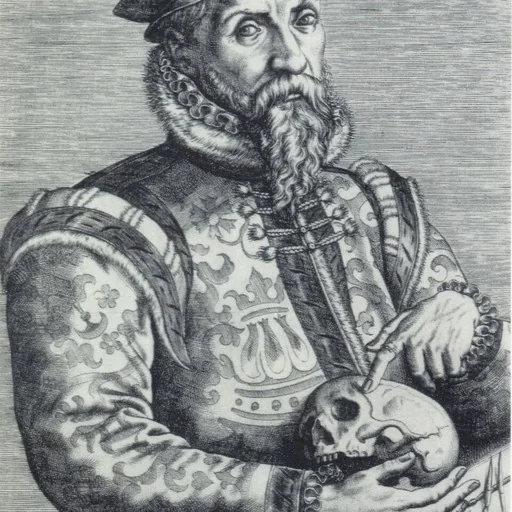
Hieronymus Cock, or Hieronymus Wellens de Cock, (1518 – 3 October 1570) was a Flemish painter and etcher as well as a publisher and distributor of prints.

 View of the Forum of Nerva
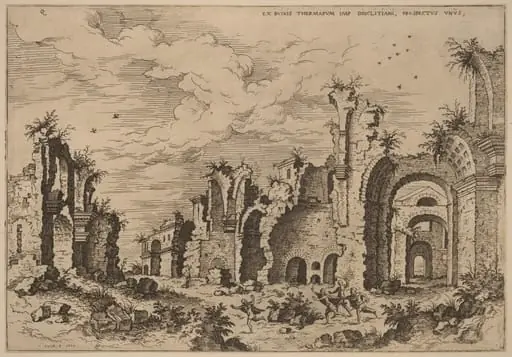 The Baths of Diocletian
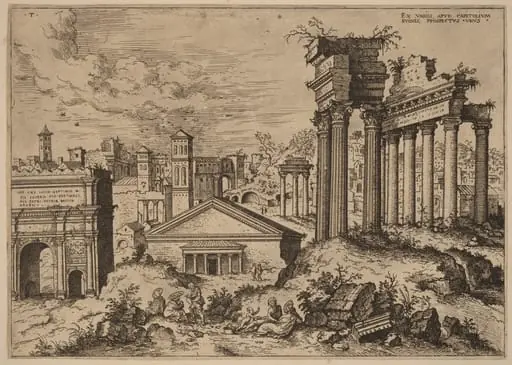 View of the Forum from the Base of the Capitol
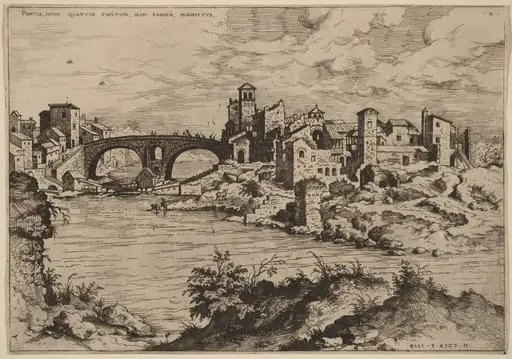 View of the Ponte Quattro Capi and the Island of the Tiber
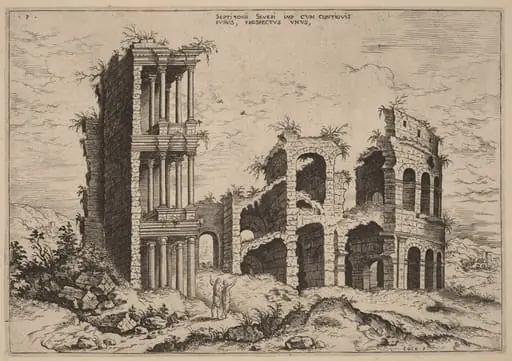 The Septizonium and the Colosseum
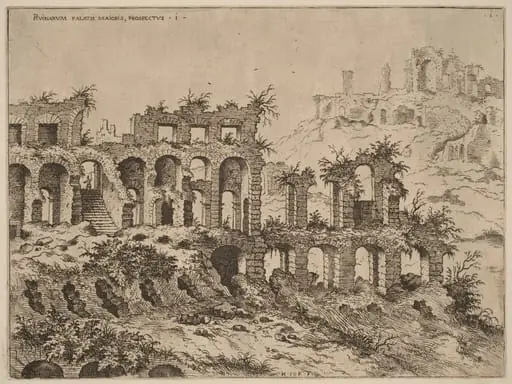 View of the Colosseum with the Palatine in the Background
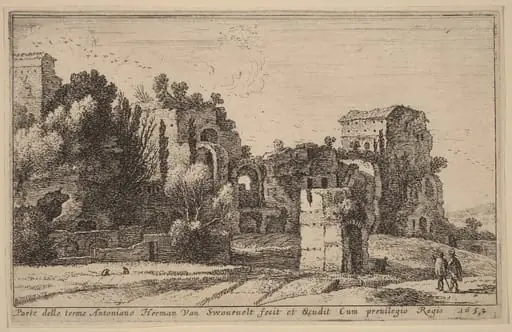 The Baths of Caracalla
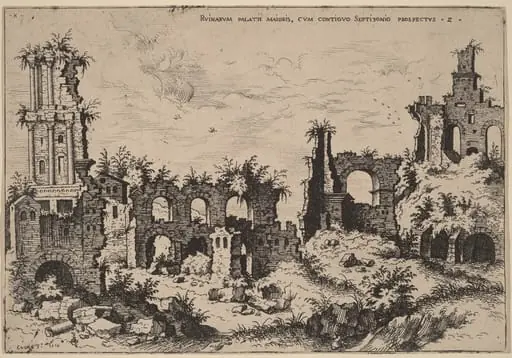 Ruins on the Palatine with the Septizonium
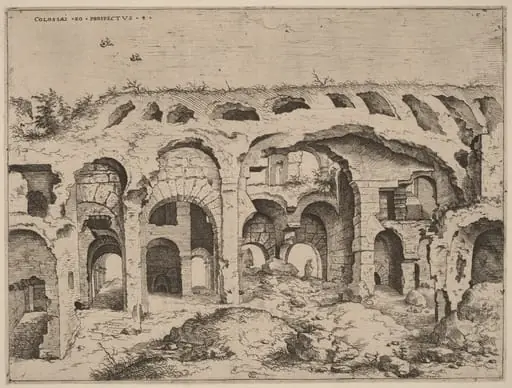 Fourth View of the Colosseum