Artwork
Apollo Killing Python
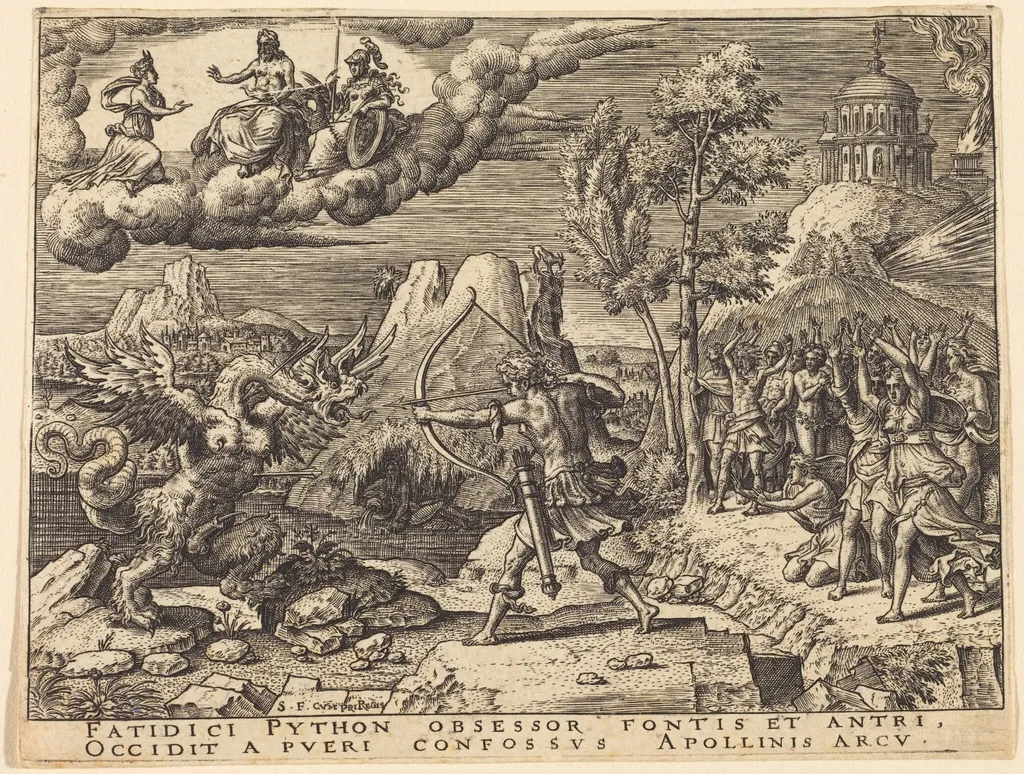
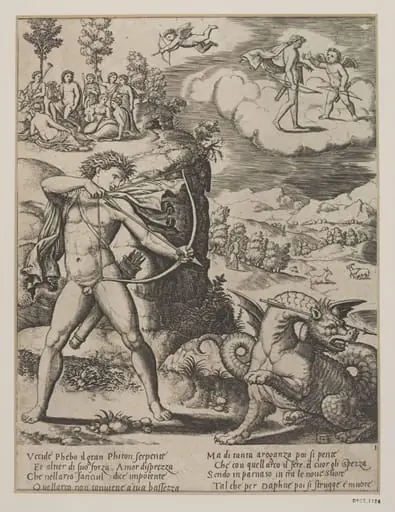
Apollo Killing Python is an ink print by the Renaissance artist Etienne Delaune. It dates from 1551 and is held in the collection of the National Gallery of Art.
About this work
The engraving uses tight lines called cross-hatching to show light and shadow.
You see Apollo with a bow drawn, aiming at a twisted python. His robes billow in an invisible wind. The snake coils around a mossy rock, mouth open.
The engraving uses tight lines called cross-hatching to show light and shadow. Apollo's muscles look hard, the snake's scales rough. It’s from 1580, when prints spread stories fast.
Think of this like a comic panel frozen in metal. Next, look up Delaune, Etienne.
Overview
Apollo Killing Python is a 1551 engraving by Etienne Delaune, depicting a pivotal moment from Greek mythology. The print showcases Apollo, armed with a drawn bow, targeting the serpent Python, which is coiled around a rocky outcropping.
Subject & Meaning
The engraving illustrates the myth of Apollo slaying Python, a symbol of the god's triumph over chaos. Apollo's dynamic pose and the snake's aggressive stance capture the intensity of the confrontation.
Technique & Style
Delaune employed cross-hatching, characterized by dense, intersecting lines, to achieve nuanced light and shadow effects. This technique accentuates the muscularity of Apollo and the textured, rough scales of the python.
History & Provenance
Created in 1551, the engraving belongs to a period when prints facilitated the widespread dissemination of mythological narratives. Note: The provided date (1580) appears to be inconsistent with the creation date (1551); the engraving's actual date is 1551.
Context
As a 16th-century print, Apollo Killing Python reflects the Renaissance interest in classical mythology. Its format, akin to a 'frozen comic panel,' suggests a narrative accessibility that contributed to the popularity of such artworks during this time.
Legacy
While specific details on the direct legacy of this engraving are not provided, it contributes to the broader legacy of Etienne Delaune's work in engraving and the enduring representation of classical myths in Western art.
Artist & collection