Artwork
The History of Apollo and Daphne
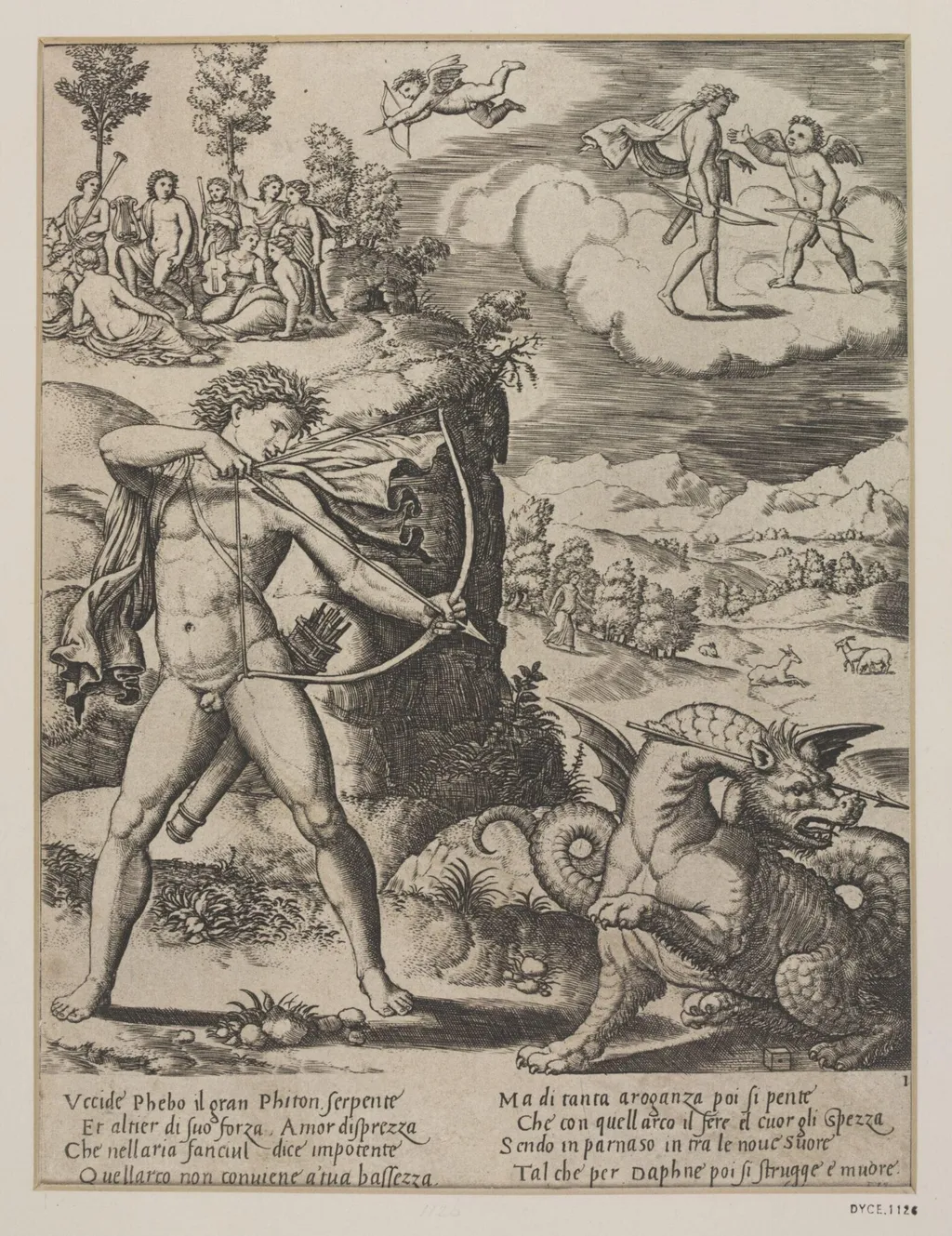
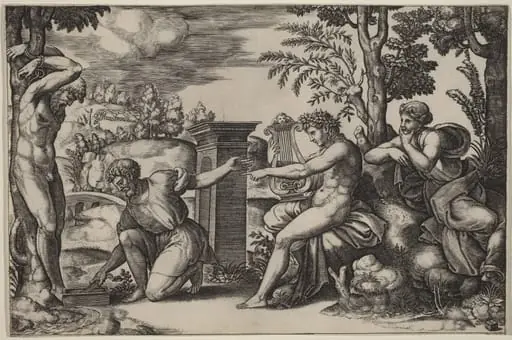
The History of Apollo and Daphne is a print by the Renaissance artist Master of the Die. It dates from 1534 and is held in the collection of the Victoria and Albert Museum.
About this work
Overview
Based on a design by Giulio Romano, the print was produced as part of a series translating his drawings into printed form.
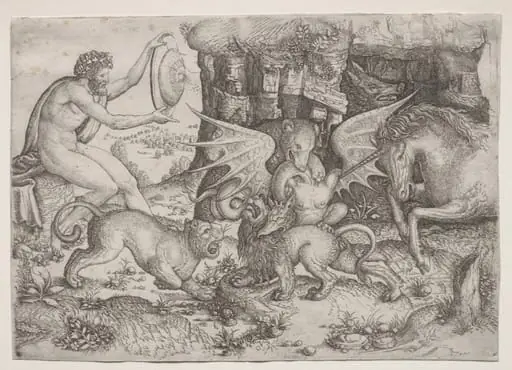
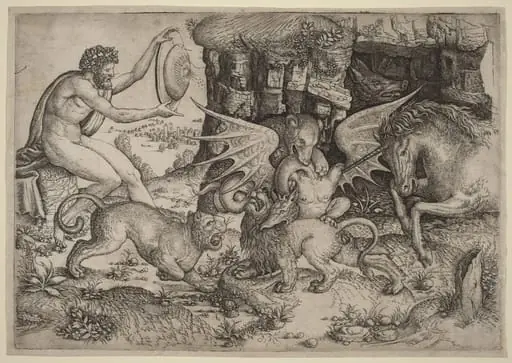
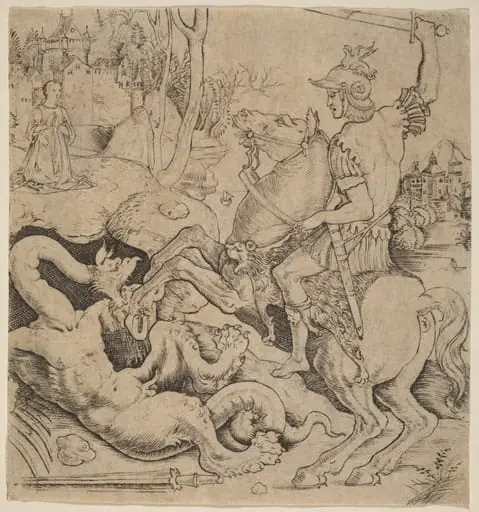
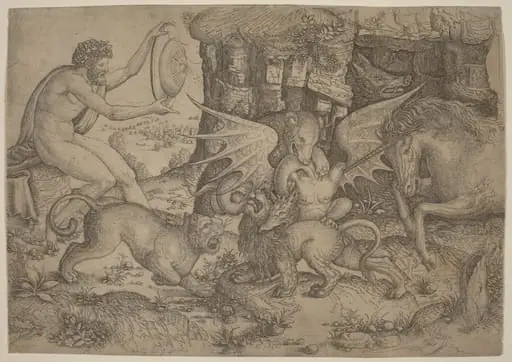
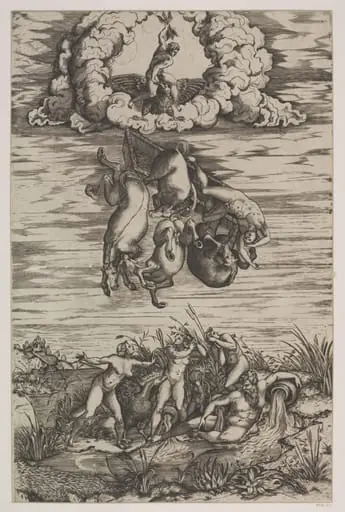
This 1534 engraving, attributed to the anonymous printmaker known as the Maître au Dé, illustrates a scene from Greek myth, though its title misidentifies the narrative. Based on a design by Giulio Romano, the print was produced as part of a series translating his drawings into printed form. Executed in fine linear detail on paper, it presents Apollo in motion amid a layered composition of figures and natural elements, reflecting the Mannerist interest in complex storytelling and dynamic form.
Subject & Meaning
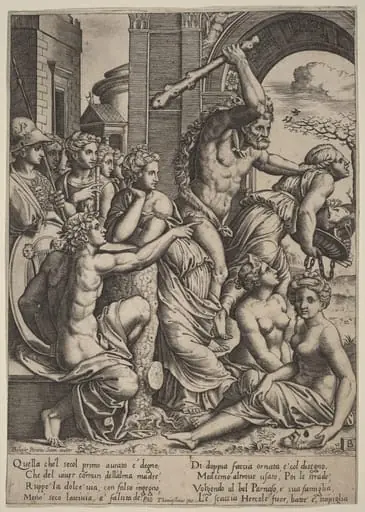
The scene depicts Apollo pursuing Daphne, not slaying Python as the title suggests. The male figure with the bow is Apollo, the female form nearby—transforming into a laurel tree—is Daphne. The dragon-like creature is a misreading of the tree’s emerging branches. The flying cherub and classical bystanders reinforce the myth’s divine context, emphasizing transformation as a consequence of divine will, a common theme in Renaissance mythological cycles.
Technique & Style
The engraving employs fine, controlled lines to render texture in foliage, drapery, and anatomy. Chiaroscuro is achieved through dense hatching and cross-hatching, creating volume and spatial depth. The composition is crowded yet carefully ordered, with figures arranged in receding planes. Romano’s Mannerist style—elongated forms, twisting poses—is preserved in the print’s energetic, almost theatrical arrangement.
History & Provenance
Created in 1534, the print belongs to a series of engravings derived from Giulio Romano’s designs, circulated among collectors and artists in northern Italy and beyond. The Maître au Dé, an unidentified engraver active in Rome, was known for translating high Renaissance compositions into print. The work’s survival in multiple institutional collections suggests its early circulation and technical reputation.
Context
This print emerged during a period when mythological subjects, especially those from Ovid’s Metamorphoses, were widely popular among humanist patrons. Romano’s designs, influenced by classical antiquity and Michelangelo’s sculptural dynamism, were disseminated through prints to extend their reach beyond frescoed walls. The engraving reflects the intersection of artistic innovation, literary revival, and print technology in early 16th-century Italy.
Legacy
Though not widely reproduced today, the print exemplifies how Mannerist compositions were translated into print culture, influencing later engravers and the visual language of mythological illustration. Its technical precision and compositional complexity mark it as a significant, if understudied, link between high Renaissance design and the broader dissemination of classical narratives through reproductive printmaking.
Artist & collection

Artist
Master of the Die (fl. 1525–1560) was an Italian engraver and printmaker. His year of birth and death are unknown. The identity of the Master of the Die is uncertain. He was given this name because he signed his prints…