Artwork
Plutarch
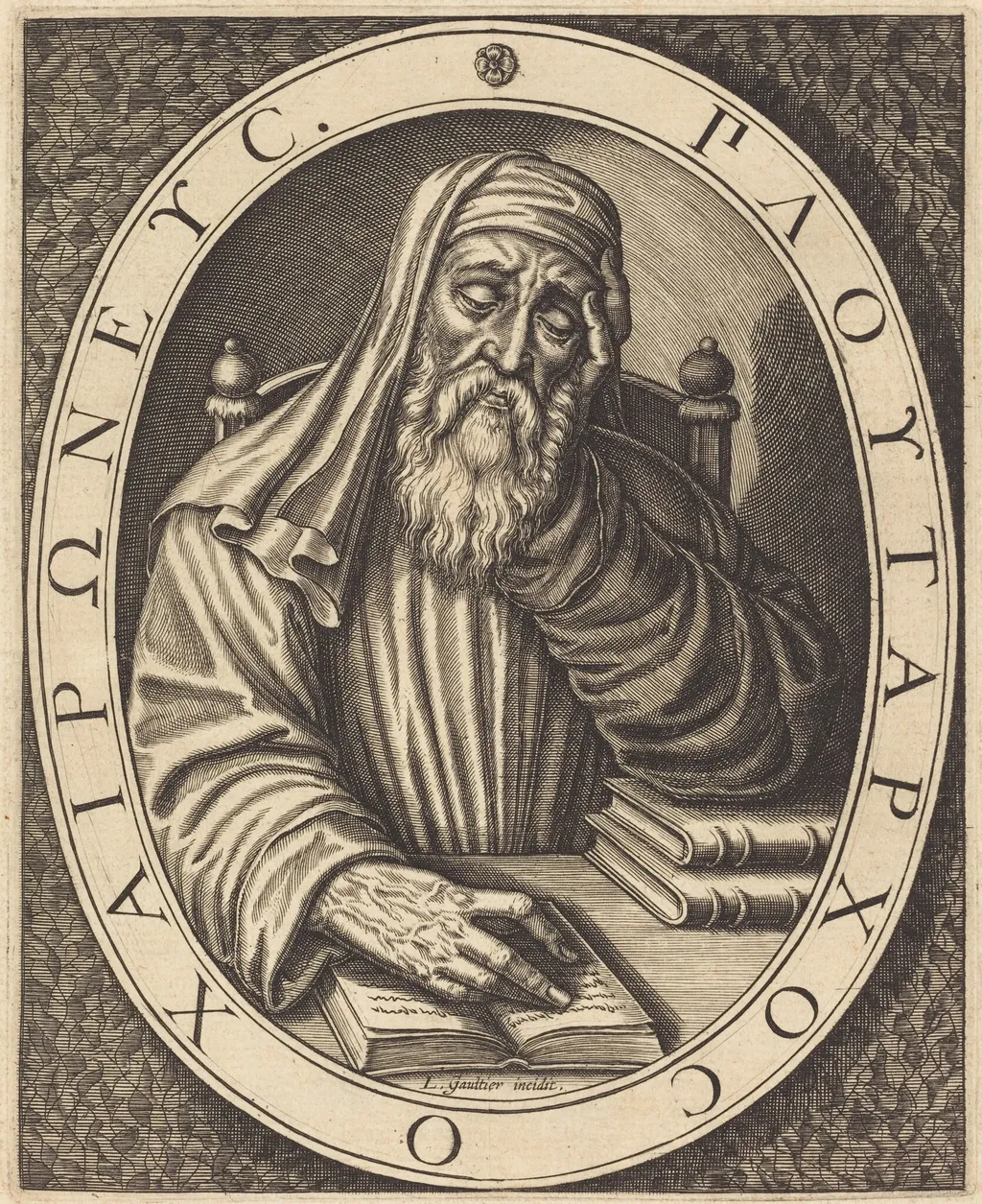
Plutarch is an ink print by the Renaissance artist Léonard Gaultier. It dates from 1601 and is held in the collection of the National Gallery of Art.
About this work
Overview
Executed in engraving on laid paper, the work reflects Gaultier’s reputation for technical precision and his focus on portraiture.
Created in 1601 by French engraver Léonard Gaultier, this black-and-white print depicts the ancient Greek writer Plutarch. Executed in engraving on laid paper, the work reflects Gaultier’s reputation for technical precision and his focus on portraiture. His career spanned over four decades in Paris, during which he produced numerous engraved portraits using only the burin, a tool requiring exceptional control and patience.
Subject & Meaning
The portrait represents Plutarch, the first-century biographer known for his Parallel Lives. He is shown as an elderly scholar, bearded and introspective, holding an open book—a symbol of his literary legacy. The inscription 'PLUTARCH' anchors the image in its historical context, emphasizing identity over narrative. The plain background directs focus to the figure’s contemplative demeanor and the weight of his intellectual contributions.
Technique & Style
Gaultier employed fine, controlled lines to model form through cross-hatching, particularly in the beard and folds of the robe. The engraving process involved incising the image directly into a copper plate, which was then inked and pressed onto paper. His style, influenced by Netherlandish engravers, favors clarity and detail over expressive flourish, resulting in a restrained, almost scholarly aesthetic.
History & Provenance
Léonard Gaultier, born in Mainz around 1561, settled in Paris by the 1580s and remained active until his death in 1641. This engraving is part of a broader body of work that includes portraits of contemporary and historical figures. While specific early ownership records are sparse, Gaultier’s prints circulated widely among collectors and scholars, reflecting his standing in early modern print culture.
Context
In early 17th-century France, engraved portraits served both commemorative and educational purposes. Plutarch’s writings were widely studied in humanist circles, making his image a fitting subject for scholarly audiences. Gaultier’s work aligns with a broader European trend of translating literary prestige into visual form, reinforcing the connection between text and image in Renaissance intellectual life.
Legacy
Gaultier’s prints, including this one, are valued for their technical discipline and contribution to the portraiture tradition in printmaking. Though less celebrated than some contemporaries, his precise engravings helped standardize the visual representation of historical figures. His methods influenced later engravers and remain a reference for studying the craft of intaglio printing in the early modern period.
Artist & collection
Artist
Léonard Gaultier, or, as he sometimes signed himself, Galter, a French engraver, was born at Mainz about 1561, and died in Paris in 1641.