Artwork
Christ on the Cross
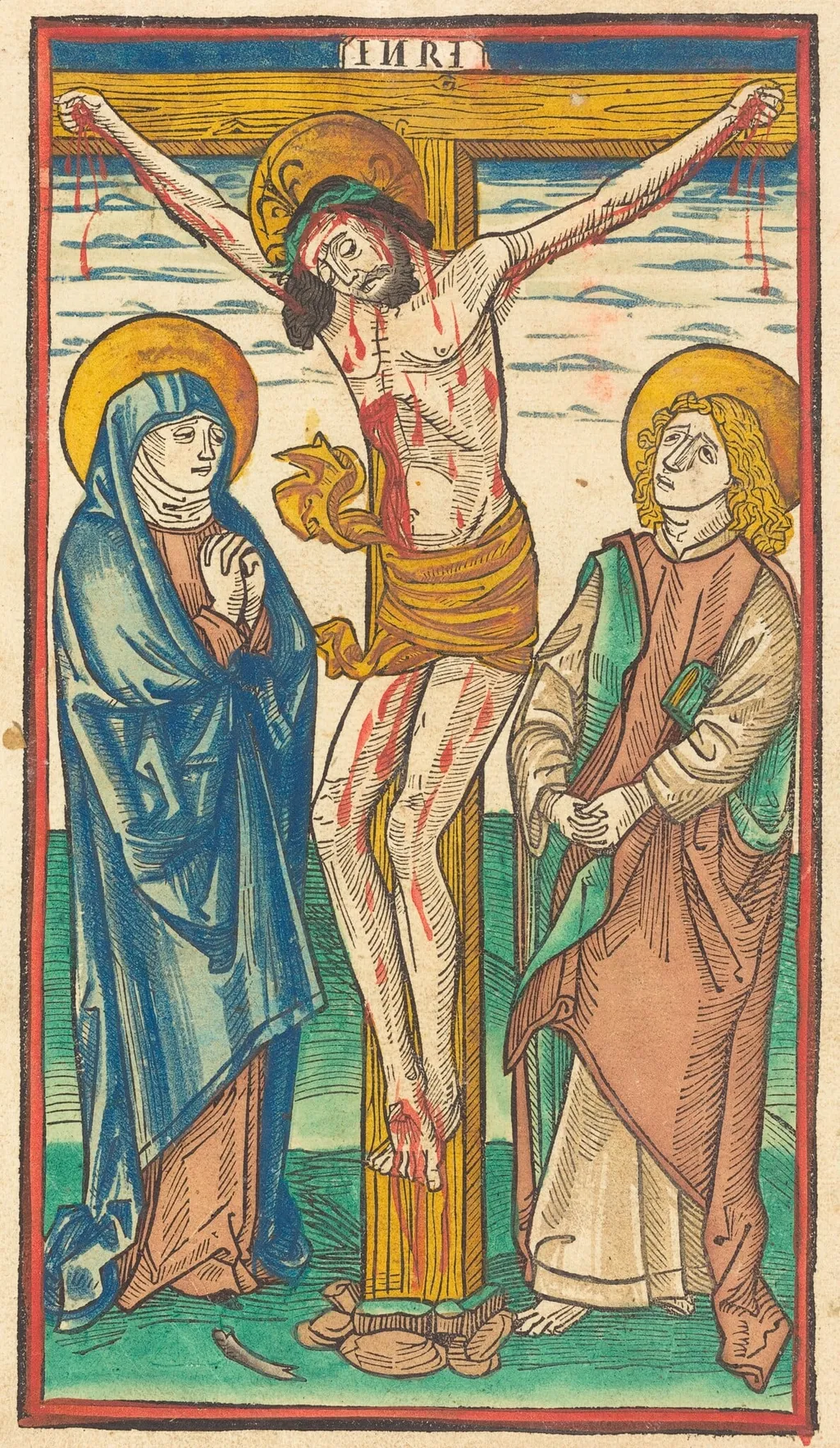
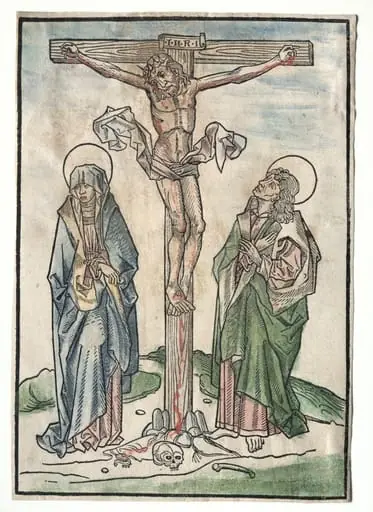
Christ on the Cross is an ink print by the Renaissance artist German 15th Century. It dates from 1485 and is held in the collection of the National Gallery of Art.
About this work
Overview
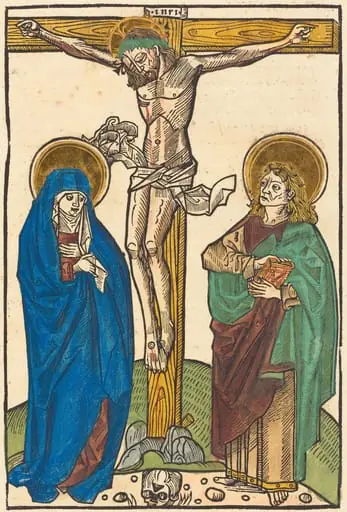
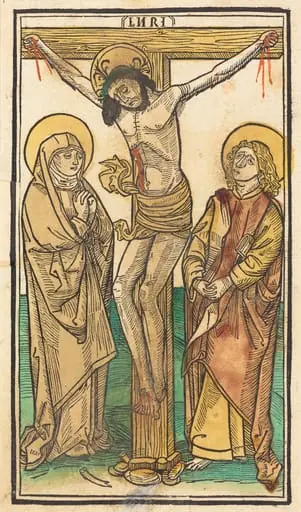
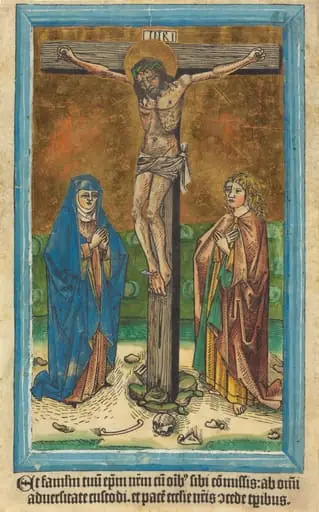
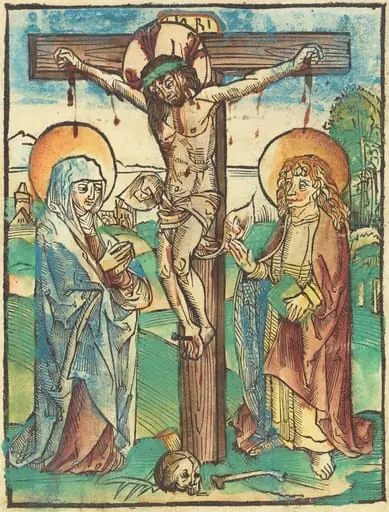
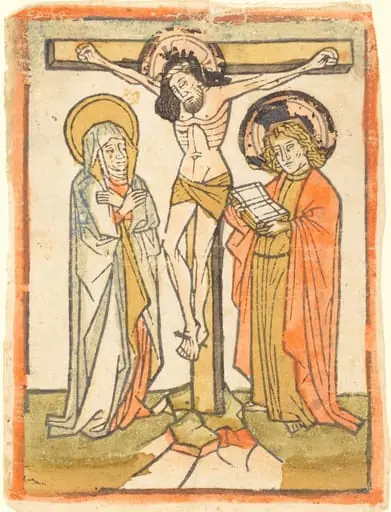
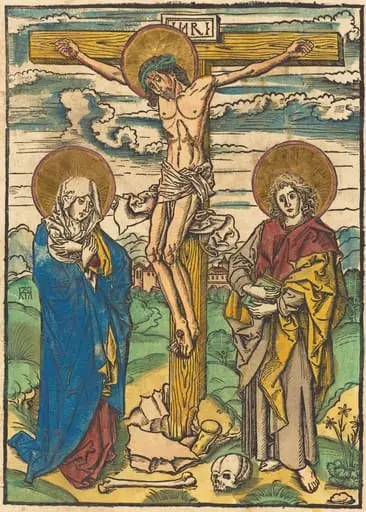
This hand-colored woodcut depicts Christ crucified, flanked by two figures, rendered in bold, flat areas of color including blue, ocher, green, and red.
This hand-colored woodcut depicts Christ crucified, flanked by two figures, rendered in bold, flat areas of color including blue, ocher, green, and red. The composition is stylized, with minimal depth and rigid postures, characteristic of early printmaking techniques. The background features a vivid sky and grass, while a decorative red border frames the scene. The word 'SEMPER' appears at the top, its meaning ambiguous in this context.
Subject & Meaning
The central figure is Christ, identified by his halo and wounds, nailed to a cross with arms outstretched. To his left, a woman in blue, likely the Virgin Mary, prays with clasped hands. To his right, a figure in earth-toned robes holds a tool, possibly a Roman soldier or a symbolic attendant. The scene conveys solemnity through stillness, emphasizing sacrifice rather than physical suffering, aligning with devotional imagery of the period.
Technique & Style
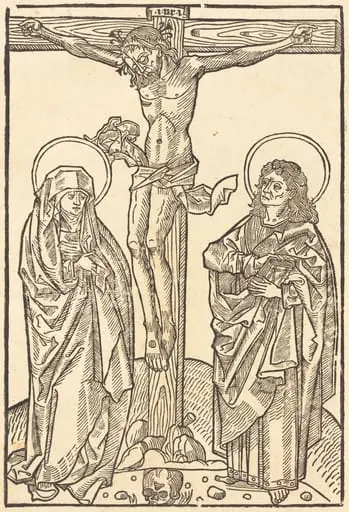
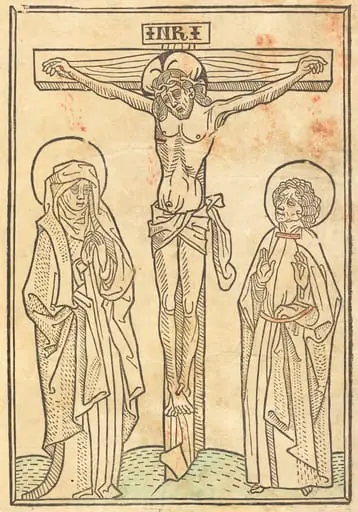
Executed as a woodcut, the image was carved into a wooden block and printed, then manually colored with pigments. The forms are simplified, with sharp outlines and flat planes of color, avoiding shading or perspective. The stiffness of the figures and the lack of naturalistic detail reflect the limitations and aesthetic priorities of early printmaking, where clarity and symbolic presence outweighed realism.
History & Provenance
The work originates from a period when woodcuts were widely used for religious imagery, likely in late medieval or early Renaissance Europe. Its hand-coloring suggests it was produced in limited quantities, possibly for private devotion or as a devotional aid. Exact origin and maker remain undocumented, but its style aligns with regional print traditions that emphasized vivid color and symbolic clarity.
Context
In an era before mass reproduction, woodcuts served as accessible religious tools for lay audiences. The use of bright, unnatural colors may have been intended to capture attention and convey spiritual significance rather than earthly accuracy. The inclusion of 'SEMPER'—Latin for 'always'—could hint at a devotional phrase, though its precise role in this image is unconfirmed.
Legacy
This print exemplifies how early printmakers translated sacred narratives into portable, repeatable forms. Its stylistic choices influenced later devotional imagery and contributed to the visual language of religious prints in Europe. Though not attributed to a known artist, it remains a representative artifact of a broader tradition that democratized religious imagery through mechanical reproduction.
Artist & collection

Artist
This 15th-century German artist carved vivid religious scenes into metal and wood, then hand-painted them in bright, symbolic colors.

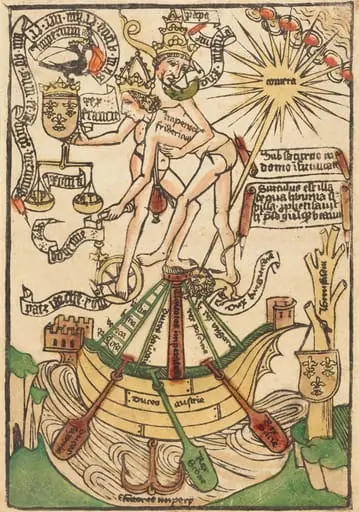 Allegory of the Meeting of Pope Paul II and Emperor Frederick III
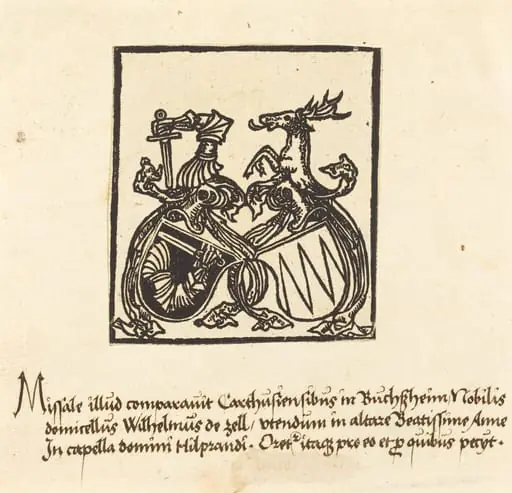 Bookplate of Wilhelm von Zell
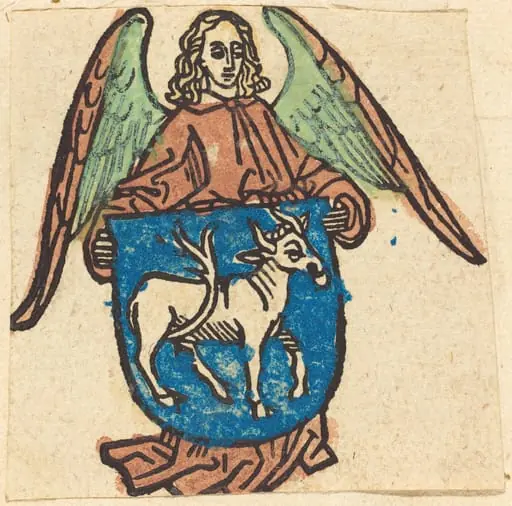 Bookplate of Hilprand Brandenburg of Bibrach
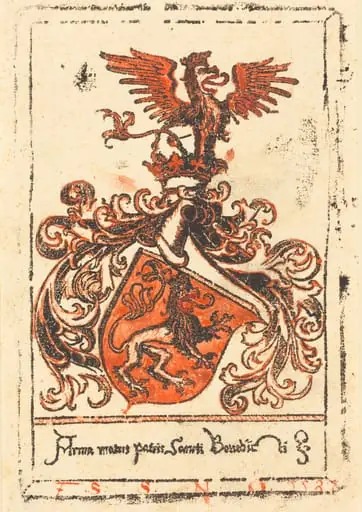 Bookplate of the Abbey of Ottobeuren
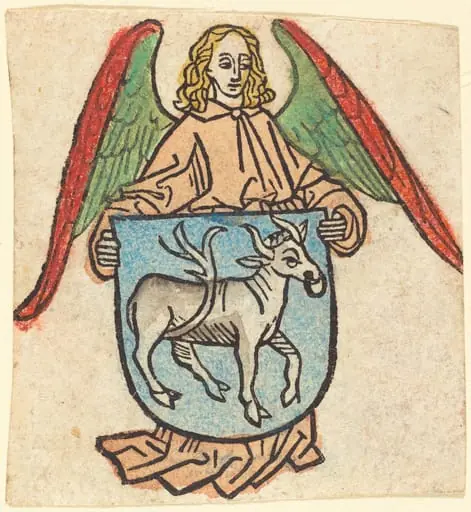 Bookplate of Hilprand Brandenburg of Bibrach
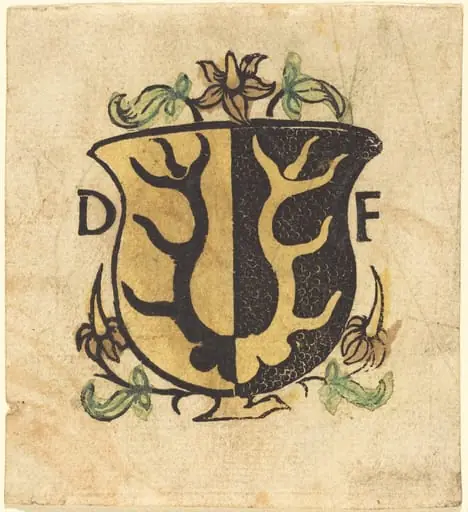 Bookplate of Dominicus Frauenfelder
![Studies for Six Figures (sheet from a model book) [recto], by German 15th Century](https://artifactworldgallery.com/img/german-15th-century--studies-for-six-figures-sheet-from-a-model-book-recto--4837429e0755bc3f-w320.webp) Studies for Six Figures (sheet from a model book) [recto]
Studies for Six Figures (sheet from a model book) [recto]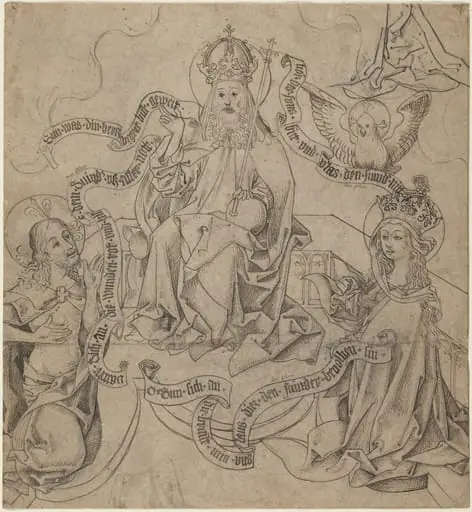 Christ and Mary Interceding with God the Father