Artwork
Risen Christ Between Saints Andrew and Longinus
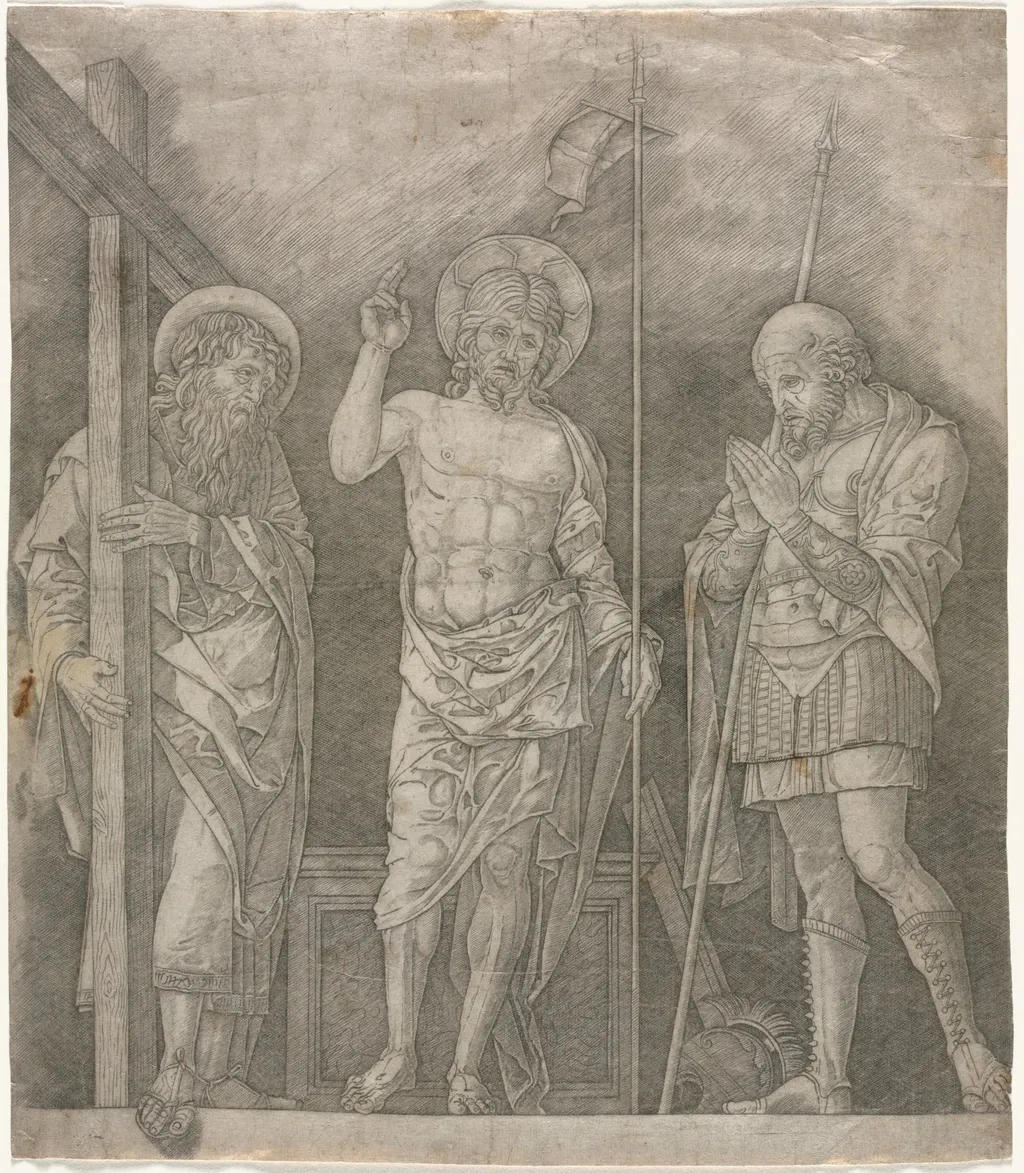
Risen Christ Between Saints Andrew and Longinus is a print by the Renaissance artist Giovanni Antonio da Brescia. It dates from 1502 and is held in the collection of the Cleveland Museum of Art.
About this work
Overview
The work exemplifies the religious subject matter favored in early 16th-century printmaking.
Created around 1502 by Giovanni Antonio da Brescia, an Italian engraver active in northern Italy, this print presents a devotional scene of the Risen Christ flanked by two saints. The work exemplifies the religious subject matter favored in early 16th-century printmaking. Giovanni Antonio, known for evolving his signature from simple initials to more complex monograms, produced this piece during a period of technical refinement in engraving, reflecting the broader artistic currents of the Italian Renaissance.
Subject & Meaning
The composition centers on Christ, nude and radiant, pointing toward heaven to signify his divine authority and resurrection. To his left, Saint Andrew holds a long cross, alluding to his martyrdom; to his right, Longinus, the Roman centurion who pierced Christ’s side, stands armored and clasped in prayer, symbolizing conversion and faith. Together, the figures form a triad of witness and redemption, reinforcing theological narratives central to Renaissance piety and the veneration of sacred history.
Technique & Style
Giovanni Antonio employed fine, controlled lines to model the human form with sculptural precision, using cross-hatching and varied line weight to suggest volume and texture. The play of light and shadow—chiaroscuro—enhances the three-dimensionality of the figures, particularly in the musculature of Christ and the folds of Andrew’s robe. The armor of Longinus is rendered with delicate parallel lines, demonstrating the engraver’s mastery of metallic surfaces and spatial depth within the constraints of the medium.
History & Provenance
The print entered the collection of The Cleveland Museum of Art, where it remains part of its holdings of early Italian engravings. While its early ownership is undocumented, its survival in good condition suggests it was preserved by collectors interested in religious imagery or the emerging print culture of northern Italy. Giovanni Antonio’s signature evolution—from 'Z.A.' to 'IO.AN.BX.'—helps date the work to the early 1500s, before his later stylistic shifts.
Context
This engraving emerged during a time when religious prints circulated widely among clergy and educated laypeople, serving as aids for private devotion. Northern Italian workshops, including those in Brescia and Venice, were hubs for producing such images, often inspired by altarpieces and frescoes. The choice of Christ flanked by saints reflects a common iconographic model, adapted here for the intimacy and reproducibility of the printed page.
Legacy
Giovanni Antonio da Brescia’s work contributed to the development of narrative engraving in Renaissance Italy, influencing later printmakers through his attention to anatomical detail and compositional clarity. Though less celebrated than contemporaries like Dürer, his prints remain important for understanding the dissemination of religious imagery and the technical capabilities of early 16th-century engravers in northern Italy.
Artist & collection

Artist
Giovanni Antonio da Brescia was an Italian engraver of northern Italy, active in the approximate period 1490–1519, during the Italian Renaissance.