Artwork
Saint John the Baptist
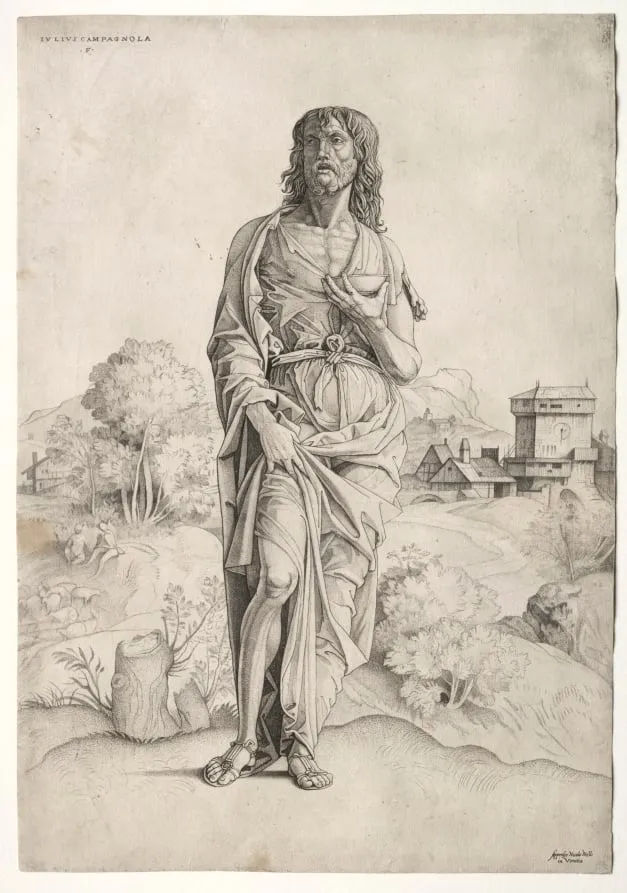
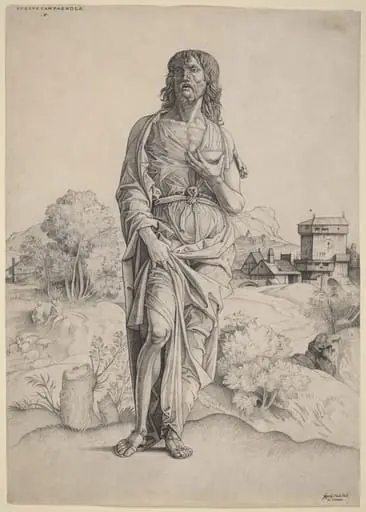
Saint John the Baptist is a print by the Renaissance artist Giulio Campagnola. It dates from 1505 and is held in the collection of the Cleveland Museum of Art.
About this work
The artist used tiny dots—called stippling—to create gentle shading instead of sharp lines.
A thin, bearded man stands in a rocky landscape, holding a bowl of water. His body looks worn from living outdoors, and the background fades into soft, misty hills.
This is John the Baptist, drawn as a print around 1505. The artist used tiny dots—called stippling—to create gentle shading instead of sharp lines. It was a new way to make skin and shadows look softer.
To see more works like this, look up *sfumato*.
Overview
Created around 1505, this print depicts Saint John the Baptist as a gaunt figure in a barren landscape. The artist, Campagnola, employed a hybrid technique blending traditional engraving with a novel method of dot-based shading. This approach allowed for a more atmospheric rendering of form and environment, distinguishing the work from contemporaneous prints that relied on sharp linear contours.
Subject & Meaning
John the Baptist is portrayed as a hermit, his emaciated frame reflecting his life of asceticism in the wilderness. He holds a bowl of water, signifying his role in baptizing Christ. The sparse setting and weathered appearance emphasize his spiritual devotion and separation from worldly life, aligning with biblical accounts of his preparation for the coming of the Messiah.
Technique & Style
Campagnola used fine stippling—small, carefully placed dots—to model the saint’s skin and the distant hills, creating a soft, diffused tone. This method replaced harsh outlines with gradual transitions of light and shadow, enhancing the sense of depth and air. The technique echoed the painterly effects of sfumato, adapting its subtlety to the medium of printmaking.
History & Provenance
The print emerged during a period of experimentation in Northern Italian printmaking. Campagnola’s innovation with stippling influenced later artists seeking to achieve tonal richness in engraved works. While specific early ownership records are sparse, the print’s technical distinction ensured its circulation among collectors and artists interested in new graphic methods.
Context
In early 16th-century Italy, printmakers sought to rival the expressive range of painting. Campagnola’s use of stippling responded to this ambition, aligning with broader trends in visual culture that valued atmospheric effects and naturalism. His work bridged the gap between the linear precision of engraving and the soft modeling of Renaissance painting.
Legacy
Campagnola’s stippled technique became a model for subsequent printmakers aiming to convey texture and mood without relying on line alone. Though not widely adopted immediately, his approach contributed to the evolution of tonal printing in the 16th century, influencing how light, form, and environment were rendered in graphic arts.
Artist & collection

Artist
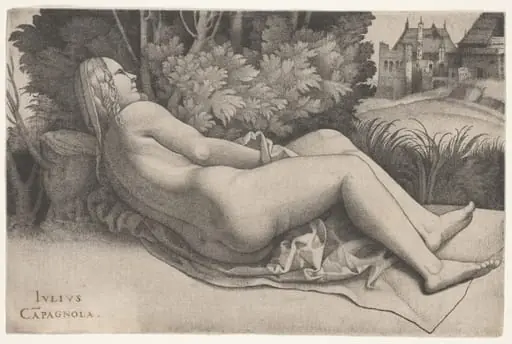
Giulio Campagnola (Italian: ; c. 1482 – c. 1515) was an Italian engraver and painter, whose few, rare, prints translated the rich Venetian Renaissance style of oil paintings of Giorgione and the early Titian into the…