Artwork
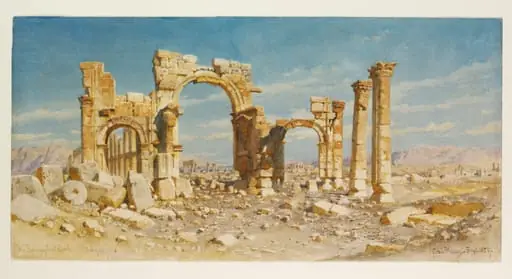
Palmyra (from Kasr el Ain)
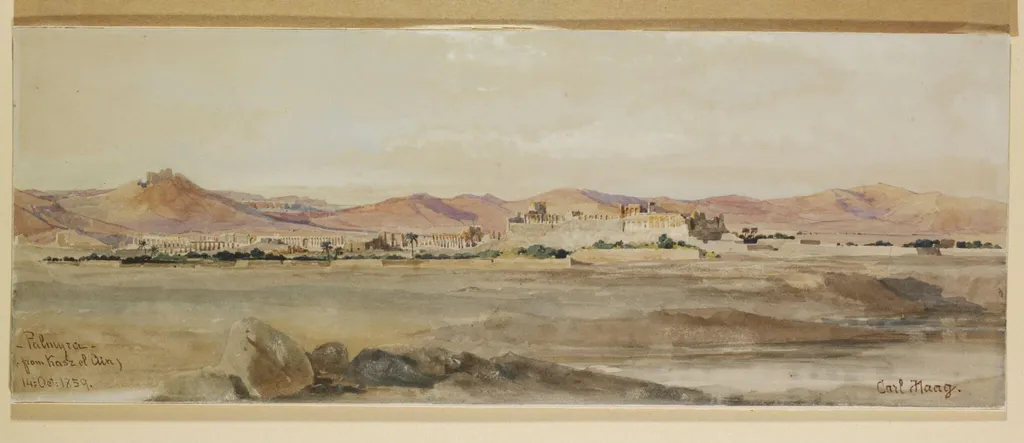
Palmyra (from Kasr el Ain) is a watercolor work on paper by the Impressionist artist Carl Haag. It dates from 1859 and is held in the collection of the Victoria and Albert Museum.
About this work
The artist signed it in the corner with the date 1859, and the title hints at a real place far from Europe.
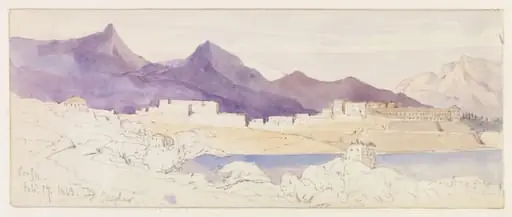
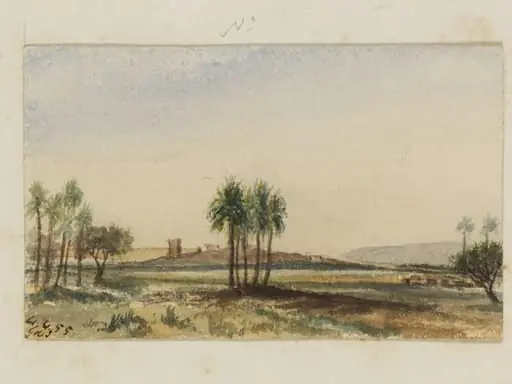
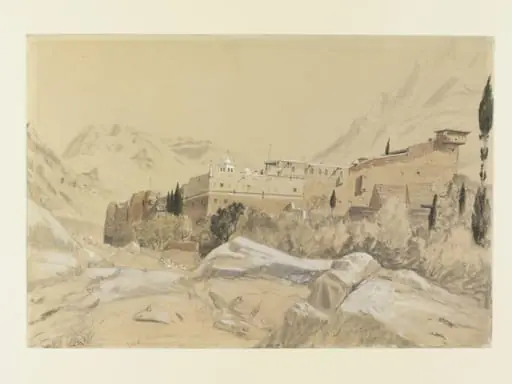
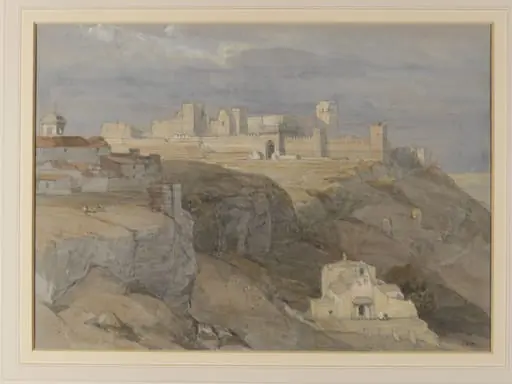
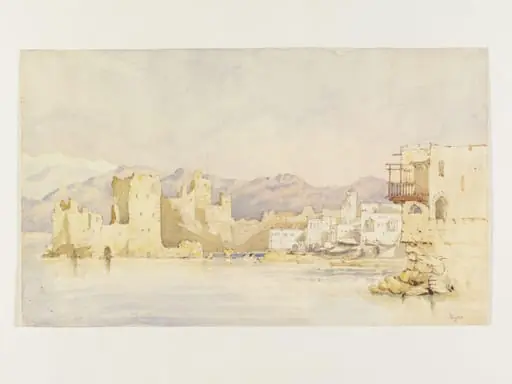
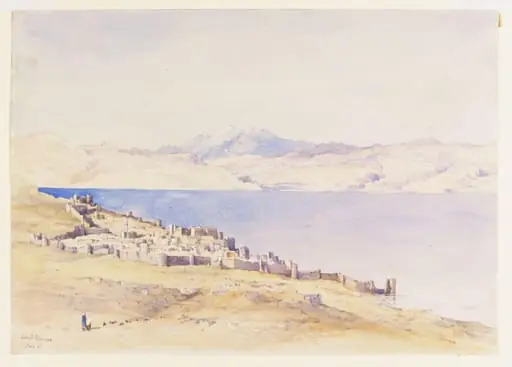
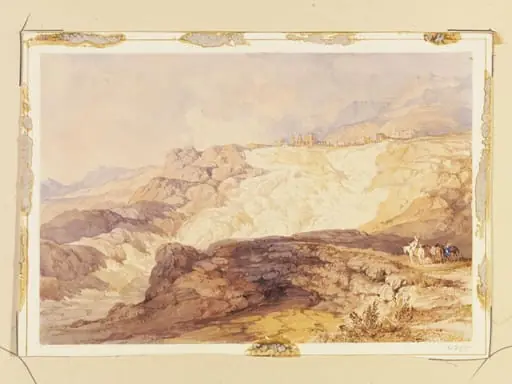
This painting shows a distant city with crumbling stone walls and towers under a pale sky. In the foreground, a rocky shore meets a quiet body of water. The colors are soft—dry earth tones, muted blues, and faint greens.
The artist signed it in the corner with the date 1859, and the title hints at a real place far from Europe.
If you like this kind of scene, check out the Victoria and Albert Museum.
Overview
Carl Haag created this watercolour in 1859 during a journey to the Middle East, capturing a view of Palmyra from the nearby site of Kasr el Ain. The work is part of a series of sketches made on location, later refined and exhibited in London. Its quiet composition and restrained palette reflect a documentary approach to landscape, typical of 19th-century travel art. The signature and date confirm its immediate post-travel origin.
Subject & Meaning
The scene depicts the ruins of Palmyra as seen from a distance, with weathered stone structures rising above a barren landscape. The still water and empty foreground suggest solitude and time’s erosion. Haag avoids human figures or dramatic lighting, emphasizing the site’s quiet decay rather than its historical grandeur. The title anchors the image in a specific, distant place, reinforcing its role as a visual record.
Technique & Style
Executed in transparent watercolour, the painting uses delicate washes to suggest atmospheric depth and texture. Earthy ochres, pale blues, and subdued greens create a harmonious tonal range. Fine brushwork defines architectural fragments without detail, while the water’s surface is rendered with minimal strokes. The composition balances horizontal bands of land, water, and sky, reflecting a restrained, observational aesthetic.
History & Provenance
Haag exhibited related works at the Old Water Colour Society between 1860 and 1863, establishing his reputation for Orientalist landscapes. The painting remained in private hands until its sale at Sotheby’s in June 1973, where it realized £90. Its survival and documented auction history suggest it was preserved as a personal record rather than a commercial commodity.
Context
In the mid-19th century, European artists and travelers increasingly visited the Levant to document ancient sites. Haag’s work aligns with this trend, contributing to a growing visual archive of the region. Unlike later romanticized depictions, his approach is understated, reflecting the period’s emerging interest in topographical accuracy over dramatic interpretation.
Legacy
Though not widely reproduced, the work contributes to the corpus of 19th-century Orientalist watercolours held in institutional collections. Its presence in museum archives, including the Victoria and Albert Museum, underscores its value as a primary visual source from a time when access to Palmyra was rare for Western audiences.
Artist & collection
Artist
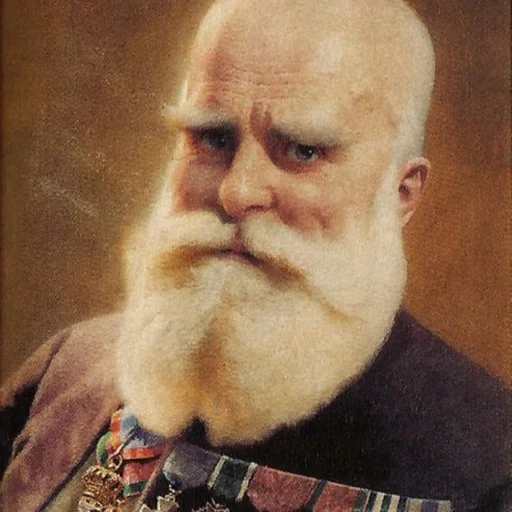
Carl Haag was a Bavarian-born painter who became a naturalized British subject and was court painter to the duke of Saxe-Coburg and Gotha.