Artwork
Amalfi
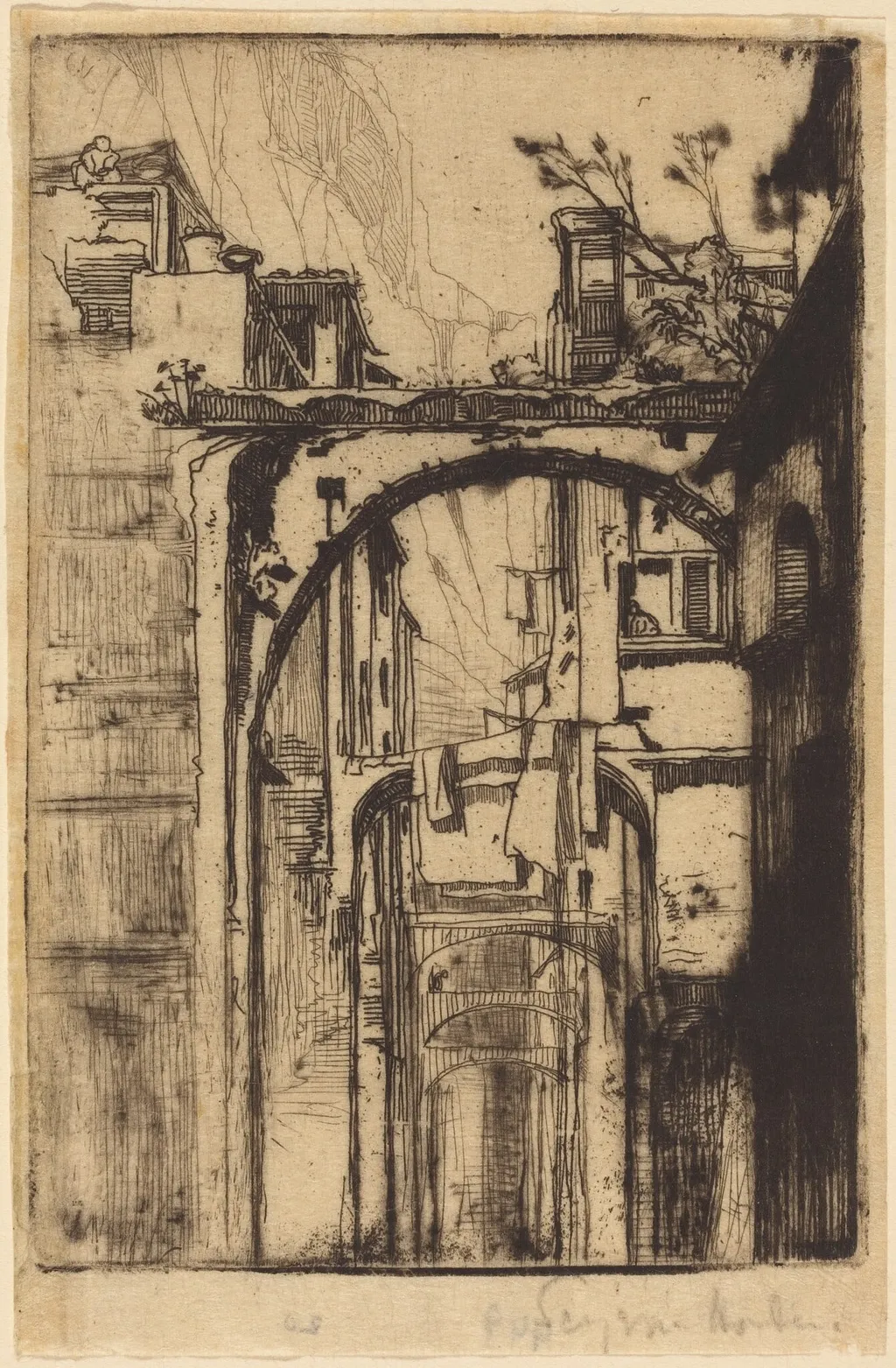
Amalfi is an ink print by the Impressionist artist Francis Seymour Haden. It dates from 1858 and is held in the collection of the National Gallery of Art.
About this work
Overview
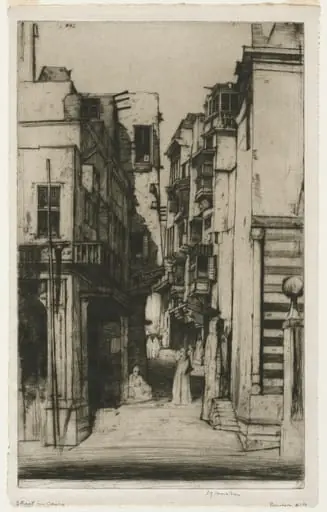
It captures a narrow urban alley in the coastal Italian town, where closely packed buildings rise vertically, their surfaces marked by time and weather.
Created in 1858, Amalfi is a print by Francis Seymour Haden, executed in etching and drypoint. It captures a narrow urban alley in the coastal Italian town, where closely packed buildings rise vertically, their surfaces marked by time and weather. The composition conveys a sense of quiet enclosure, with everyday details—clotheslines, potted plants, and distant figures—adding subtle life to the shadowed space.
Subject & Meaning
The scene depicts an ordinary street in Amalfi, devoid of grandeur or ceremony. Haden focuses on the intimate, worn textures of daily life: peeling plaster, uneven rooftops, and the casual presence of residents. There is no narrative climax, only the quiet rhythm of a place shaped by habit and environment. The work reflects an interest in the unidealized reality of Mediterranean towns, observed with quiet attention.
Technique & Style
Haden employed drypoint to carve fine, burr-rich lines directly into a metal plate, creating soft, velvety shadows and intricate surface detail. Etching supplemented these with sharper, controlled strokes for architectural elements like railings and window frames. The combination yields a dense, tactile texture that enhances the sense of age and weathering, while the deep contrasts emphasize the play of light and shadow in the confined space.
History & Provenance
Haden produced Amalfi during a period of travel in southern Italy, part of his broader engagement with European landscapes. The print was likely made shortly after his visit, reflecting his direct observation rather than studio reconstruction. It remained within private collections until entering institutional holdings, where it is now recognized as an early example of his printmaking focused on urban topography.
Context
In the mid-19th century, artists increasingly turned to everyday scenes as subjects, moving away from idealized historic or mythological themes. Haden, influenced by the English tradition of topographical drawing and emerging interest in printmaking as an independent art form, used etching and drypoint to capture the authenticity of place. Amalfi aligns with this shift, valuing observation over ornamentation.
Legacy
Amalfi exemplifies Haden’s role in revitalizing etching as a medium for personal expression. Its emphasis on texture, atmosphere, and unembellished detail influenced later generations of printmakers, particularly those interested in urban and domestic scenes. Though not widely exhibited in his lifetime, the work now stands as a quiet testament to the artistic potential of the everyday.
Artist & collection


![House of Dante da Castiglione [Casa di Dante da Castiglione], by Telemaco Signorini](https://artifactworldgallery.com/img/telemaco-signorini--house-of-dante-da-castiglione-casa-di-dante-da-castiglione--92db125a9a8d04db-w320.webp)