Artwork
Equestrian Portrait of the Emperor Maximilian
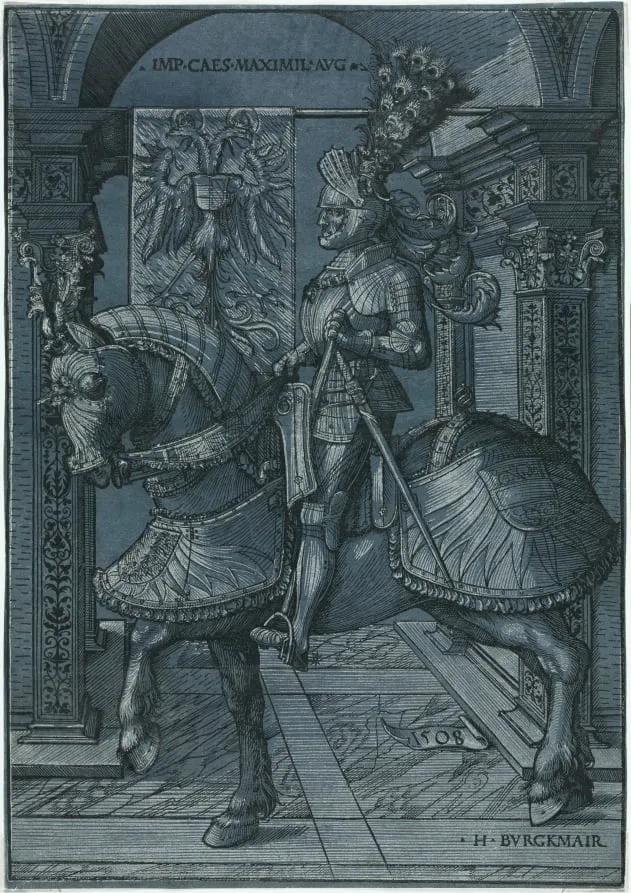
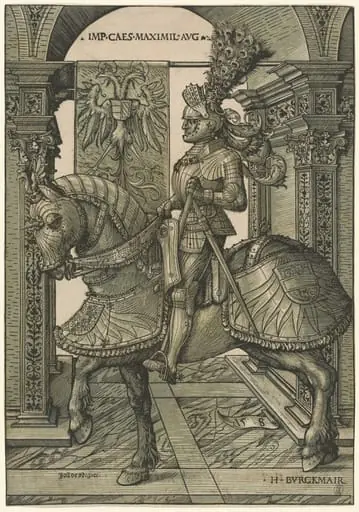
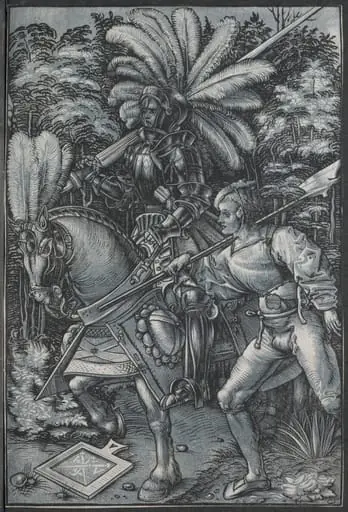
Equestrian Portrait of the Emperor Maximilian is a print by the Renaissance artist Hans Burgkmair the Elder. It dates from 1508 and is held in the collection of the Cleveland Museum of Art. This rare chiaroscuro woodcut depicts Holy Roman Emperor Maximilian I in a classical equestrian pose, emphasizing his imperial authority.
About this work
This trick, called chiaroscuro (pronounced "ky-ah-roh-SKOO-roh"), makes the scene pop off the page.
This woodcut shows Emperor Maximilian on horseback in strict profile, like a Roman coin. His armor gleams in white, the horse in black ink. Above him, tiny Latin letters spell out his grand titles.
The artist used two blocks to print the image—one for light, one for dark. This trick, called chiaroscuro (pronounced "ky-ah-roh-SKOO-roh"), makes the scene pop off the page.
Want to see more of his prints? Look up Hans Burgkmair (German, 1473–1531).
Overview
This rare chiaroscuro woodcut depicts Holy Roman Emperor Maximilian I in a classical equestrian pose, emphasizing his imperial authority. Printed with black and white inks on blue, hand-colored paper, it showcases an early experiment with chiaroscuro technique.
Subject & Meaning
Maximilian I is portrayed in full profile, evoking ancient Roman equestrian statues and imperial coinage. Inscriptions and the Hapsburg two-headed eagle banner assert his lineage and equivalence to ancient Roman leaders.
Technique & Style
The print utilizes chiaroscuro, achieved through two woodblocks—one for light, one for dark—to create depth. The contrast between white armor (light block) and black ink (dark block, e.g., the horse) enhances the visual impact.
History & Provenance
One of two surviving impressions on hand-colored paper, this being the only blue example. Attributed to Hans Burgkmair (German, 1473–1531), a prominent artist of the time.
Context
Created during Maximilian's reign (1486–1519), the work reflects the Renaissance humanist fascination with classical antiquity, as well as the Hapsburgs' efforts to legitimize their power through artistic patronage.
Legacy
As an early chiaroscuro woodcut, it influenced the development of printmaking techniques in the Renaissance, demonstrating the potential of chiaroscuro for dramatic effect in two-dimensional art.
Artist & collection
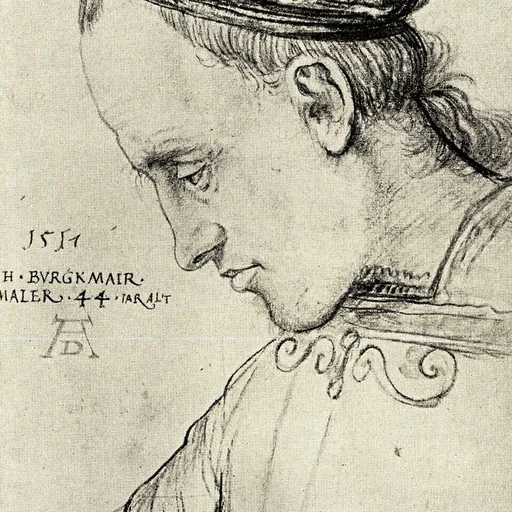
Artist
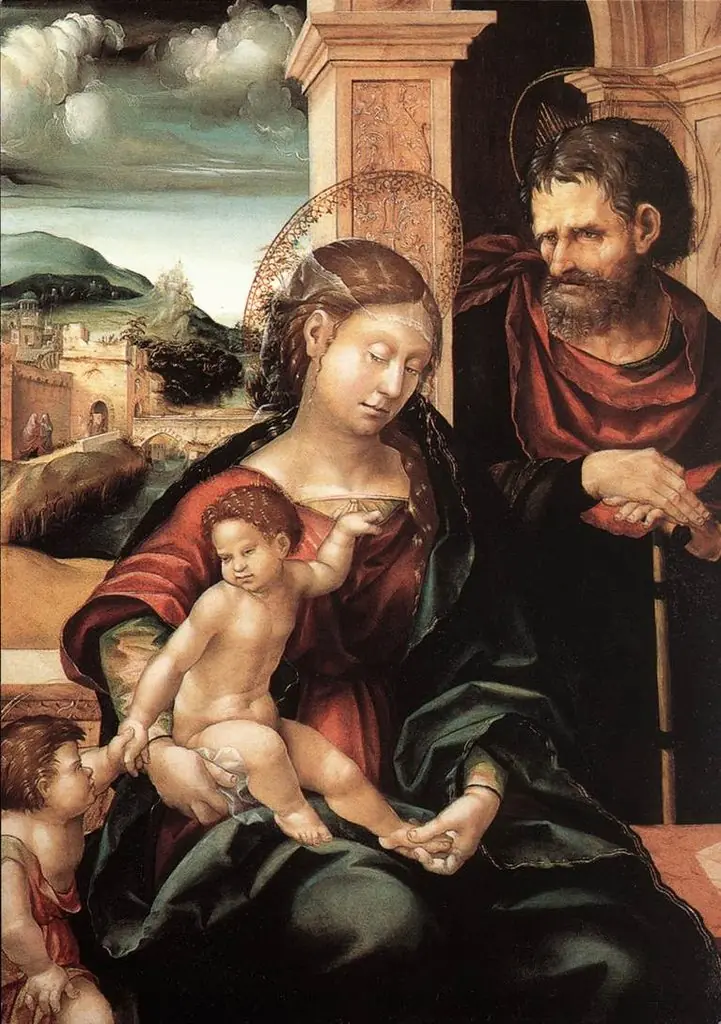
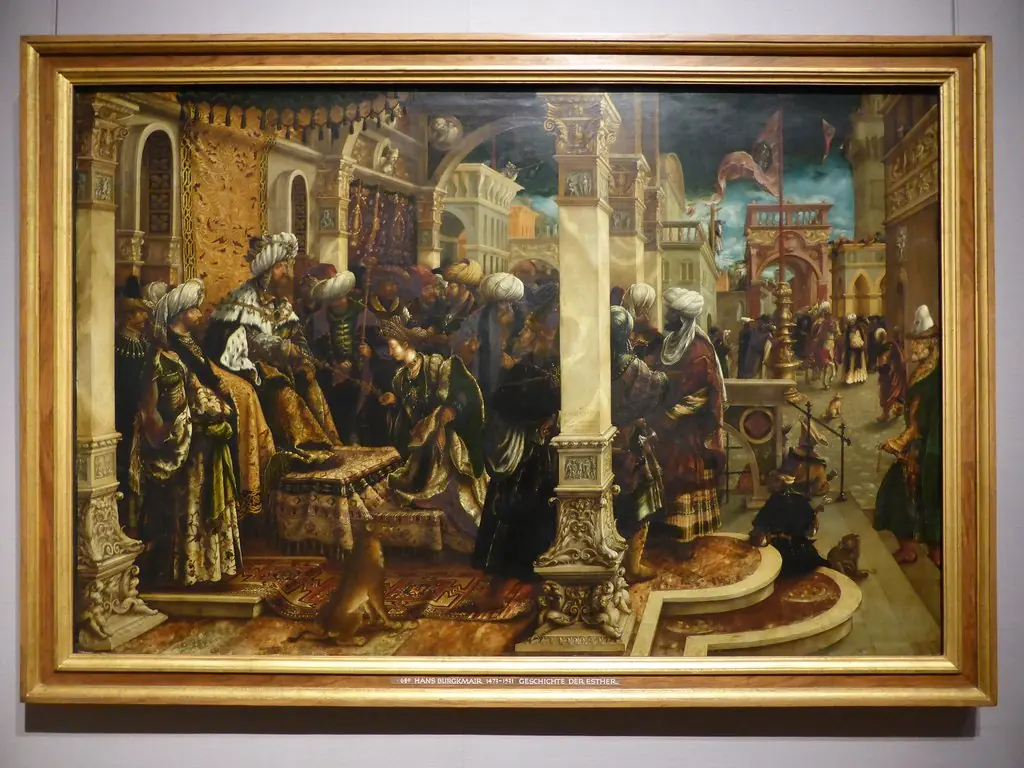
Hans Burgkmair the Elder (1473–1531) was a German artist, born in Augsburg.

![The High Priest before Pilate [verso], by German 16th Century](https://artifactworldgallery.com/img/german-16th-century--the-high-priest-before-pilate-verso--0e55f00eccfecd8d-w320.webp)