Artwork
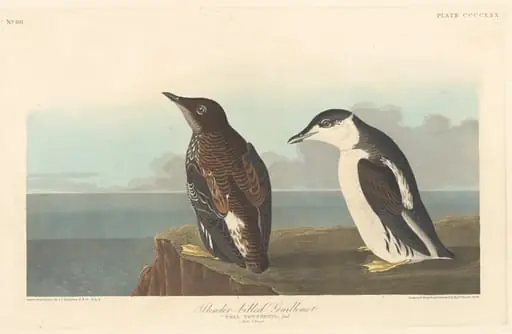
Black-throated Guillemot, Nobbed-billed Auk, Curled-Crested Auk and Horned-billed Guillemot
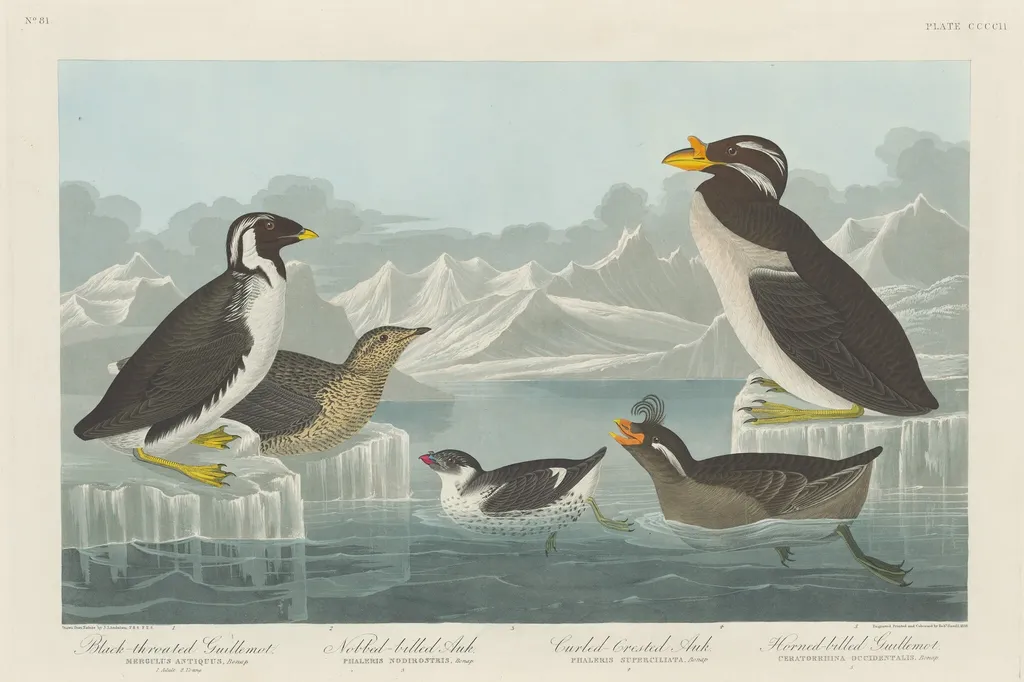
Black-throated Guillemot, Nobbed-billed Auk, Curled-Crested Auk and Horned-billed Guillemot is an ink print by the Romanticist artist Robert Havell Jr.. It dates from 1838 and is held in the collection of the National Gallery of Art.
About this work
Overview
Part of a broader series documenting North Atlantic avian life, the work reflects the Havell family’s multi-generational expertise in printmaking.
Created in 1838 by Robert Havell Jr., this hand-colored engraving and aquatint features four seabird species on Whatman wove paper. Part of a broader series documenting North Atlantic avian life, the work reflects the Havell family’s multi-generational expertise in printmaking. Though the family had ties to Indian artistic traditions, this piece is dedicated solely to ornithological accuracy, emphasizing detail over decorative flourish.
Subject & Meaning
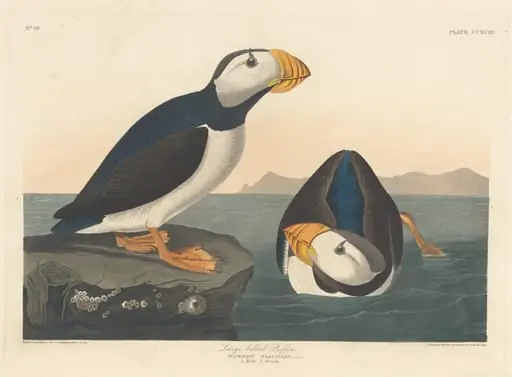
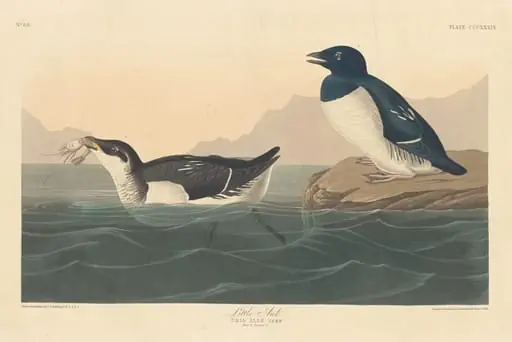
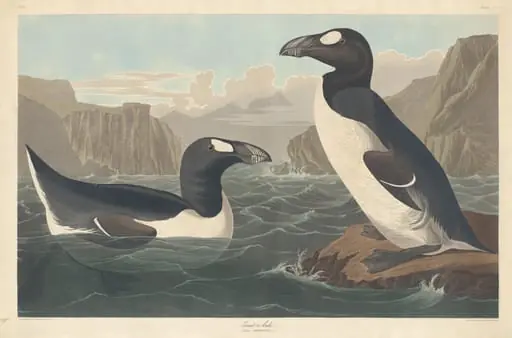
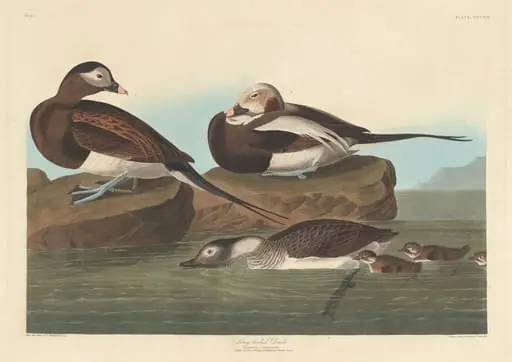
The print depicts the Black-throated Guillemot, Nobbed-billed Auk, Curled-Crested Auk, and Horned-billed Guillemot in naturalistic poses—perched on ice and swimming in water. Each bird is labeled with its scientific name, underscoring the illustration’s purpose as a taxonomic record. The inclusion of icy terrain and distant mountains situates the species within their Arctic and sub-Arctic habitats, reinforcing the work’s role in scientific documentation rather than artistic fantasy.
Technique & Style
Havell employed fine-line engraving and aquatint to render intricate feather textures, beak details, and the reflective surface of ice. Hand-coloring was applied with precision to match observed plumage, while the background’s soft blue washes and muted mountain outlines create depth without distraction. The composition balances scientific clarity with subtle atmospheric perspective, typical of 19th-century natural history illustration.
History & Provenance
Robert Havell Jr. inherited his father’s engraving practice and continued producing plates for major natural history publications. This print likely originated as part of a larger ornithological project, possibly linked to John James Audubon’s works, with which Havell was closely associated. The use of high-quality Whatman paper and meticulous hand-coloring indicates it was intended for scholarly or institutional audiences rather than mass distribution.
Context
In the 1830s, European and American naturalists were systematically cataloging global fauna, driven by colonial exploration and scientific curiosity. Havell’s work emerged within this wave, contributing to a growing body of visual records that replaced speculative illustrations with observed reality. The absence of human figures or narrative elements reflects the period’s shift toward objective, specimen-based documentation in natural science.
Legacy
Havell’s prints remain valued for their technical precision and fidelity to avian anatomy. Though overshadowed in popular memory by larger works, his contributions helped standardize the visual language of ornithological illustration. The print endures in museum and academic collections as an example of how craftsmanship and scientific rigor intersected in pre-photographic natural history.
Artist & collection

Artist
The Havell family of Reading, Berkshire, England, included a number of notable engravers, etchers and painters, as well as writers, publishers, educators, and musicians.