Artwork
Great Auk
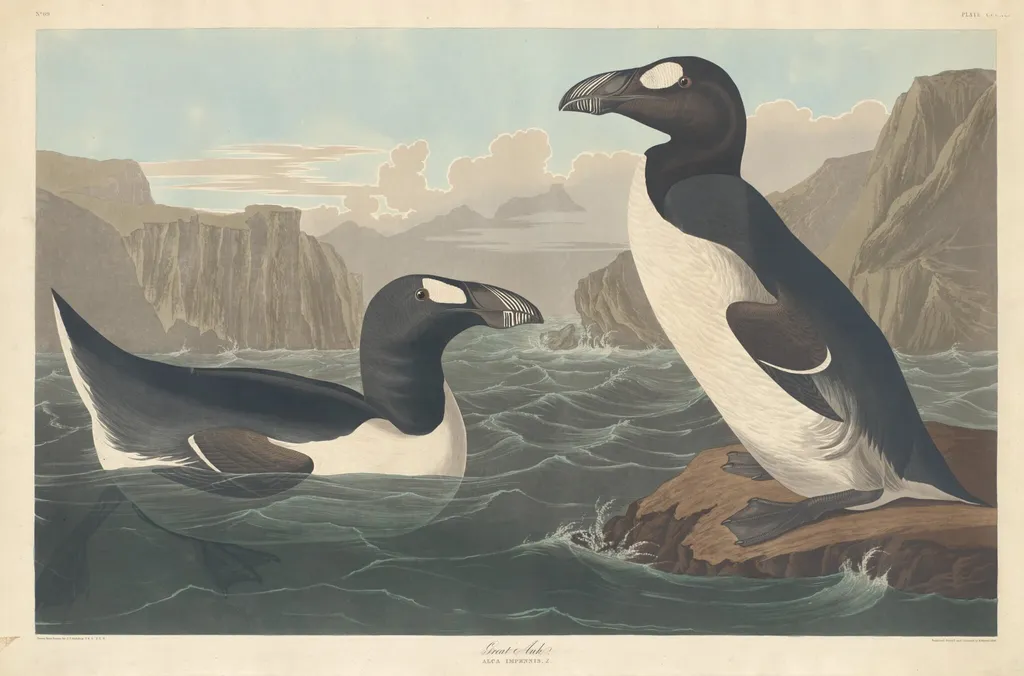
Great Auk is an ink print by the Romanticist artist Robert Havell Jr.. It dates from 1836 and is held in the collection of the National Gallery of Art.
About this work
Overview
It portrays the Great Auk, a flightless seabird now extinct, rendered with precision through layered print techniques.
This 1836 print by Robert Havell Jr. is a hand-colored engraving and aquatint on Whatman wove paper, part of a series documenting North American birds. It portrays the Great Auk, a flightless seabird now extinct, rendered with precision through layered print techniques. The Havell family, known for their reproductive printmaking in Berkshire, England, specialized in translating naturalist illustrations into detailed, colored prints for scientific and public audiences.
Subject & Meaning
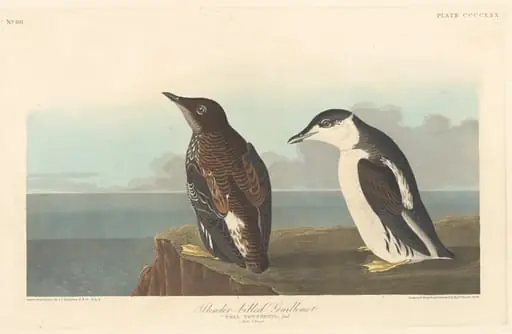
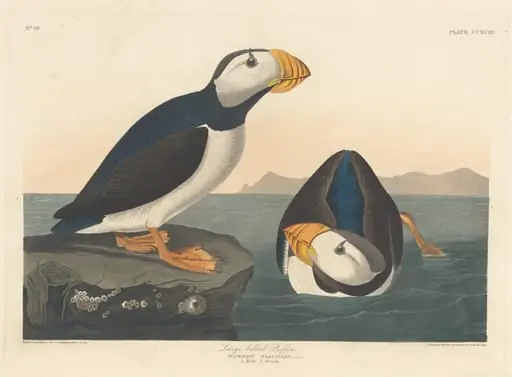
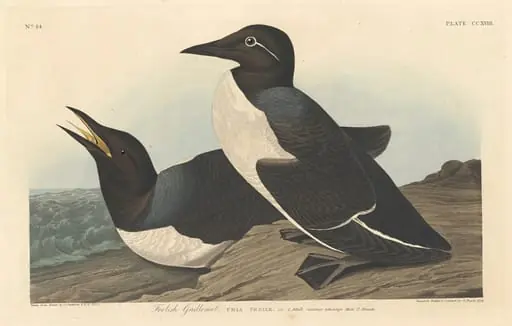
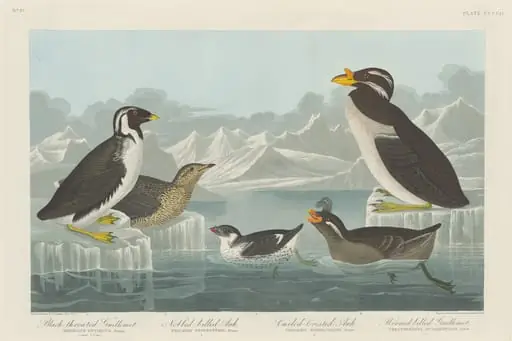
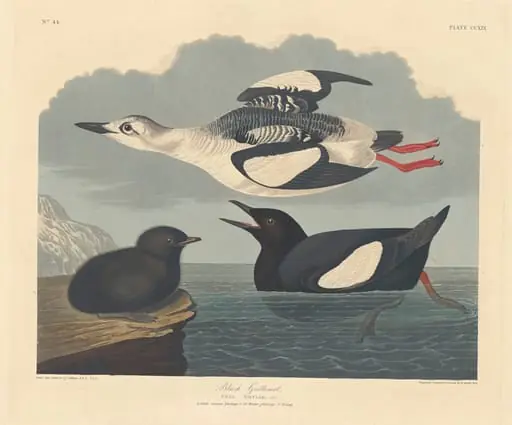
The image captures two Great Auks standing on rocky shores, one facing left, the other right, as if in quiet interaction. Their black-and-white plumage, thick beaks, and upright posture reflect their adaptation to cold northern waters. The composition conveys neither drama nor anthropomorphism, but rather a quiet record of a species already in decline, offering a sober visual archive before its extinction in the mid-19th century.
Technique & Style
Havell employed engraving and aquatint to achieve fine tonal gradations and texture, particularly in the birds’ feathers and the turbulent sea. Hand-coloring added lifelike detail to the plumage and sky, a hallmark of the Havell workshop’s approach. The background cliffs and clouds are softly rendered, balancing naturalism with the limitations of reproductive printmaking, avoiding overt romanticism in favor of observational clarity.
History & Provenance
Created as part of John James Audubon’s 'The Birds of America' project, this print was produced in London under Robert Havell Jr.’s supervision. The Havell family’s workshop had long collaborated with naturalists, translating watercolor studies into engraved plates. This particular image was based on Audubon’s field sketches, and the print was issued in parts between 1827 and 1838, distributed to subscribers across Europe and North America.
Context
The Great Auk was hunted extensively for its feathers, meat, and oil, leading to its extinction by the 1840s. This print emerged during a period of growing scientific interest in natural history, yet also amid accelerating species loss due to human exploitation. While Romanticism influenced contemporary aesthetics, Havell’s work prioritizes documentation over emotional idealization, aligning more closely with Enlightenment-era naturalism.
Legacy
As one of the last visual records of the Great Auk, this print serves as a historical artifact of extinction. It remains a key reference in ornithological studies and conservation discourse. The Havell family’s technical rigor ensured its durability and clarity, allowing future generations to study the bird’s form and habitat with rare fidelity, long after the species vanished from the wild.
Artist & collection

Artist
The Havell family of Reading, Berkshire, England, included a number of notable engravers, etchers and painters, as well as writers, publishers, educators, and musicians.