Artwork
Fulmer Petrel
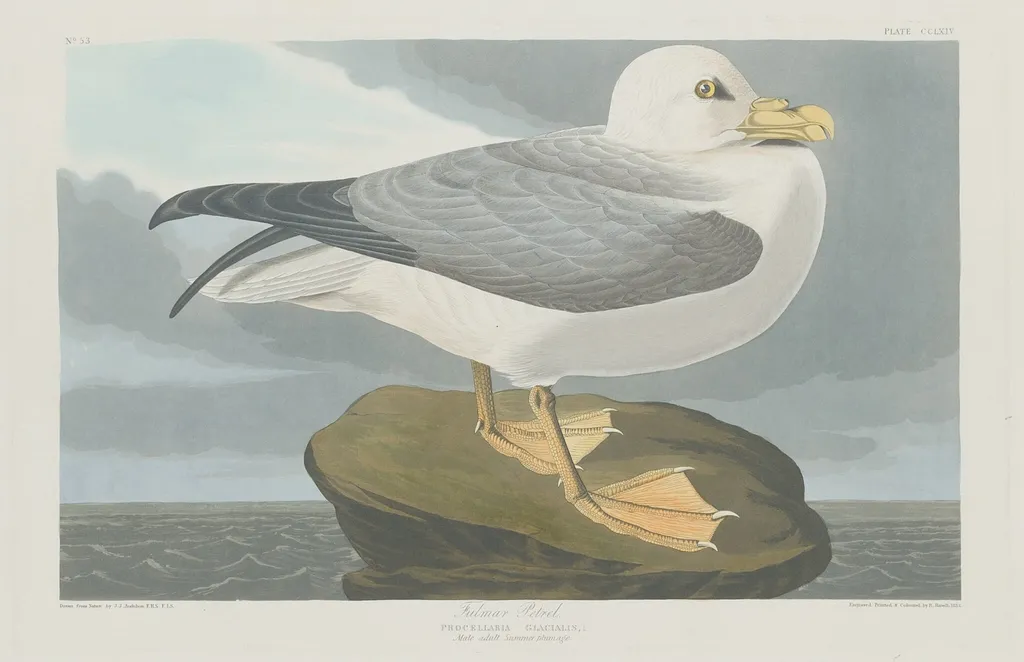
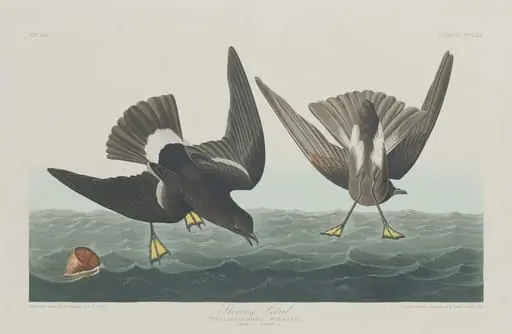
Fulmer Petrel is an ink print by the Romanticist artist Robert Havell Jr.. It dates from 1835 and is held in the collection of the National Gallery of Art.
About this work
Overview
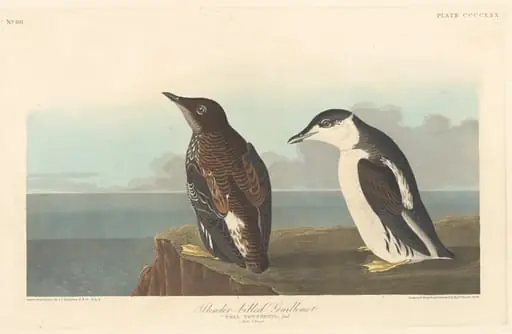
Created in 1835, *Fulmer Petrel* is a hand‑colored print that combines engraving with aquatint on a sheet of Whatman wove paper. The image portrays a seabird perched on a rocky shore, its white plumage contrasted by gray wings and a vivid yellow bill, set against a tranquil sea with gentle surf.
Subject & Meaning
The work depicts a petrel, a marine bird associated with coastal environments, rendered in a naturalistic pose with wings slightly opened as if ready to launch. The calm water and modest wave detail emphasize the bird’s habitat, reflecting the 19th‑century interest in documenting wildlife accurately for scientific and educational purposes.
Technique & Style
Havell employed fine, linear engraving to delineate feather texture, while aquatint provided subtle tonal washes that model the bird’s form and the surrounding sea. Hand‑coloring adds selective hues—white, gray, and yellow—enhancing realism without overwhelming the delicate tonal balance characteristic of early natural history prints.
History & Provenance
Robert Havell Jr., son of the noted engraver and publisher Robert Havell the Elder, produced the print within the Havell family workshop in Reading, Berkshire. The family was renowned for their expertise in aquatint and for collaborations with Indian artists, situating this piece within a broader tradition of reproductive printmaking that served both artistic and scientific markets.
Context
During the 1830s, advances in printing technology allowed for increasingly precise illustrations of flora and fauna. Prints like *Fulmer Petrel* were often used in ornithological publications and natural history collections, meeting the era’s demand for visual documentation of species encountered by explorers and scholars.
Own this work as a print
Artist & collection

Artist
The Havell family of Reading, Berkshire, England, included a number of notable engravers, etchers and painters, as well as writers, publishers, educators, and musicians.