Artwork
Golden Plover
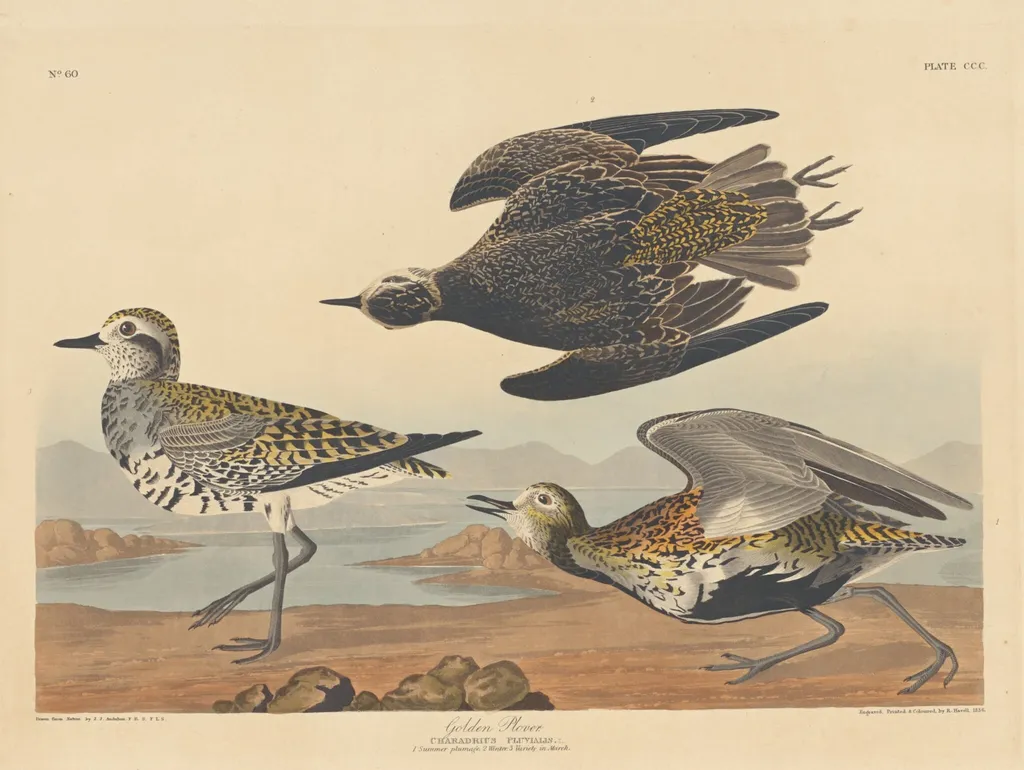
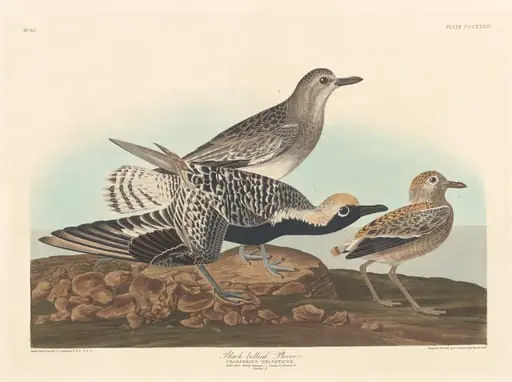
Golden Plover is an ink print by the Romanticist artist Robert Havell Jr.. It dates from 1836 and is held in the collection of the National Gallery of Art.
About this work
Overview
Created in 1836 by Robert Havell Jr., this print is a hand-colored engraving and aquatint on Whatman wove paper. It belongs to a tradition of reproductive natural history illustration, where detailed prints were made to accompany scientific publications. The Havell family, known for their technical precision in printmaking, contributed significantly to such works in early 19th-century Britain.
Subject & Meaning
The birds’ plumage, rendered in subtle gradations of brown, yellow, and black, emphasizes their adaptation to open landscapes.
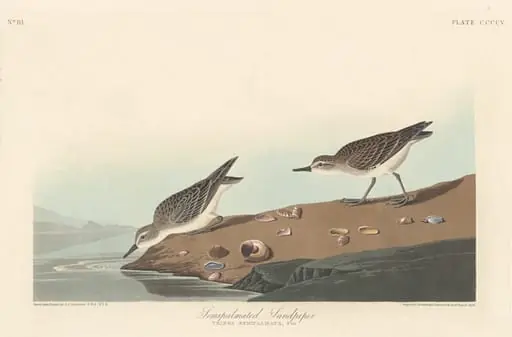
The image depicts three golden plovers in varying poses—one in mid-flight, two standing on ground. Their bodies are oriented in different directions, suggesting movement and natural behavior. The birds’ plumage, rendered in subtle gradations of brown, yellow, and black, emphasizes their adaptation to open landscapes. The composition captures the species in its habitat without anthropomorphism, reflecting a scientific interest in avian life.
Technique & Style
Havell employed engraving for fine linear detail and aquatint to achieve soft tonal transitions, particularly in the birds’ feathers and the distant landscape. Hand-coloring was applied with care to match observed natural hues, avoiding theatricality. The use of Whatman wove paper, prized for its smooth texture, allowed for precise ink absorption and delicate color layering, characteristic of high-quality naturalist prints of the era.
History & Provenance
Robert Havell Jr. worked within a family workshop established by his father, Robert Havell Sr., and uncle Daniel Havell, who were active in London’s print trade. Their studio specialized in reproducing ornithological illustrations, often for publications like Audubon’s *Birds of America*. This print likely originated as part of such a series, produced for scientific audiences and collectors interested in natural history.
Context
In the 1830s, detailed ornithological prints were vital for documenting species before widespread photography. Artists like Havell collaborated with naturalists to ensure anatomical accuracy. The inclusion of a distant horizon with water and mountains situates the birds within a recognizable North American or European coastal environment, aligning with contemporary efforts to map wildlife geographically.
Legacy
The Havell family’s prints remain valued for their technical fidelity and restrained aesthetic. While not widely exhibited today, their work underpins the visual record of 19th-century ornithology. This print exemplifies how artisanal printmaking served science, preserving species imagery with clarity and care before the advent of modern photographic reproduction.
Artist & collection

Artist
The Havell family of Reading, Berkshire, England, included a number of notable engravers, etchers and painters, as well as writers, publishers, educators, and musicians.