Artwork
Ruddy Plover
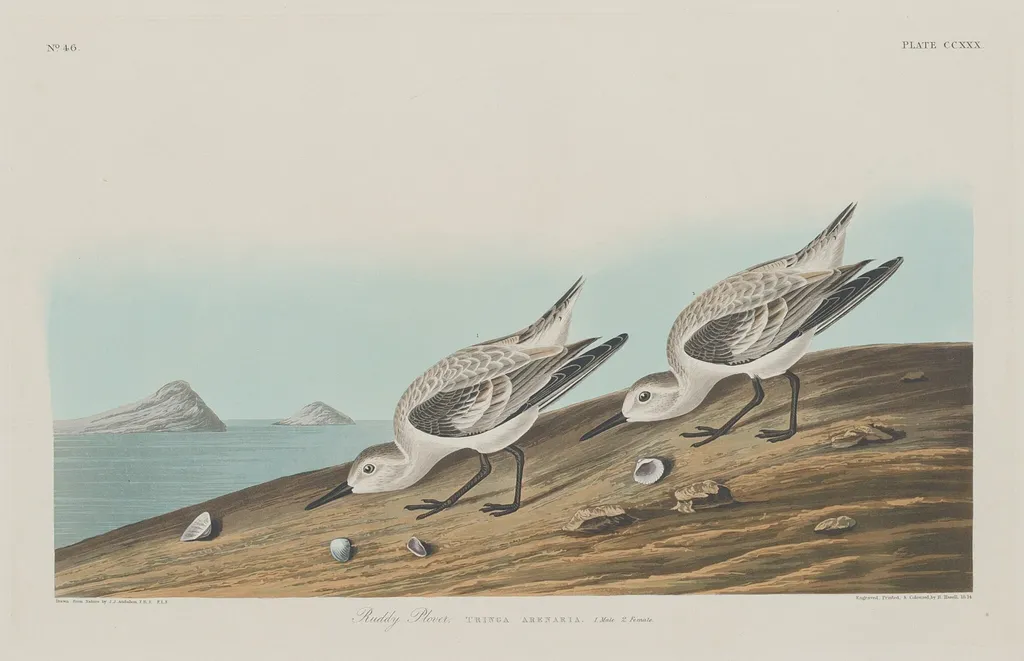
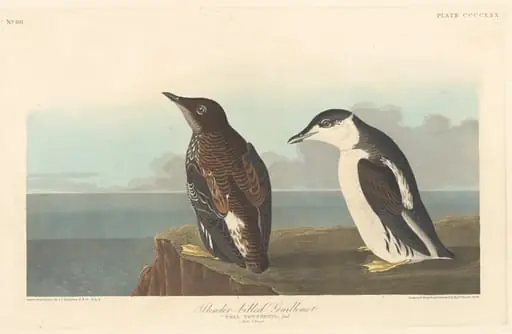
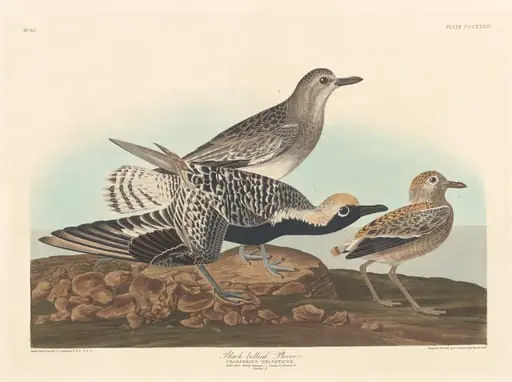
Ruddy Plover is an ink print by the Romanticist artist Robert Havell Jr.. It dates from 1834 and is held in the collection of the National Gallery of Art.
About this work
Overview
, this hand-colored engraving and aquatint was produced on Whatman wove paper, a high-quality support favored by British printmakers.
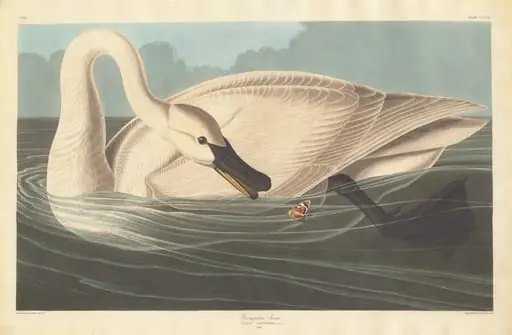
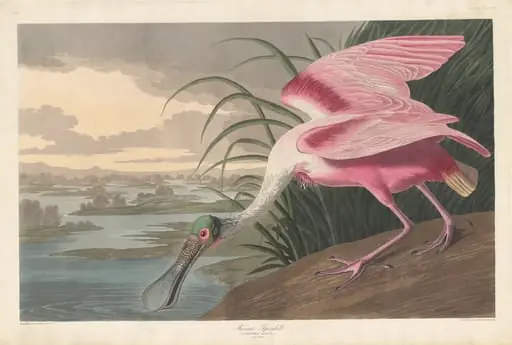
Created in 1834 by Robert Havell Jr., this hand-colored engraving and aquatint was produced on Whatman wove paper, a high-quality support favored by British printmakers. Part of a broader tradition of reproductive printmaking within the Havell family, the work exemplifies the technical precision and tonal subtlety achieved through layered aquatint processes. The image belongs to a series documenting avian species, reflecting the period’s scientific interest in natural history.
Subject & Meaning
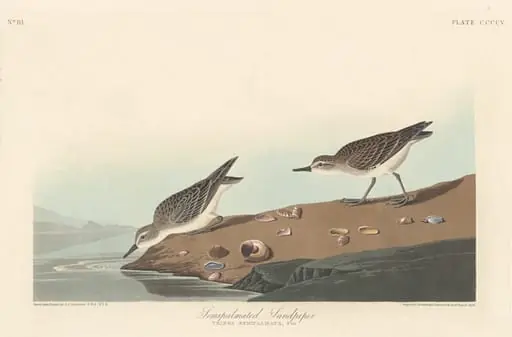
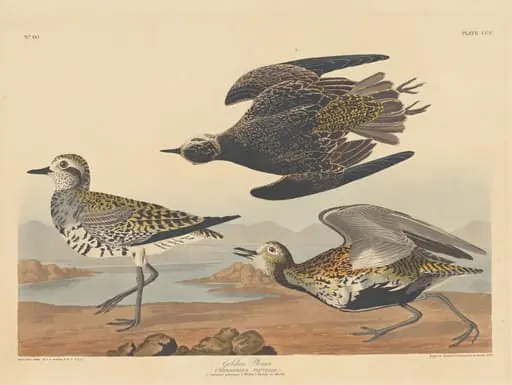
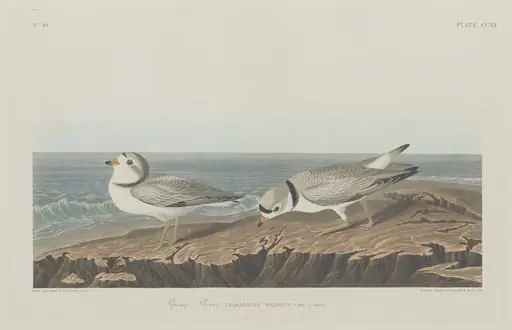
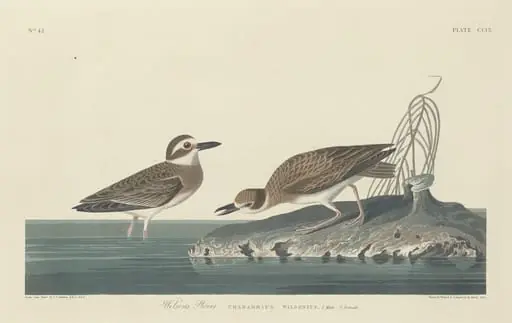
The print depicts a male and female ruddy plover on a coastal rocky shore, the male actively foraging while the female remains still nearby. The scene, annotated by the artist to distinguish the sexes, emphasizes behavioral observation over symbolism. The inclusion of scattered seashells and distant islands situates the birds within a specific habitat, reinforcing the work’s role as a record of natural life rather than an allegorical composition.
Technique & Style
Havell employed engraving for fine linear detail and aquatint to achieve soft gradations of tone, particularly in the birds’ plumage. Hand-coloring was applied with precision to enhance naturalistic texture without overwhelming the underlying lines. The use of Whatman paper allowed for fine ink absorption and delicate washes, supporting the subtle interplay of light and shadow that defines the birds’ forms and the tranquil seascape behind them.
History & Provenance
The Havell family, based in Reading, Berkshire, operated a well-established printmaking workshop known for its collaboration with naturalists and publishers. Robert Havell Jr. contributed to major ornithological projects, including John James Audubon’s *Birds of America*. This print likely originated as part of a commercial or scientific series, circulating among collectors and institutions interested in accurate depictions of British and colonial wildlife.
Context
In the early 19th century, British printmaking merged scientific inquiry with artistic craftsmanship, especially in natural history illustration. The demand for detailed, life-sized bird images grew alongside colonial exploration and the rise of amateur ornithology. Havell’s work reflects this trend, aligning with contemporaneous efforts to document species through visual means that balanced accuracy with aesthetic refinement.
Legacy
Though not widely exhibited today, Havell’s prints remain referenced in studies of 19th-century natural history illustration. His technique influenced later printmakers working in the aquatint tradition, particularly in the rendering of feather textures and atmospheric depth. The work endures as a quiet example of how technical mastery served the documentation of the natural world during a period of expanding scientific curiosity.
Artist & collection

Artist
The Havell family of Reading, Berkshire, England, included a number of notable engravers, etchers and painters, as well as writers, publishers, educators, and musicians.