Artwork
Wilson's Plover
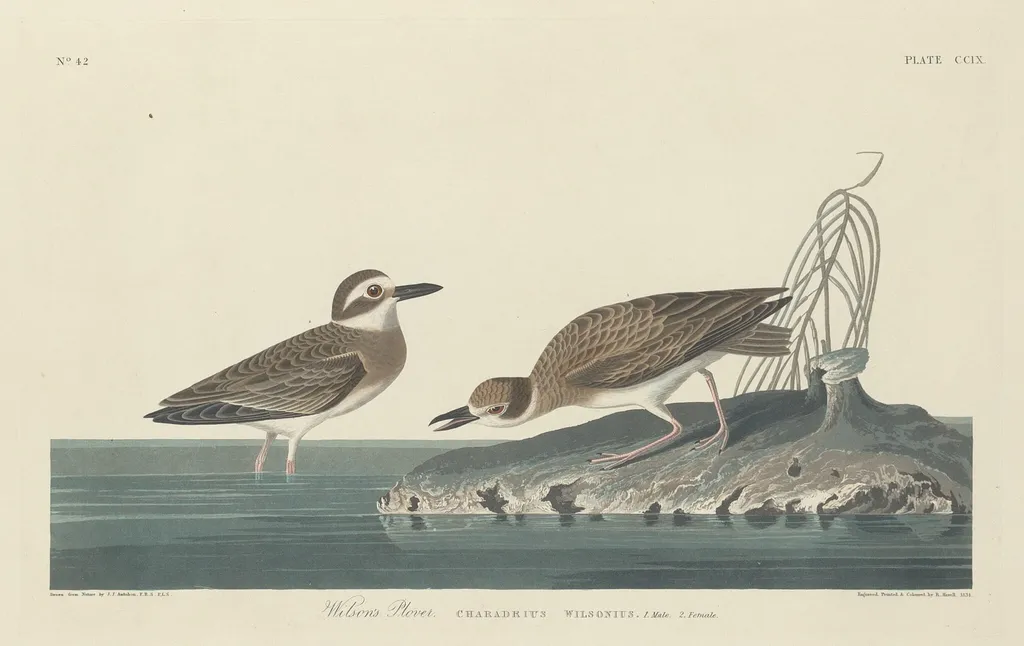
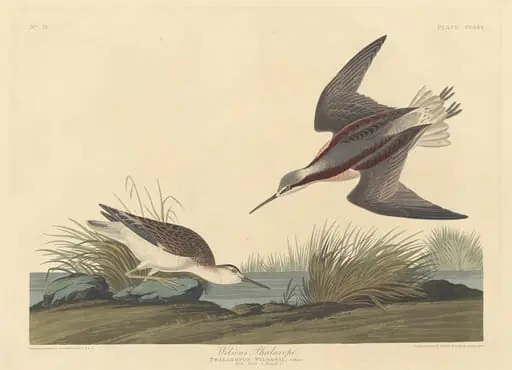
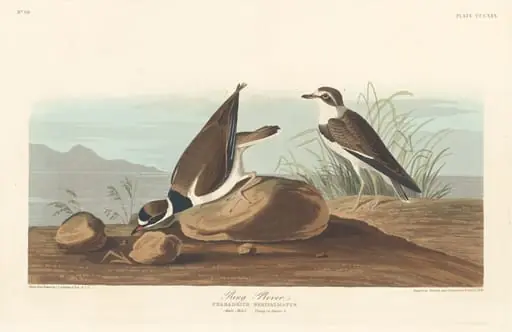
Wilson's Plover is an ink print by the Romanticist artist Robert Havell Jr.. It dates from 1834 and is held in the collection of the National Gallery of Art.
About this work
Overview
Robert Havell Jr. produced this hand-colored engraving and aquatint in 1834 on Whatman wove paper, part of a series documenting North American birds. The Havell family, based in Reading, Berkshire, were known for their technical mastery in printmaking, particularly aquatint, and maintained professional ties to natural history illustration through collaborations with ornithologists.
Subject & Meaning
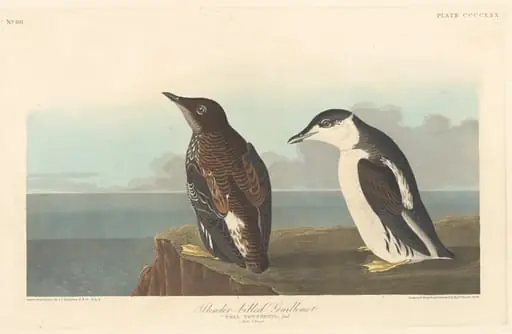
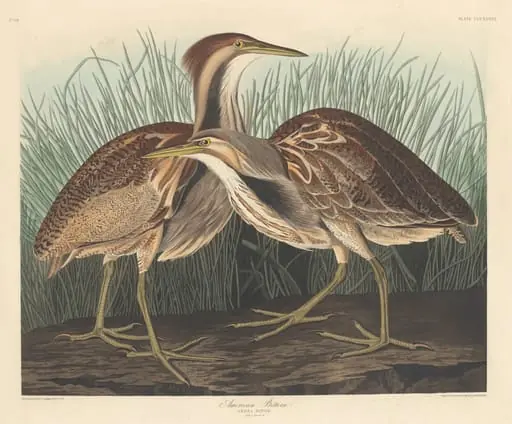
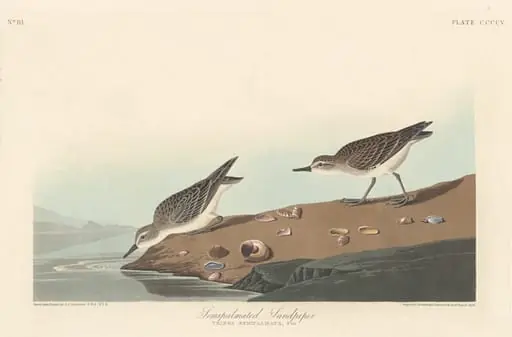
The print portrays two Wilson’s plovers standing on a rocky shore, one turned left, the other right, their brown plumage and pale underparts rendered with careful attention to detail. The birds appear still, engaged in quiet observation, framed by a sparse coastal landscape. The composition suggests a moment of natural equilibrium, emphasizing the bird’s habitat without anthropomorphic narrative.
Technique & Style
Havell employed engraving for fine linear detail and aquatint for subtle tonal gradations, particularly in the water and rock surfaces. Hand-coloring was applied with precision to match the bird’s natural hues, while the background’s muted blues and greens create atmospheric depth. The use of Whatman paper, prized for its durability and texture, enhanced the print’s tactile quality.
History & Provenance
The work originated as part of a larger ornithological publication, likely linked to Alexander Wilson’s American Ornithology. Havell, who completed the engravings after his father’s death, inherited both the technical methods and the publishing project. The print’s survival in institutional collections reflects its role in early American natural history documentation.
Context
Created during a period of growing scientific interest in North American fauna, the image aligns with early 19th-century efforts to catalog species through visual means. While European artistic traditions influenced the composition, the subject matter and setting were distinctly American, distinguishing it from contemporary European wildlife prints.
Legacy
Havell’s prints, including this one, remain important references for ornithological illustration and printmaking history. Their technical rigor and fidelity to natural forms set a standard for later scientific imagery. Though not widely exhibited today, they persist in academic and museum archives as key artifacts of early American natural history.
Artist & collection

Artist
The Havell family of Reading, Berkshire, England, included a number of notable engravers, etchers and painters, as well as writers, publishers, educators, and musicians.