Artwork
Loggerhead Shrike
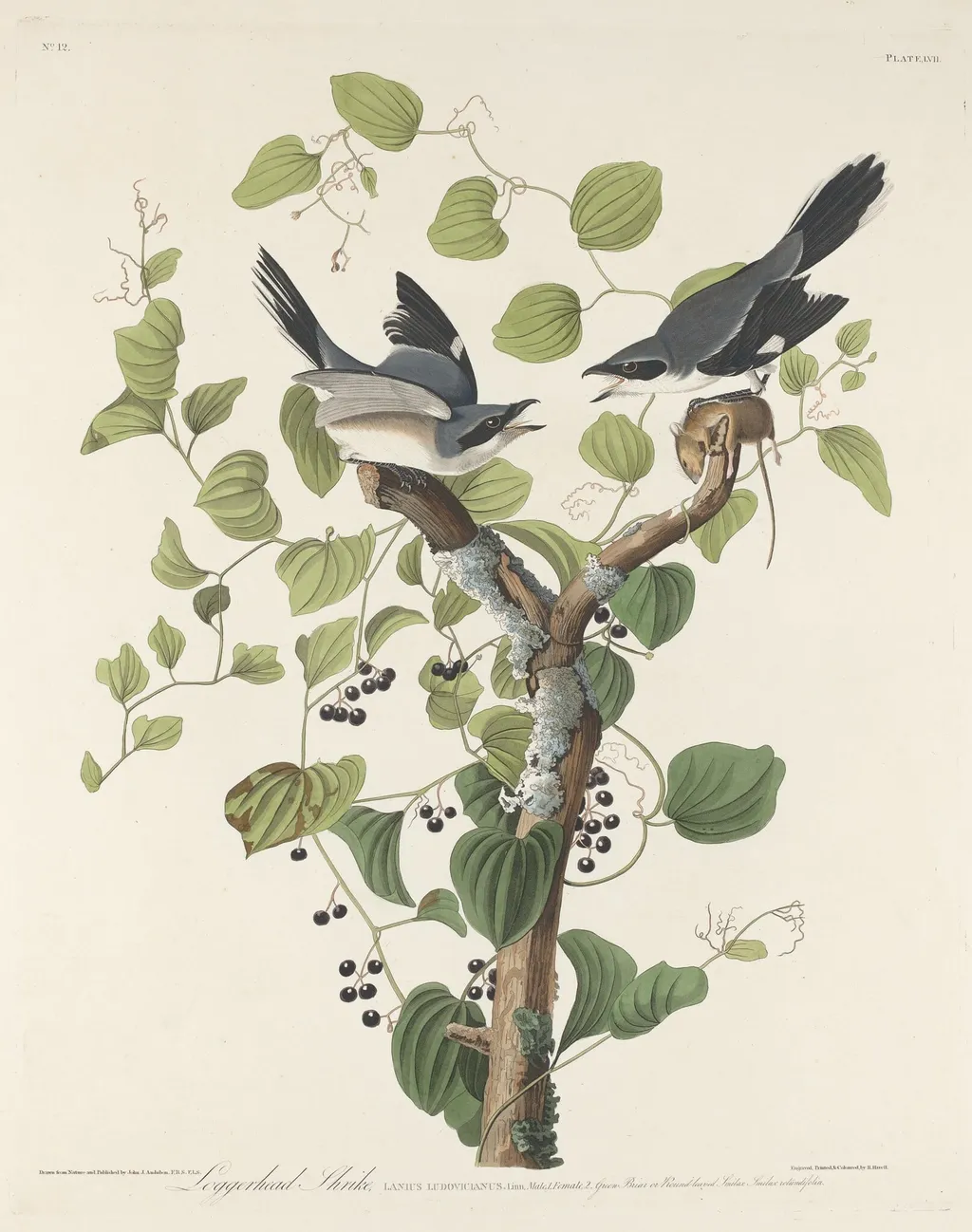
Loggerhead Shrike is an ink print by the Romanticist artist Robert Havell Jr.. It dates from 1829 and is held in the collection of the National Gallery of Art.
About this work
Overview
Robert Havell Jr. produced the print titled *Loggerhead Shrike* in 1829. Executed as a hand‑coloured engraving combined with aquatint, the image appears on a sheet of Whatman wove paper. The composition shows two grey‑bodied shrikes with white underparts and black wings, perched on a brown branch studded with green leaves, dark berries and lichen.
Technique & Style
The work exemplifies the Havell family’s mastery of aquatint, a printmaking process that creates tonal washes through acid‑etched plates. Havell added colour by hand after the impression was taken, allowing subtle, muted hues to enhance the naturalistic detail of the birds and foliage.
Subject & Meaning
The print depicts the loggerhead shrike, a predatory passerine noted for its habit of impaling prey on thorns. By presenting the birds in a quiet, mutually attentive pose, the image emphasizes observation of behaviour rather than dramatising the bird’s violent reputation.
History & Provenance
Created during a period when the Havell workshop was heavily involved in natural‑history illustration, the piece reflects the family’s long‑standing engagement with Indian artistic traditions and scientific publishing. It forms part of a broader corpus of early‑19th‑century zoological prints produced for reference works and collectors.
Artist & collection

Artist
The Havell family of Reading, Berkshire, England, included a number of notable engravers, etchers and painters, as well as writers, publishers, educators, and musicians.