Artwork
Pine Finch
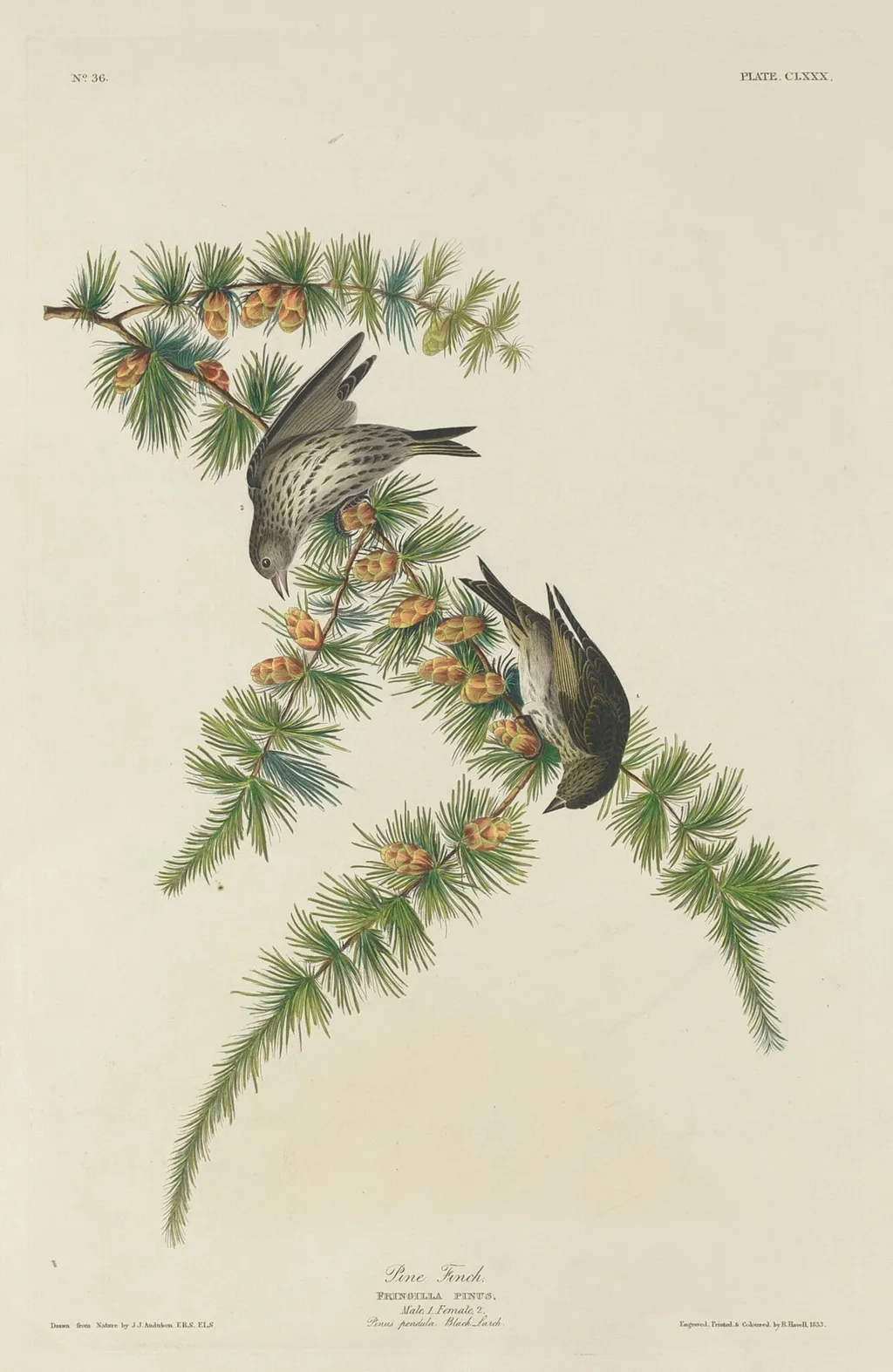
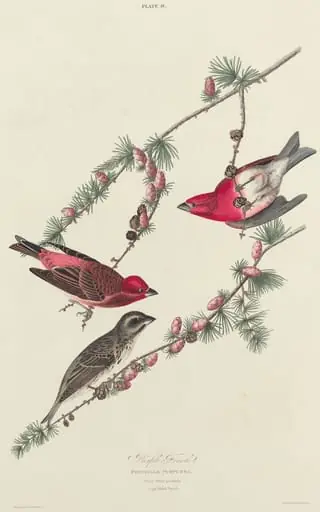
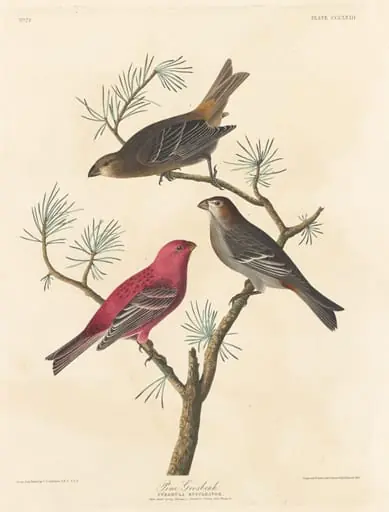
Pine Finch is an ink print by the Romanticist artist Robert Havell Jr.. It dates from 1833 and is held in the collection of the National Gallery of Art.
About this work
Overview
Created in 1833, *Pine Finch* is a hand‑colored engraving combined with aquatint, executed on smooth Whatman wove paper. The print depicts two finches perched on a curved pine branch, surrounded by sharp green needles and small brown cones. The composition balances the birds’ opposite gazes, one striped in brown and black, the other darker with patches of white, rendering a quiet natural scene.
Subject & Meaning
The opposing orientations of the birds suggest a moment of observation rather than narrative drama.
The work presents a close study of the pine finch, a small passerine native to coniferous forests. By placing the birds on a detailed branch, the image emphasizes the relationship between the species and its habitat, reflecting the 19th‑century interest in documenting wildlife with scientific precision. The opposing orientations of the birds suggest a moment of observation rather than narrative drama.
Technique & Style
Havell employed fine engraving lines to render feather texture and pine‑needle detail, while the aquatint layer provides subtle tonal washes that model form and depth. Hand‑coloring adds selective hues to the birds and foliage, enhancing realism. This combination of line work, tonal variation, and color typifies the meticulous approach of natural‑history illustration during the period.
History & Provenance
The print was produced by Robert Havell Jr., a member of the Havell family renowned for their expertise in aquatint and for publishing illustrated natural‑history volumes. As the son of Robert Havell Sr., he continued the family’s tradition of high‑quality printmaking. *Pine Finch* exemplifies the Havells’ broader engagement with Indian and European scientific illustration, though its specific ownership record remains limited.
Artist & collection

Artist
The Havell family of Reading, Berkshire, England, included a number of notable engravers, etchers and painters, as well as writers, publishers, educators, and musicians.