Artwork
Towee Bunting
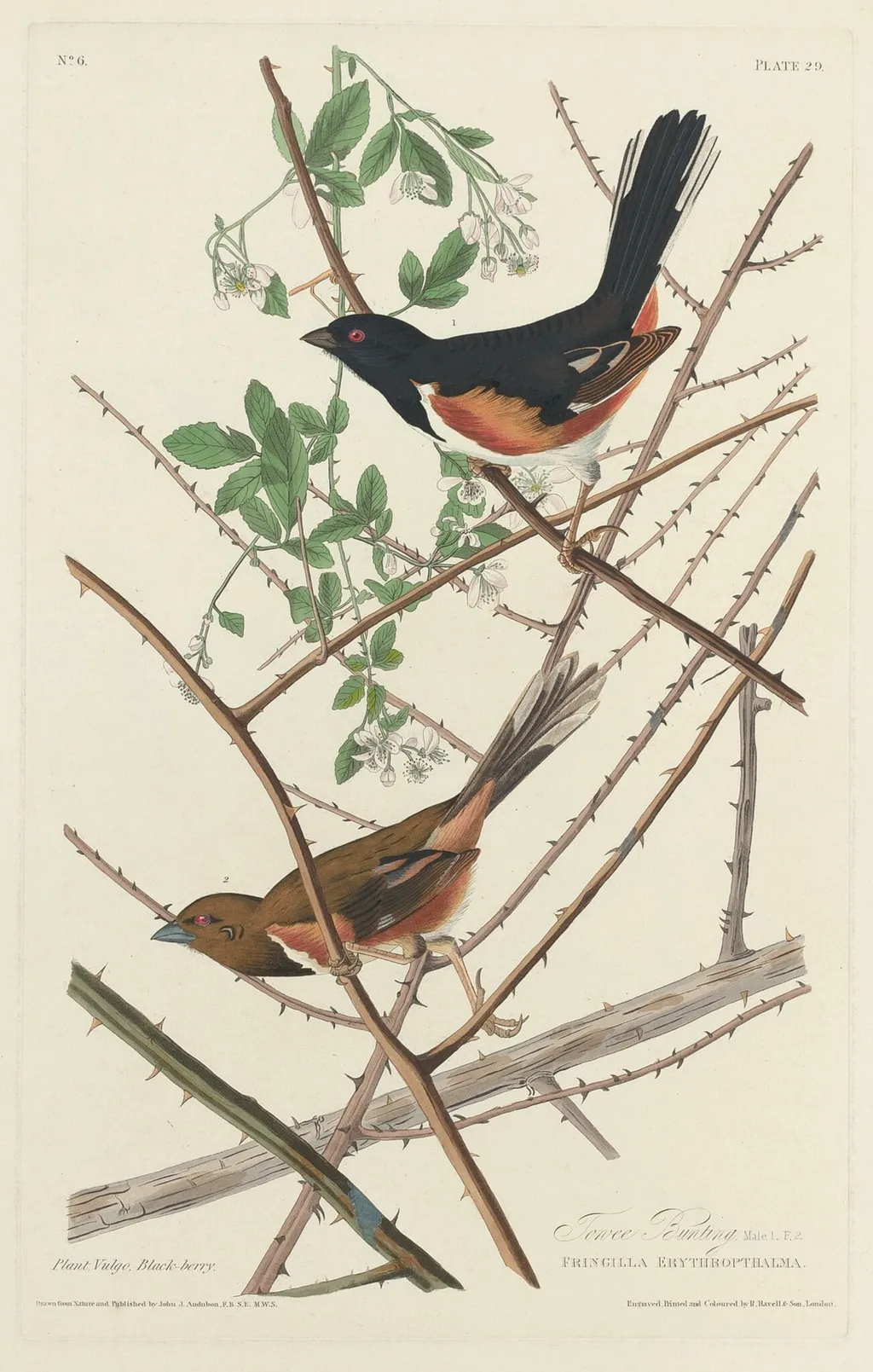
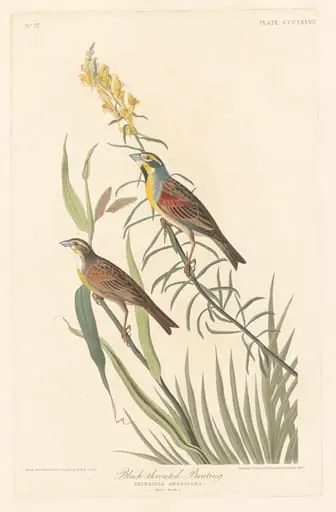
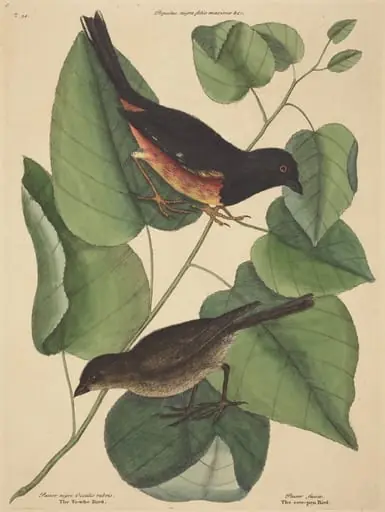
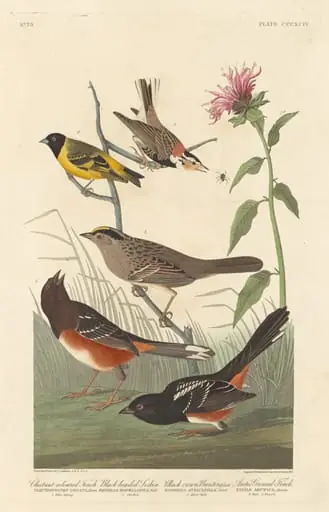
Towee Bunting is an ink print by the Romanticist artist Robert Havell Jr.. It dates from 1828 and is held in the collection of the National Gallery of Art.
About this work
Overview
The work belongs to a broader tradition of ornithological prints produced in early 19th-century Britain, blending artistic skill with zoological documentation.
Created in 1828 by Robert Havell Jr., this hand-colored engraving and aquatint depicts two birds on thorny branches, rendered on Whatman wove paper. As part of a family known for printmaking and natural history illustration, Havell applied precise engraving techniques to capture avian detail with scientific clarity. The work belongs to a broader tradition of ornithological prints produced in early 19th-century Britain, blending artistic skill with zoological documentation.
Subject & Meaning
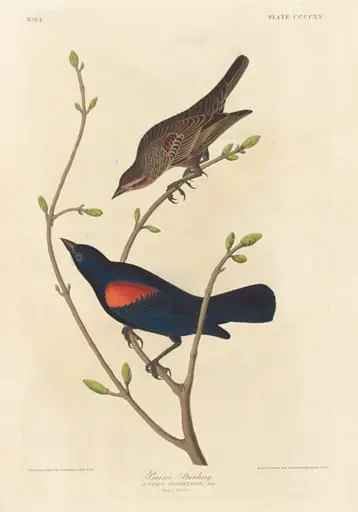
The image portrays two birds identified as 'Towee Bunting,' perched among blackberry branches adorned with small white blossoms. The birds’ contrasting plumage—black and orange, brown and red—highlights their distinctiveness within the natural world. The inclusion of the plant species grounds the illustration in botanical accuracy, suggesting an intent to document both animal and plant life as interconnected elements of the environment, rather than as decorative motifs.
Technique & Style
Havell employed fine-line engraving and aquatint to achieve subtle tonal gradations in the birds’ feathers and the textured surfaces of the branches. Hand-coloring enhanced the natural hues of plumage and flowers with delicate washes, preserving the precision of the engraved lines. The plain background eliminates distraction, directing attention to the intricate rendering of feathers, thorns, and leaves, reflecting a commitment to observational accuracy over ornamental flourish.
History & Provenance
Robert Havell Jr. was part of a multi-generational family of English engravers based in Reading, Berkshire, who specialized in natural history prints. His work on ornithological subjects, including this piece, was often linked to publications documenting species from Britain and its colonies. Though the specific commission for this print is unrecorded, its production aligns with the Havell family’s broader engagement in illustrating wildlife for scientific and educational audiences during the early 1800s.
Context
In the 1820s, illustrated natural history publications gained popularity among both scholars and amateur naturalists. Artists like Havell contributed to this movement by producing detailed, color-accurate prints that served as visual references. The focus on native species such as the Towee Bunting and blackberry reflects a growing interest in cataloging local flora and fauna, distinct from the exoticism prevalent in colonial-era natural history art.
Legacy
Havell’s prints, including this one, remain valued for their technical precision and fidelity to natural forms. While not widely known outside specialist circles, they represent a quiet but significant contribution to the transition from artistic illustration to scientific documentation in ornithology. Their enduring relevance lies in their quiet adherence to observation, offering a historical record of how species were perceived and recorded before the advent of photography.
Artist & collection

Artist
The Havell family of Reading, Berkshire, England, included a number of notable engravers, etchers and painters, as well as writers, publishers, educators, and musicians.