Artwork
Willow Grous
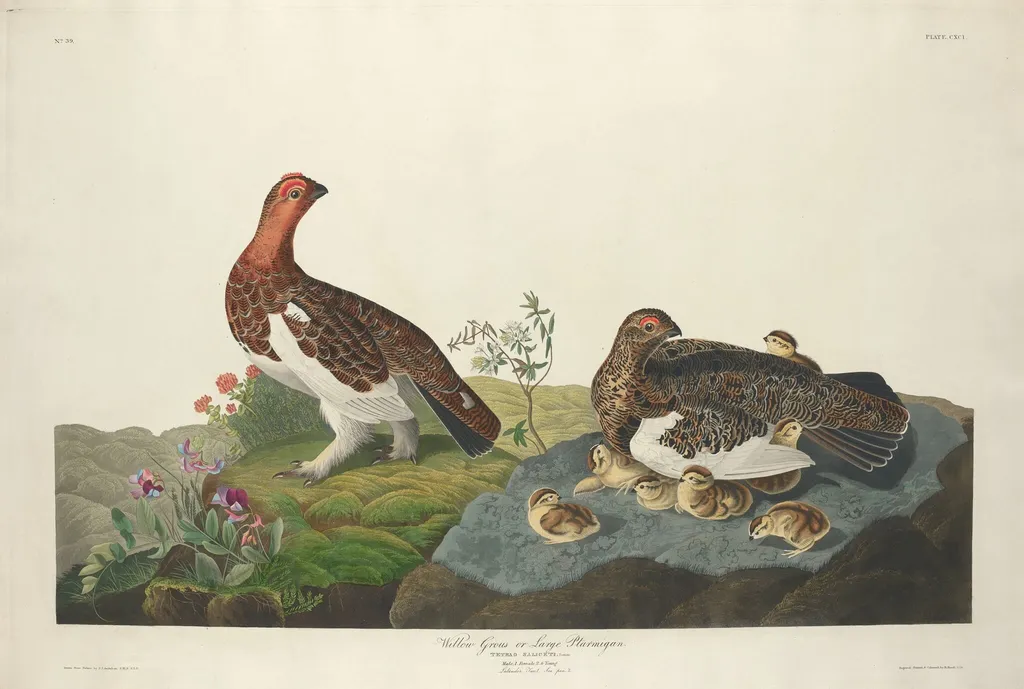
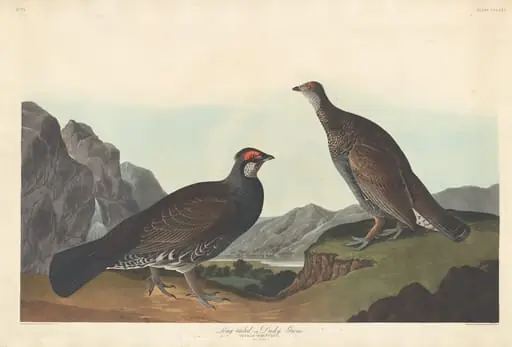
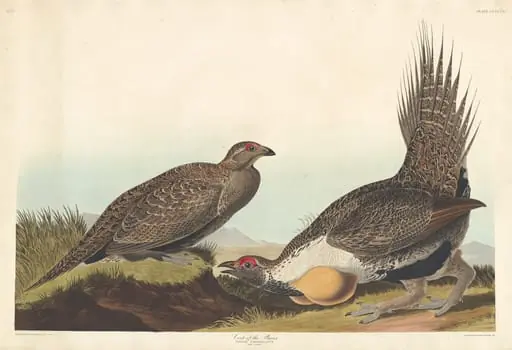
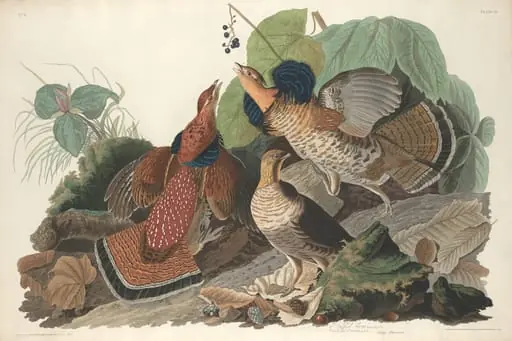
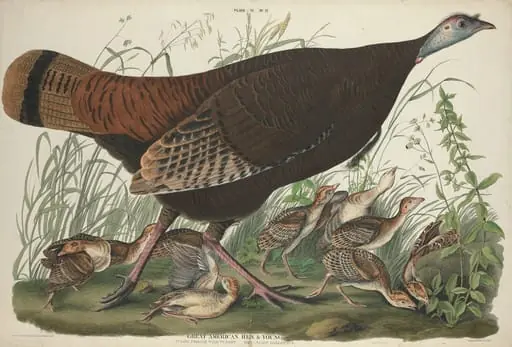
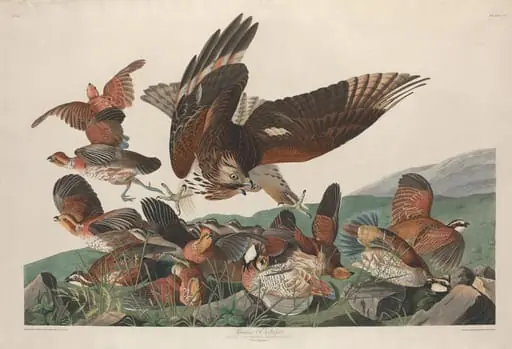
Willow Grous is an ink print by the Romanticist artist Robert Havell Jr.. It dates from 1834 and is held in the collection of the National Gallery of Art.
About this work
Overview
The print presents a naturalistic scene of willow grouse—an adult male, a female, and their young—set against a meadow of grasses, wildflowers and low shrubs.
Created in 1834, *Willow Grous* is a hand‑colored engraving and aquatint executed on fine Whatman wove paper. The print presents a naturalistic scene of willow grouse—an adult male, a female, and their young—set against a meadow of grasses, wildflowers and low shrubs. The composition balances detailed bird study with a softly rendered landscape, typical of early‑nineteenth‑century British wildlife illustration.
Subject & Meaning
The image captures a family of willow grouse in their arctic‑subarctic habitat, emphasizing the tender interaction between the adult birds and their offspring. By foregrounding the birds’ plumage and posture, the work conveys a sense of vitality and the continuity of species within a fragile environment, reflecting contemporary interests in natural history and observation.
Technique & Style
Havell combined traditional line engraving with aquatint, a tonal method that produces washes of colour, then applied hand‑applied pigments to enhance key details, notably the male’s reddish neck. The aquatint provides a subtle gradation of light and shadow, while the hand‑coloring adds vivid accents, resulting in a richly textured yet precise representation.
History & Provenance
Robert Havell Jr., part of a family renowned for their aquatint work, produced the print during a period when the Havells were closely linked to Indian artistic circles, though this particular piece focuses on European fauna. The work was likely issued as part of a series of natural‑history prints that circulated among collectors and scientific societies in the 1830s.
Context
In the early nineteenth century, detailed wildlife prints served both scientific and decorative purposes, catering to a growing public fascination with cataloguing nature. Havell’s expertise in aquatint placed him among the leading practitioners who could render fine tonal variation, aligning his output with contemporaneous publications such as *The Naturalist’s Library*.
Legacy
*Willow Grous* exemplifies the intersection of art and natural history that characterized the period, influencing later illustrators who sought to combine accurate observation with aesthetic appeal. The print remains a reference point for studies of early wildlife engraving techniques and the Havell family’s contribution to the medium.
Artist & collection

Artist
The Havell family of Reading, Berkshire, England, included a number of notable engravers, etchers and painters, as well as writers, publishers, educators, and musicians.