Artwork
Mucius Saevola
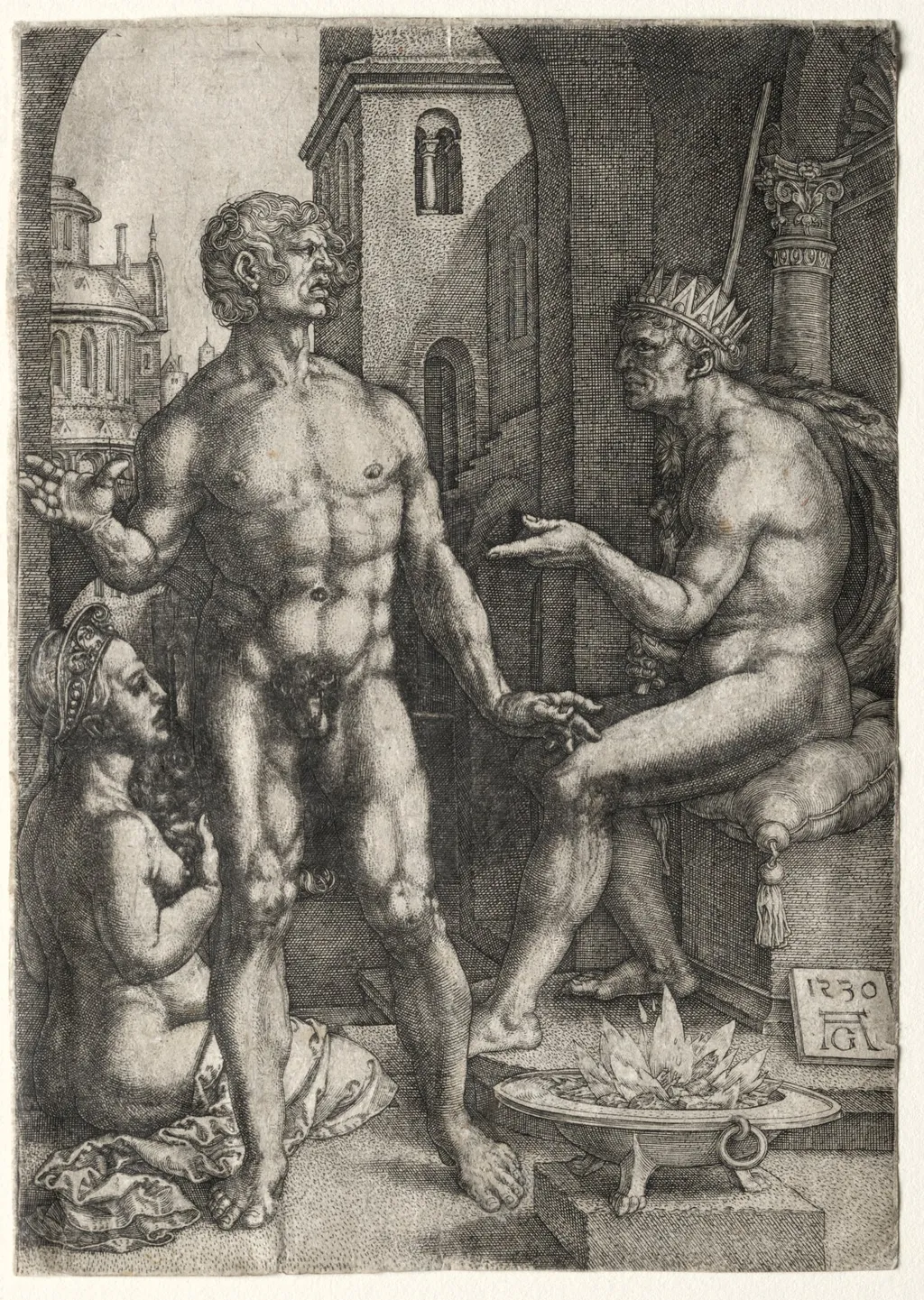
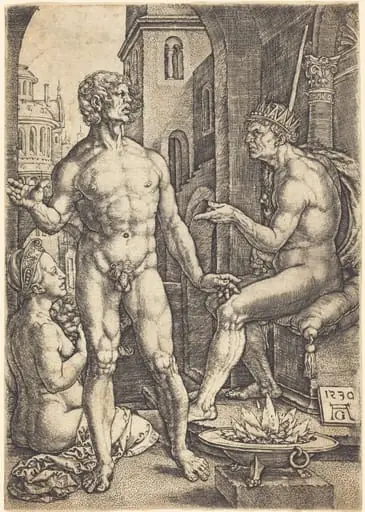
Mucius Saevola is a print by the Renaissance artist Heinrich Aldegrever. It dates from 1530 and is held in the collection of the Cleveland Museum of Art.
About this work
Overview
Its composition centers on two figures in a confined interior, illuminated by a single flame, with a distant urban skyline suggesting broader political context.
Created in 1530 by Heinrich Aldegrever, this etching depicts a moment from Roman legend involving the hero Mucius Scaevola. Rendered in fine linear detail and dramatic tonal contrast, the print is part of the collection at The Cleveland Museum of Art. Its composition centers on two figures in a confined interior, illuminated by a single flame, with a distant urban skyline suggesting broader political context.
Subject & Meaning
The scene illustrates the moment when Mucius Scaevola, having attempted to assassinate the Etruscan king Porsena, is brought before him. The seated figure, crowned with leaves, represents Porsena, while the standing man, holding a torch, is Mucius. The torch symbolizes his failed act of violence, and the calm demeanor of the king contrasts with the warrior’s resolve, underscoring themes of courage and stoicism.
Technique & Style
Aldegrever employed etching to achieve sharp, intricate lines and deep chiaroscuro effects. The figures emerge from a shadowy background through carefully graded tonal contrasts, with the flame acting as the sole light source. Delicate hatching defines musculature and fabric, while the faint cityscape in the distance is rendered with minimal strokes, enhancing the intimacy of the central encounter.
History & Provenance
The print was produced during Aldegrever’s active period in Westphalia, where he was known for small-scale religious and mythological subjects. It entered the Cleveland Museum of Art’s collection in the 20th century, likely through a broader acquisition of Northern Renaissance prints. Its preservation reflects its status as a well-documented example of early 16th-century German printmaking.
Context
Aldegrever’s work emerged amid the Protestant Reformation, a time when secular classical narratives gained renewed interest among Northern European artists. His prints often drew from Roman history to convey moral or civic virtues. This piece aligns with contemporary humanist interests in stoic heroism, resonating with audiences who valued resilience and self-control in turbulent times.
Legacy
Though not widely reproduced, this etching exemplifies Aldegrever’s skill in translating dramatic narratives into compact, psychologically charged compositions. It influenced later Northern printmakers who favored chiaroscuro and classical themes. Today, it remains a key reference for understanding how mythological subjects were adapted in Reformation-era graphic art.
Own this work as a print
Artist & collection

Artist
Heinrich Aldegrever or Aldegraf was a German painter and engraver. He was one of the "Little Masters", the group of German artists making small old master prints in the generation after Albrecht Dürer.

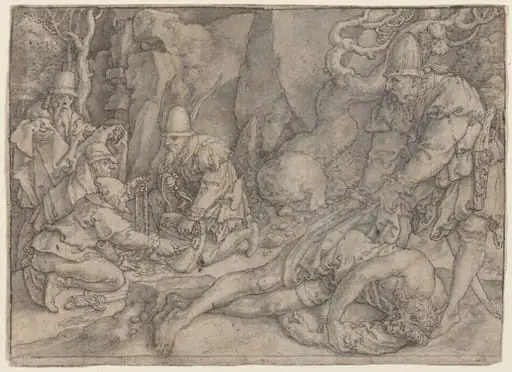
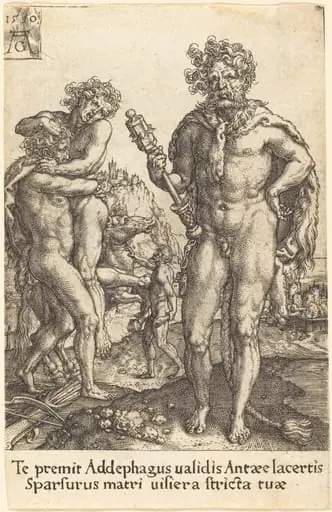 Hercules and Anthaeus
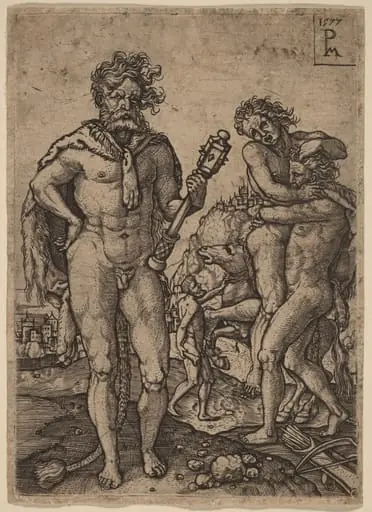 Hercules and Antaeus
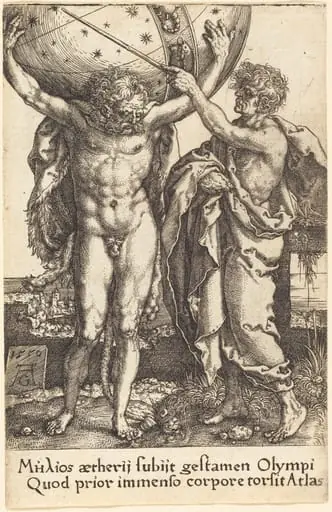 Hercules and Atlas
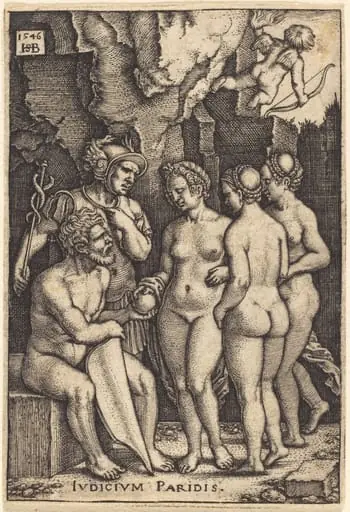 The Judgment of Paris
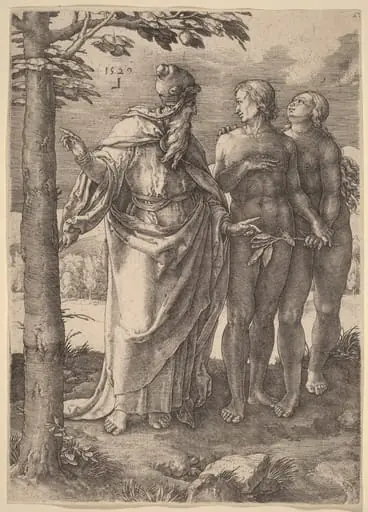 The First Prohibition
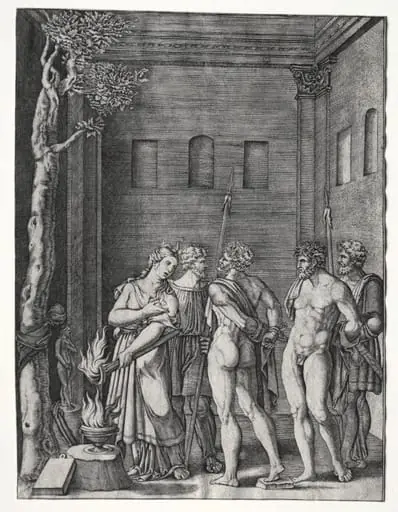 Orestes and Pylades brought to Iphigenia for Sacrifice
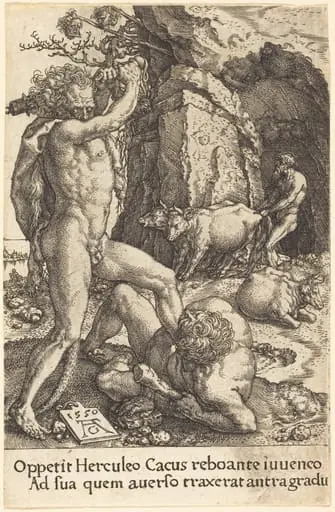 Hercules Killing Cacus
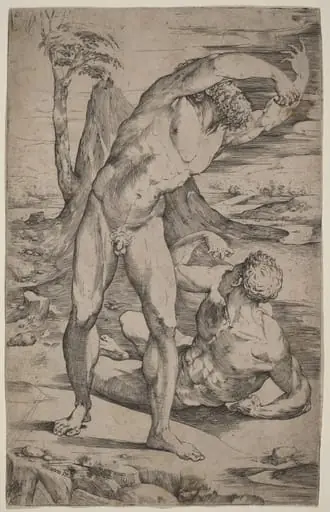 Two Male Nudes Gesturing in a Landscape
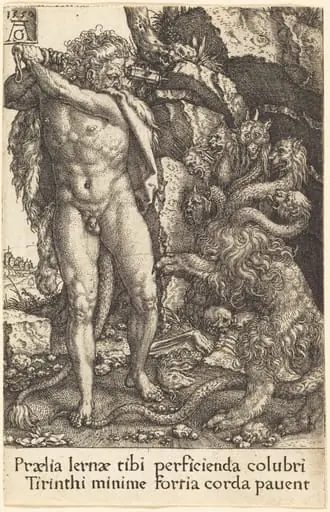 Hercules Fighting with the Hydra of Lernea
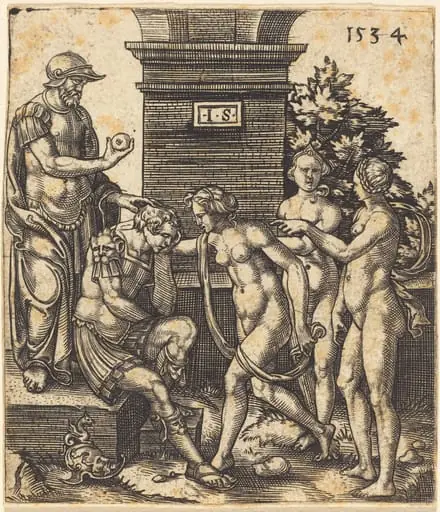 Judgment of Paris
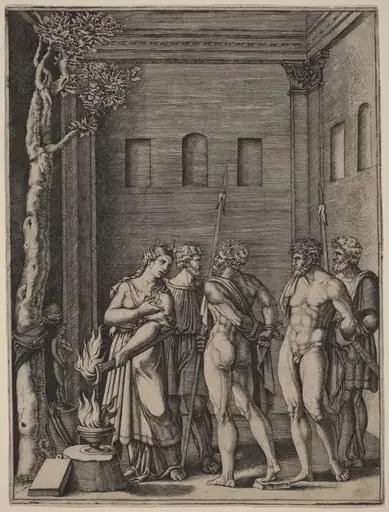 Iphigenia Recognizing Her Brother
 Mucius Scaevola