Artwork
Die Edelfrau (The Noblewoman)
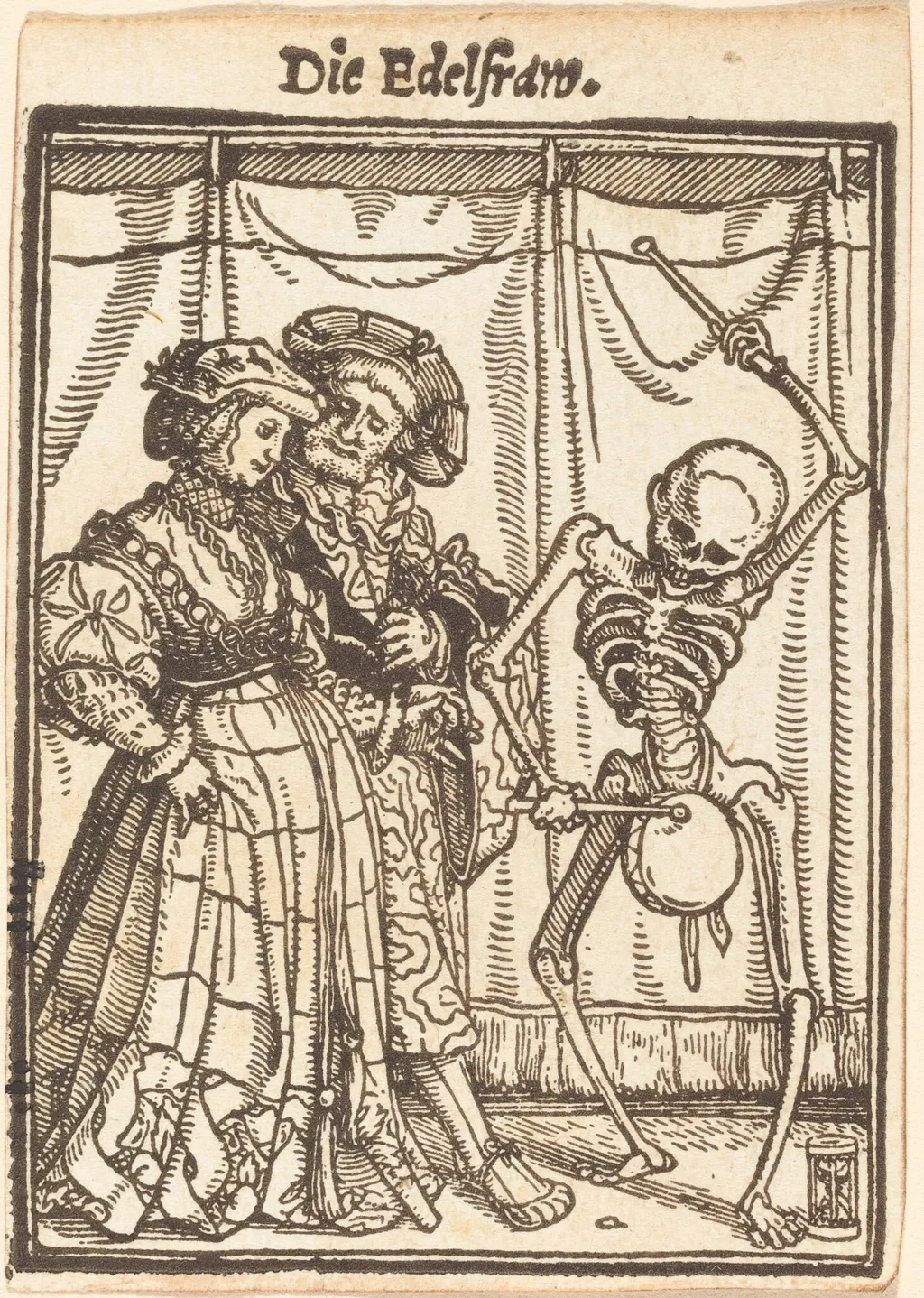
Die Edelfrau (The Noblewoman) is an ink print by the Renaissance artist Hans Lützelburger. It dates from 1526 and is held in the collection of the National Gallery of Art.
About this work
Overview
Though the design’s origin is uncertain, Lützelburger’s refined carving technique elevated the image into a finely detailed print.
Created around 1526, *Die Edelfrau* is a woodcut by Hans Lützelburger, a master blockcutter active in Augsburg. Though the design’s origin is uncertain, Lützelburger’s refined carving technique elevated the image into a finely detailed print. He was renowned for translating complex compositions into durable wood matrices, and this work reflects his precision. He died in June 1526, leaving the piece among his final efforts.
Subject & Meaning
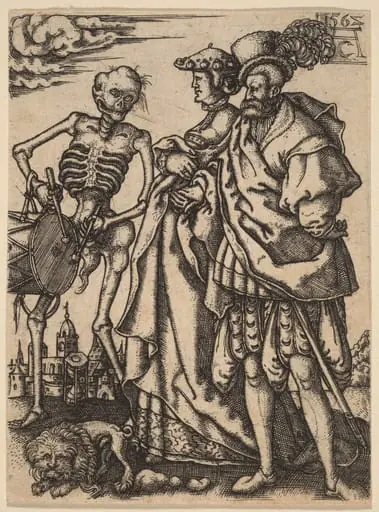
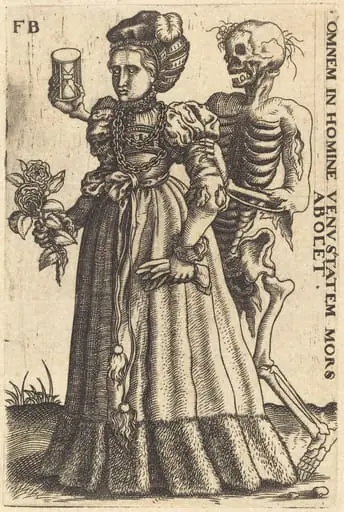
The image depicts a wealthy woman adorned in elaborate attire, holding a mirror, while a skeleton beside her, armed with a bow, gestures toward her. A dog rests at her feet, a symbol often tied to loyalty or vigilance. The contrast between her opulent clothing and the skeletal figure evokes a memento mori theme, reminding viewers of mortality’s inevitability regardless of social status. The mirror may suggest self-reflection or vanity, deepening the moral undertone.
Technique & Style
Lützelburger employed fine, controlled lines to render textures in fabric, hair, and bone with exceptional clarity. The woodcut’s intricate details—such as the patterned dress and delicate skeletal form—demonstrate his mastery of negative space and tonal gradation. Unlike broader, more decorative prints of the era, this work favors precision over ornamentation, aligning with the Northern Renaissance emphasis on observational detail and symbolic economy.
History & Provenance
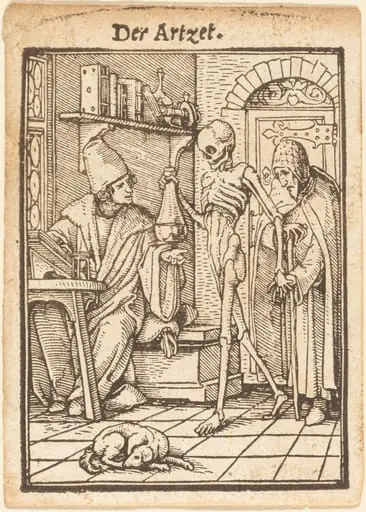
The print emerged during a period of prolific woodcut production in southern Germany, where artists and craftsmen collaborated across design and execution. Lützelburger, known for his work on Holbein’s *Dance of Death*, was part of a network centered in Augsburg. *Die Edelfrau* was likely produced shortly before his death in 1526, and its survival in multiple institutional collections suggests early circulation among collectors and religious institutions.
Context
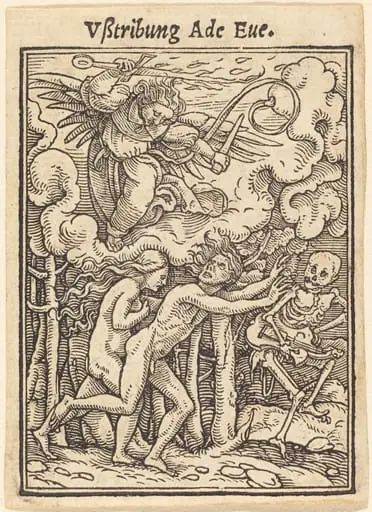
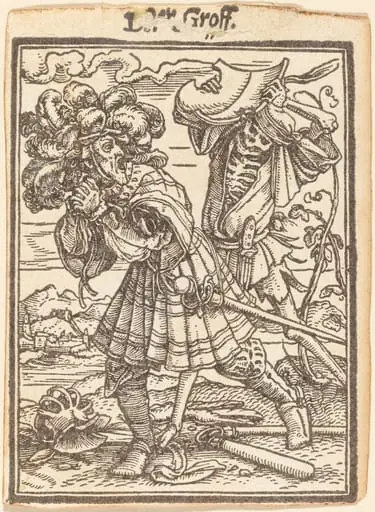
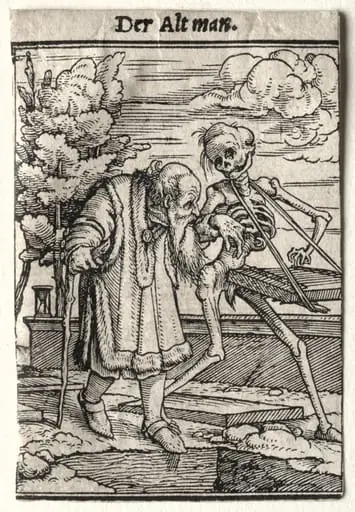
This image belongs to a broader tradition of Northern European prints that merged moral instruction with visual storytelling. The *Dance of Death* motif, popularized by Holbein and others, used stark contrasts between the living and the dead to critique earthly pride. In a time of religious upheaval, such imagery resonated with audiences seeking spiritual reflection, blending humanist ideals with devotional themes in accessible, reproducible form.
Legacy
Lützelburger’s technical skill set a benchmark for woodcut craftsmanship in the early 16th century. Though his name is less known than designers like Holbein, his cutting defined the aesthetic quality of many printed works of the period. *Die Edelfrau* endures as an example of how skilled artisans transformed conceptual themes into enduring visual statements, influencing later generations of printmakers in both technique and thematic depth.
Artist & collection

Artist
Hans Lützelburger (died June 1526), also known as Hans Franck, was a German blockcutter ("formschneider") for woodcuts, regarded as one of the finest of his day.