Artwork
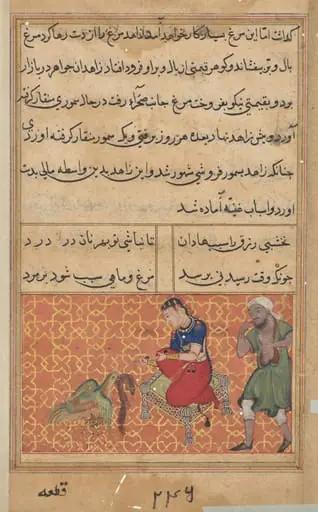
The parrot brings a fruit from the Tree of Life to the king of Syria, from a Tuti-nama (Tales of a Parrot): Ninth Night
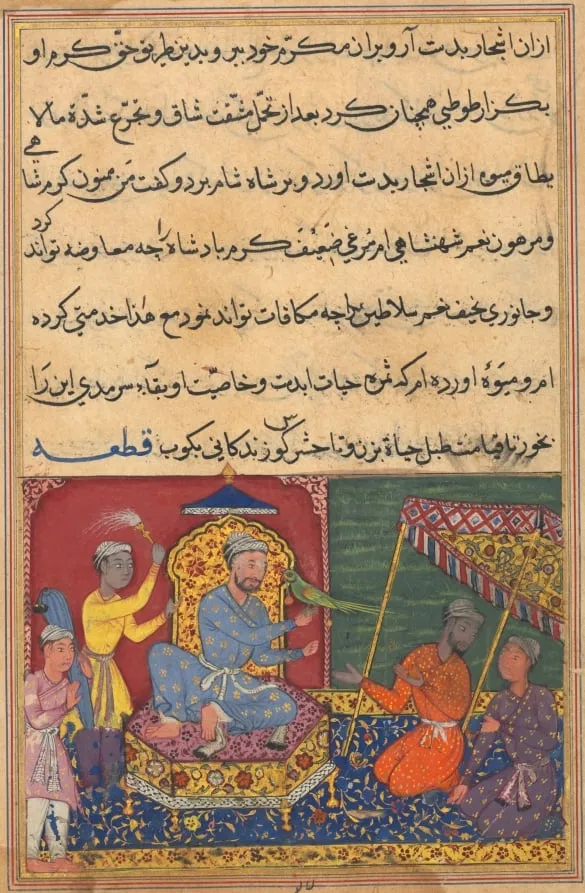
The parrot brings a fruit from the Tree of Life to the king of Syria, from a Tuti-nama (Tales of a Parrot): Ninth Night is an unspecified painting by the Mughal Painting artist Lalu. It dates from 1560 and is held in the collection of the Cleveland Museum of Art.
About this work
This painting comes from a book of stories told by a parrot to keep a queen from leaving home.
A bright green parrot sits on a king’s hand, offering him a glowing orange fruit. The king looks unsure, even though the fruit promises eternal life.
This painting comes from a book of stories told by a parrot to keep a queen from leaving home. The king’s hesitation shows wisdom—he’d rather stay mortal than risk unknown consequences. The tiny details, like the parrot’s feathers and the fruit’s shine, make the scene feel alive.
To see more art like this, look up mughal india, court of akbar (reigned 1556–1605).
Overview
The work illustrates a scene from the ninth night of the *Tuti‑nama* (Tales of a Parrot), a manuscript narrative in which a green parrot presents a glowing orange fruit to the Syrian king. The bird perches on the monarch’s hand, while the ruler looks uncertain about accepting the offering that promises everlasting life.
Subject & Meaning
In the story, the parrot has retrieved the fruit from a netherworld tree as a reward for the king’s long‑standing generosity. The king’s hesitation reflects a moral choice: to remain mortal and avoid unforeseen consequences rather than seize the promise of immortality, underscoring themes of prudence and the limits of desire.
Technique & Style
The painting employs vivid coloration, with the parrot rendered in bright green and the fruit in luminous orange, creating a striking contrast against the surrounding tones. Fine brushwork details the bird’s feathers and the fruit’s sheen, lending a sense of immediacy and three‑dimensionality typical of Mughal court art.
Context
Produced in the Mughal period, likely during the reign of Akbar (1556–1605), the image reflects the court’s interest in Persian literary motifs and the integration of Indian artistic conventions. The *Tuti‑nama* itself served a didactic purpose, using the parrot’s tales to dissuade a queen from abandoning her domestic duties.
Legacy
The scene exemplifies the cross‑cultural exchange between Persian narrative traditions and Mughal visual culture, influencing later manuscript illustrations that blend storytelling with elaborate, naturalistic detail.
Artist & collection

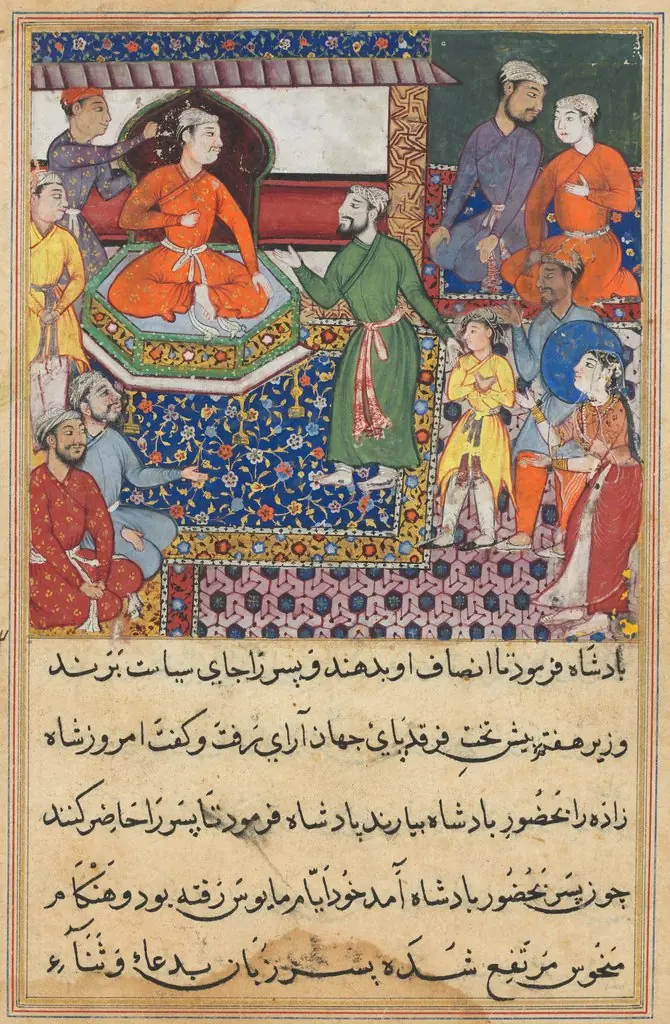 The handmaiden again pleads for the death of the prince, from a Tuti-nama (Tales of a Parrot): Eighth Night
 The handmaiden again pleads for the death of the prince, from a Tuti-nama (Tales of a Parrot): Eighth Night
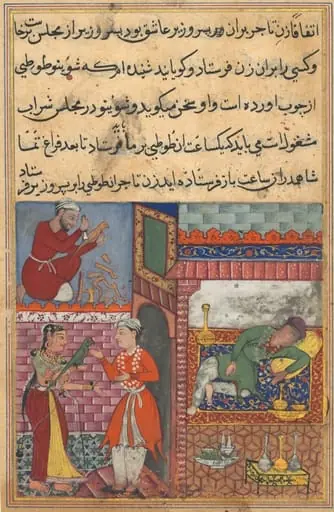 The vizier’s son receives the magic wooden parrot from the wife of the merchant, who is drunk, and has a replica made by a carpenter, from a Tuti-nama (Tales of a Parrot): Tenth Night
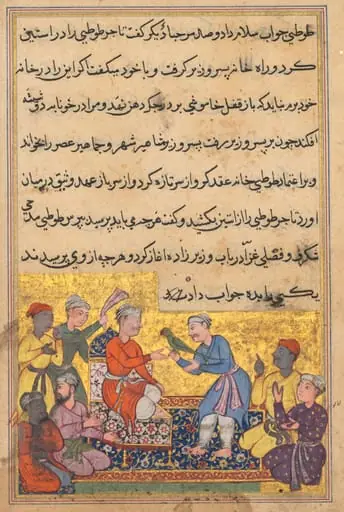 The magic parrot of the merchant talks to the vizier’s son, from a Tuti-nama (Tales of a Parrot): Tenth Night
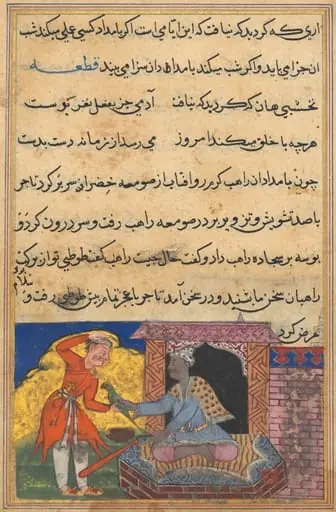 The monk returns the magic parrot to its rightful owner, the merchant, from a Tuti-nama (Tales of a Parrot): Tenth Night
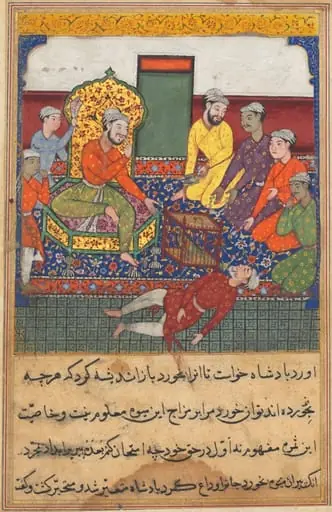 The old man eats of the fruit of the Tree of Life, but drops dead, from a Tuti-nama (Tales of a Parrot): Ninth Night
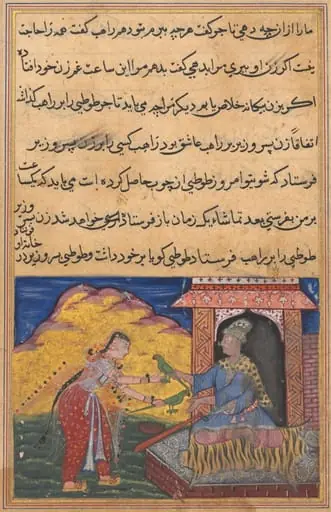 The wife of the son of the vizier brings the magic wooden parrot to her lover, the monk, who exchanges it for the replica, from a Tuti-nama (Tales of a Parrot): Tenth Night
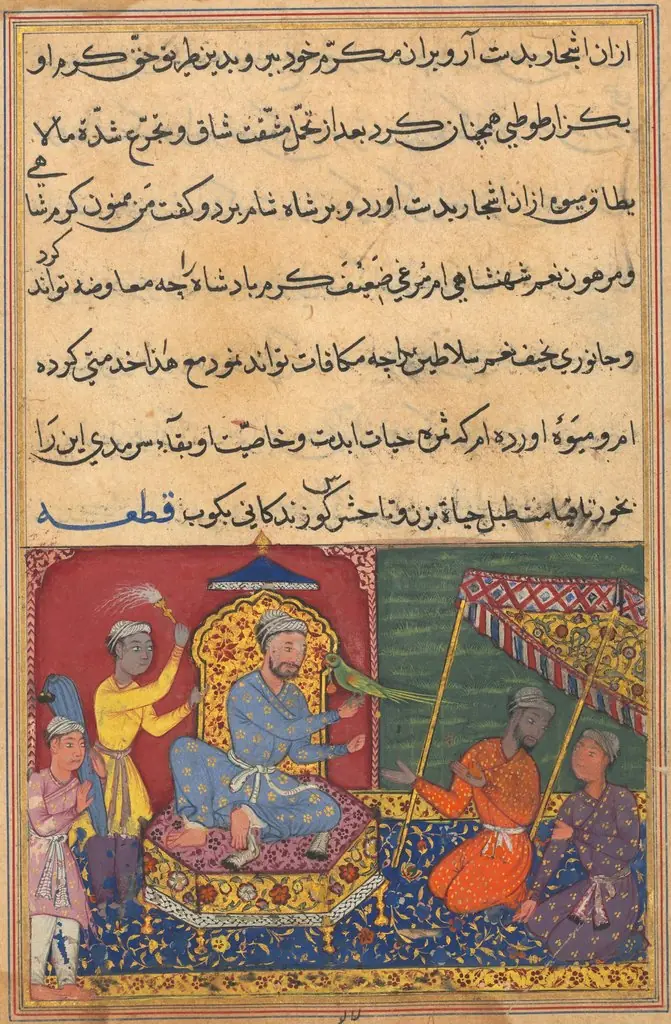 The parrot brings a fruit from the Tree of Life to the king of Syria, from a Tuti-nama (Tales of a Parrot): Ninth Night
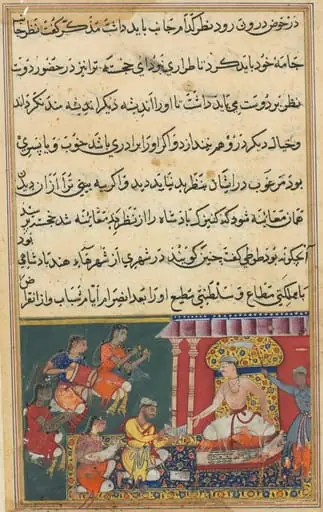 The astrologer predicts a calamity for the newly born prince in his thirteenth year, but one which he would be able to overcome, from a Tuti-nama (Tales of a Parrot): Eighth Night
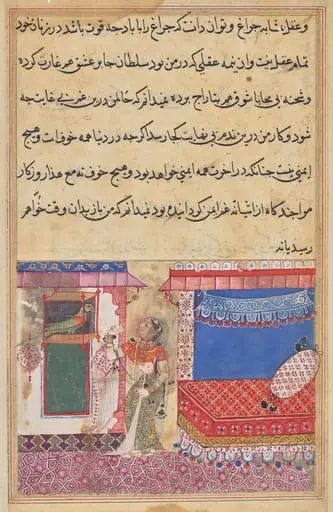 The Parrot Addresses Khujasta at the Beginning of the Eighteenth Night, from a Tuti-nama (Tales of a Parrot)
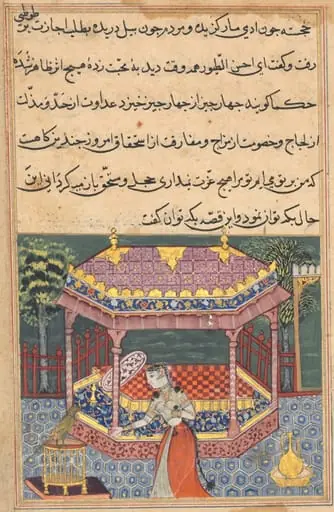 The parrot addresses Khujasta at the beginning of the thirty-seventh night, from a Tuti-nama (Tales of a Parrot)
 The bird of seven colors brings a sable to the pious man, from a Tuti-nama (Tales of a Parrot): Fifty-second Night