Artwork
View of the Quadrant: the Main Door, the Square, the Church and the Loggia of the Monastery of the Monte della Vernia (Prospettiva dell'ingresso della prima porta, con la Piazza, Chiesa, & Loggie del Monastero del Monte della Vernia, come sta quest'Anno MDCXII) [plate D]
![View of the Quadrant: the Main Door, the Square, the Church and the Loggia of the Monastery of the Monte della Vernia (Prospettiva dell'ingresso della prima porta, con la Piazza, Chiesa, & Loggie del Monastero del Monte della Vernia, come sta quest'Anno MDCXII) [plate D], by Jacopo Ligozzi, ink, 1612](https://artifactworldgallery.com/img/jacopo-ligozzi--view-of-the-quadrant-the-main-door-the-square-the-church-and--5e02c68b32f38e19-w1024.webp)
View of the Quadrant: the Main Door, the Square, the Church and the Loggia of the Monastery of the Monte della Vernia (Prospettiva dell'ingresso della prima porta, con la Piazza, Chiesa, & Loggie del Monastero del Monte della Vernia, come sta quest'Anno MDCXII) [plate D] is an ink print by the Baroque artist Jacopo Ligozzi. It dates from 1612 and is held in the collection of the National Gallery of Art.
About this work
Overview
The work reflects Ligozzi’s skill in translating three-dimensional spaces into intricate linear compositions, characteristic of late Mannerist draftsmanship.
Created in 1612, this engraved print by Jacopo Ligozzi presents a vertical composite view of the Monte della Vernia monastery complex. Composed of two joined sheets, it captures the entrance, courtyard, church, and surrounding loggia with precise architectural detail. The work reflects Ligozzi’s skill in translating three-dimensional spaces into intricate linear compositions, characteristic of late Mannerist draftsmanship.
Subject & Meaning
The scene depicts the monastery’s functional and spiritual heart: the main gate, open courtyard, and ecclesiastical buildings framed by arched colonnades. Figures—riders, laborers, and seated individuals—animate the space, suggesting daily monastic life. The inclusion of a small stage implies ritual or communal activity, reinforcing the site’s role as both religious center and social hub.
Technique & Style
Ligozzi employed fine cross-hatching to model surfaces, rendering brickwork, foliage, and stone with layered lines that suggest texture and depth. The composition is tightly controlled, with perspective drawn toward the church’s tower, guiding the viewer’s eye upward. The precision of line work reveals his background in illustration and miniature painting, prioritizing clarity over dramatic effect.
History & Provenance
The print was produced during Ligozzi’s tenure at the Medici court, where he documented architectural and natural subjects for scholarly and devotional purposes. Its date, MDCXII, anchors it to a specific year of monastic activity. Though no early ownership records are widely documented, its technical quality suggests it was made for a learned or ecclesiastical audience rather than mass circulation.
Context
In early 17th-century Tuscany, monastic sites like Monte della Vernia were both pilgrimage destinations and centers of regional administration. Ligozzi’s depiction aligns with a broader trend of topographical recording favored by patrons interested in geography, religious heritage, and cartographic precision, blending observation with orderly representation.
Legacy
This engraving remains a rare visual record of the monastery’s appearance in the early 1600s. Its meticulous detail has aided architectural historians in reconstructing the site’s original layout. While not widely reproduced, it exemplifies the intersection of art, documentation, and religious topography in late Renaissance Italy.
Artist & collection
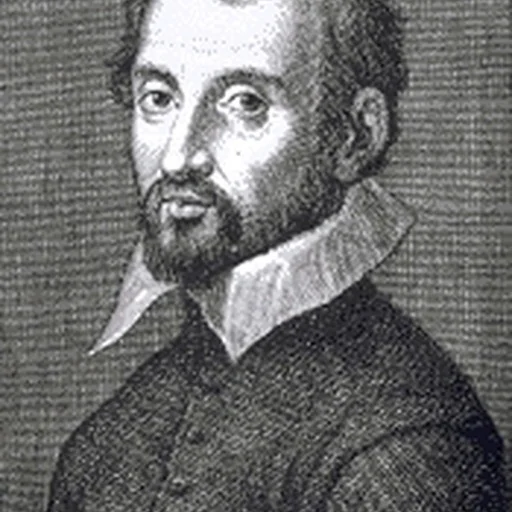
Artist
Jacopo Ligozzi (1547–1627) was an Italian painter, illustrator, designer, and miniaturist. His art can be categorized as late-Renaissance and Mannerist styles.


![Chapel of Saint Sebastian (Cappella di San Sebastiano) [plate N], by Jacopo Ligozzi](https://artifactworldgallery.com/img/jacopo-ligozzi--chapel-of-saint-sebastian-cappella-di-san-sebastiano-plate-n--144b97ba4a91d67b-w320.webp)
![Church of the Stigmata (Chiesa delle Stimmate) [plate M], by Jacopo Ligozzi](https://artifactworldgallery.com/img/jacopo-ligozzi--church-of-the-stigmata-chiesa-delle-stimmate-plate-m--255dd75981bd30e3-w320.webp)
 A Street with Various Buildings, Colonnades and an Arch
 The Roman Capitol
 Italian Buildings on a Hillside
 Elevation of Churches including the Holy Manger
 Architectural Fantasy with a Fountain, Classical Ruins, and a Bridge
 Eighteen Views of Rome: The Trevi Fountain
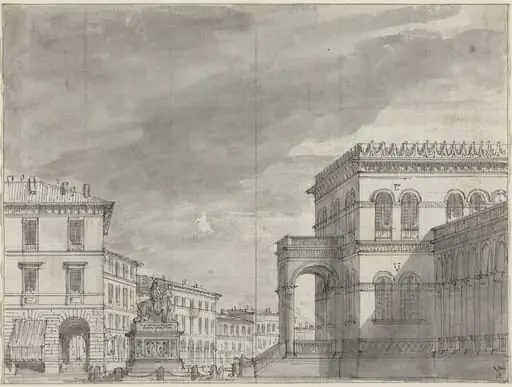 Piazza with an Equestrian Monument and a Palace
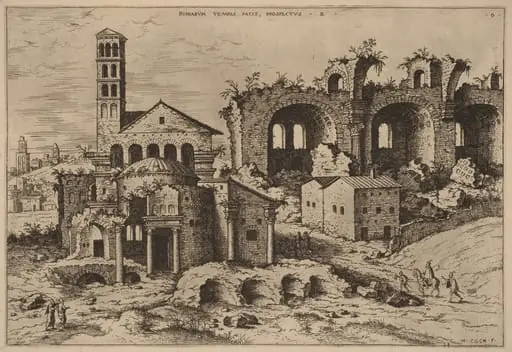 The Temple of Augustus and Faustina, the Temple of Divus Romulus, and the Basilica of Constantine
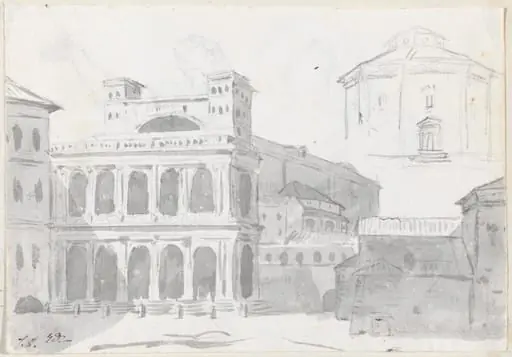 San Giovanni Laterano and a Baptistry
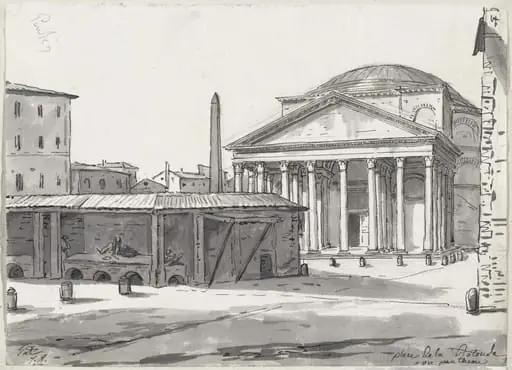 The Pantheon Seen from the Piazza
 Roman Rooftops
 Elevation of a Church