Artwork
An Indigo Factory, Allahabad
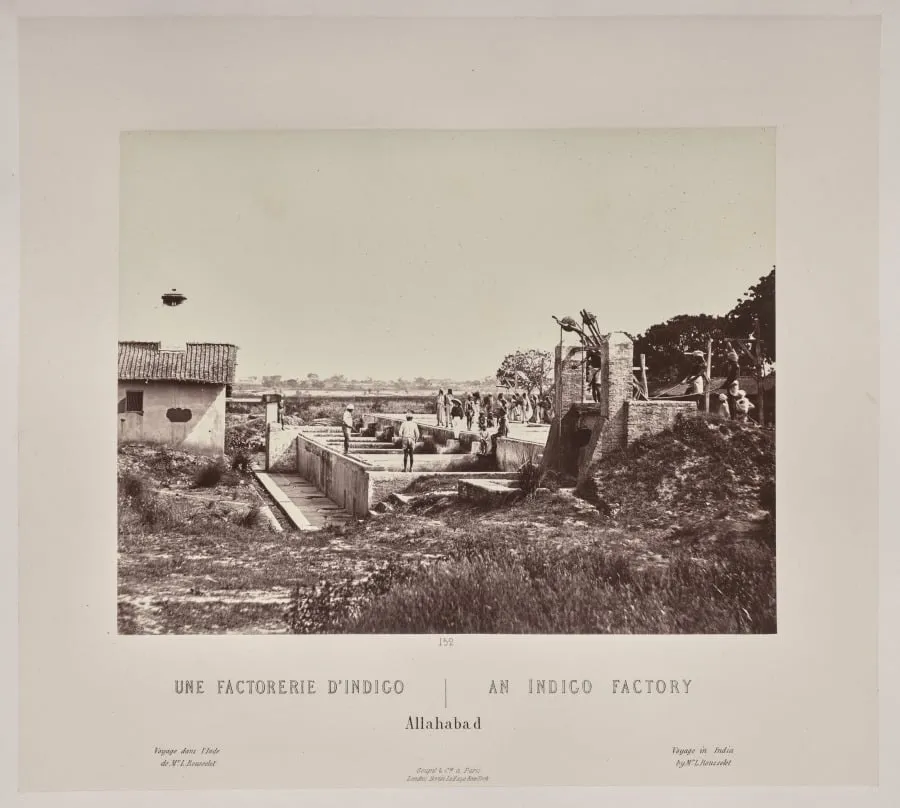
An Indigo Factory, Allahabad is a photography by the Impressionist artist Louis-Théophile Marie Rousselet. It dates from 1866 and is held in the collection of the Cleveland Museum of Art. Taken in the 1860s during Louis-Théophile Rousselet’s travels in India, this photograph captures an indigo factory in Allahabad.
About this work
You see a busy indigo factory in India, with workers in white clothes stirring huge vats of deep blue dye.
You see a busy indigo factory in India, with workers in white clothes stirring huge vats of deep blue dye.
Rousselet drew this while traveling through India in the 1860s. He wanted his sketches to show the real look of the place, so he taught himself photography there. The factory feels alive—steam rises, hands move, the dye stains everything.
To see how photography changed travel art, look up *Louis-Théophile Marie Rousselet (French, 1845–1929)*.
Overview
Taken in the 1860s during Louis-Théophile Rousselet’s travels in India, this photograph captures an indigo factory in Allahabad. Rousselet, initially a sketch artist, turned to photography to more accurately document India’s landscapes and labor. The image reflects his technical adaptation to the medium and his desire to move beyond idealized drawings toward direct visual record.
Subject & Meaning
The photograph depicts laborers in white garments tending large vats of indigo dye, their movements suggesting rhythmic, repetitive work. Steam rises from the vats, and the deep blue pigment stains surfaces and clothing, emphasizing the physicality of production. The scene presents industry not as exotic spectacle but as embedded daily practice, grounding colonial-era economic activity in human labor.
Technique & Style
Rousselet employed wet-plate collodion photography, a demanding process requiring on-site preparation of glass plates. His composition balances detail and atmosphere: the workers are framed within the industrial architecture, with light and smoke guiding the viewer’s eye. The image’s clarity and tonal range reflect his growing mastery, avoiding romanticization in favor of observational precision.
History & Provenance
The photograph was made during Rousselet’s extended journey across northern India, commissioned by French institutions seeking ethnographic documentation. It later appeared in his 1875 publication, which compiled images of monuments, rulers, and industrial sites. The original plates remain in private and institutional collections, with this image among the few surviving records of pre-industrial dye production in the region.
Context
In the 1860s, indigo cultivation and processing were central to British colonial economics in India, often tied to coercive labor systems. While Rousselet did not explicitly critique these conditions, his focus on the factory’s operational reality offers a rare visual record of production outside the colonial elite’s gaze—contrasting with the more common depictions of palaces and temples.
Legacy
Rousselet’s photographic work helped shift European perceptions of India from picturesque fantasy to documented complexity. His indigo factory image stands as an early example of industrial ethnography in colonial photography, influencing later documentary approaches. It remains a reference point for studies on labor, material culture, and the role of photography in colonial knowledge production.
Artist & collection
Artist
Louis-Théophile Marie Rousselet
Louis-Théophile Marie Rousselet (1845–1929) was a French artist.