Artwork
Alliance de l'Allemagne et de l'Espagne avec la Hollande 1672 Cintre de la Gallerie du côté du Salon de la Guerre (Alliance of Germany and Spain with Holland 1672, Center of the Gallery next to the Salon of War) [pl. 31]
![Alliance de l'Allemagne et de l'Espagne avec la Hollande 1672 Cintre de la Gallerie du côté du Salon de la Guerre (Alliance of Germany and Spain with Holland 1672, Center of the Gallery next to the Salon of War) [pl. 31], by Jean-Baptiste Massé, ink, 1752](https://artifactworldgallery.com/img/jean-baptiste-masse--alliance-de-l-allemagne-et-de-l-espagne-avec-la-hollande-167--4b670ecaa7c4c5d8-w1024.webp)
Alliance de l'Allemagne et de l'Espagne avec la Hollande 1672 Cintre de la Gallerie du côté du Salon de la Guerre (Alliance of Germany and Spain with Holland 1672, Center of the Gallery next to the Salon of War) [pl. 31] is an ink print by the Romanticist artist Jean-Baptiste Massé. It dates from 1752 and is held in the collection of the National Gallery of Art. Jean‑Baptiste Massé’s 1752 engraving, executed on laid paper, captures a seventeenth‑century diplomatic episode.
About this work
On the left, soldiers in armor fight with weapons, while on the right, a woman in flowing robes stands on a raised platform, reaching toward them.
This print shows a dramatic scene with two groups of people in the middle of action. On the left, soldiers in armor fight with weapons, while on the right, a woman in flowing robes stands on a raised platform, reaching toward them. The background has a grand staircase and a canopy, with more figures in the distance.
Notice the text at the bottom—it’s French and names a 1672 alliance between Germany, Spain, and Holland. This isn’t just a battle; it’s a historical moment turned into art.
If this style of storytelling in art interests you, look up engraving.
Overview
Jean‑Baptiste Massé’s 1752 engraving, executed on laid paper, captures a seventeenth‑century diplomatic episode. The image occupies a central position in a gallery scene that adjoins the Salon of War, illustrating the 1672 alliance among the German states, Spain and the Dutch Republic.
Subject & Meaning
The composition juxtaposes two contrasting groups: on the left, armored soldiers engaged in combat, while on the right a robed woman stands on an elevated platform, extending a gesture toward the fighters. The tableau suggests a narrative of political union expressed through martial and ceremonial elements, emphasizing the cooperative intent of the treaty.
Technique & Style
Massé employed fine line engraving to render intricate details of armor, fabric, and architectural background. The use of laid paper provides a subtle texture that enhances the depth of the stairwell and canopy, while the balanced distribution of figures reflects the orderly aesthetic typical of mid‑eighteenth‑century French printmaking.
History & Provenance
The print forms part of the *Galerie de Versailles* series, a collection of historical paintings reproduced as engravings between 1732 and 1753. Massé, known for his work at the court of Louis XV, contributed this piece to the project, which aimed to disseminate images of French royal history and diplomatic achievements.
Context
Created during a period when French art served both decorative and didactic purposes, the engraving aligns with contemporary efforts to memorialize past alliances that reinforced France’s political narrative. Its placement beside the Salon of War underscores the connection between military prowess and diplomatic strategy.
Artist & collection
Artist
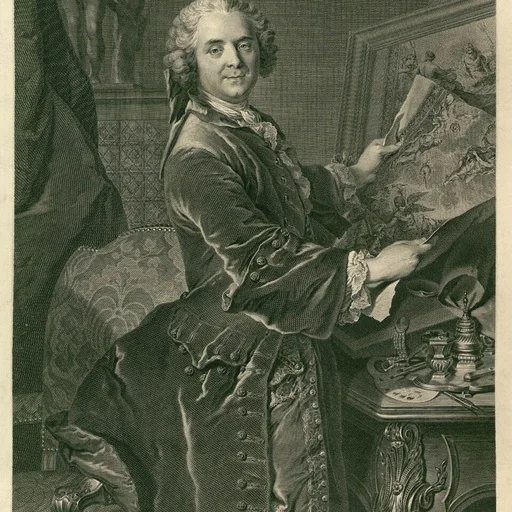
Jean-Baptiste Massé (29 December 1687, in Paris – 26 September 1767, in Paris) was a French miniature painter, engraver, and draftsman, best remembered as the court painter of Louis XV, for training Jean-Étienne Liotard…

 Pierre Louis Dubus (1721–1799), Called Préville, of the Comédie-Française
![Protection accordée aux beaux-arts 1663 (Protection Granted to the Fine Arts 1663) [pl. 24], by Jean-Baptiste Massé](https://artifactworldgallery.com/img/jean-baptiste-masse--protection-accordee-aux-beaux-arts-1663-protection-granted-t--045f3db9c3e49b51-w320.webp) Protection accordée aux beaux-arts 1663 (Protection Granted to the Fine Arts 1663) [pl. 24]
Protection accordée aux beaux-arts 1663 (Protection Granted to the Fine Arts 1663) [pl. 24]![Coupole du Salon de la Paix (Cupola of the Salon of Peace) [pl. 44], by Jean-Baptiste Massé](https://artifactworldgallery.com/img/jean-baptiste-masse--coupole-du-salon-de-la-paix-cupola-of-the-salon-of-peace-pl--083dda9da8b00531-w320.webp) Coupole du Salon de la Paix (Cupola of the Salon of Peace) [pl. 44]
Coupole du Salon de la Paix (Cupola of the Salon of Peace) [pl. 44]![La Prééminence de la France reconnue par l'Espagne 1662 (The Preeminance of France Recognized by Spain 1662) [pl. 17], by Jean-Baptiste Massé](https://artifactworldgallery.com/img/jean-baptiste-masse--la-preeminence-de-la-france-reconnue-par-l-espagne-1662-the--0865c0d8271fc4b5-w320.webp) La Prééminence de la France reconnue par l'Espagne 1662 (The Preeminance of France Recognized by Spain 1662) [pl. 17]
La Prééminence de la France reconnue par l'Espagne 1662 (The Preeminance of France Recognized by Spain 1662) [pl. 17]![L'Allemagne Cintre du Salon de la Guerre du côté des appartemens du Roi (Germany, Center of the Salon of War next to the King's Chambers) [pl. 37], by Jean-Baptiste Massé](https://artifactworldgallery.com/img/jean-baptiste-masse--l-allemagne-cintre-du-salon-de-la-guerre-du-cote-des-apparte--107e6bb2bd4fa1ce-w320.webp) L'Allemagne Cintre du Salon de la Guerre du côté des appartemens du Roi (Germany, Center of the Salon of War next to the King's Chambers) [pl. 37]
L'Allemagne Cintre du Salon de la Guerre du côté des appartemens du Roi (Germany, Center of the Salon of War next to the King's Chambers) [pl. 37]![L'Espagne Cintre du Salon de la Paix sur l'Arcade de la Galerie (Spain, Center of the Salon of Peace in the Gallery's Arcade) [pl. 47], by Jean-Baptiste Massé](https://artifactworldgallery.com/img/jean-baptiste-masse--l-espagne-cintre-du-salon-de-la-paix-sur-l-arcade-de-la-gale--1780f995882c221b-w320.webp) L'Espagne Cintre du Salon de la Paix sur l'Arcade de la Galerie (Spain, Center of the Salon of Peace in the Gallery's Arcade) [pl. 47]
L'Espagne Cintre du Salon de la Paix sur l'Arcade de la Galerie (Spain, Center of the Salon of Peace in the Gallery's Arcade) [pl. 47]![Coupole du Salon de la Guerre (Cupola of the Salon of War) [pl. 35], by Jean-Baptiste Massé](https://artifactworldgallery.com/img/jean-baptiste-masse--coupole-du-salon-de-la-guerre-cupola-of-the-salon-of-war-pl--2b9793f18c09c4bc-w320.webp) Coupole du Salon de la Guerre (Cupola of the Salon of War) [pl. 35]
Coupole du Salon de la Guerre (Cupola of the Salon of War) [pl. 35]![L'Europe Chrêtienne en Paix Cintre du Salon de la Paix du côté des appartemens de la Reine (Christian Europe in Peace, Center of the Salon of Peace next to the Queen's Chambers) [pl. 45], by Jean-Baptiste Massé](https://artifactworldgallery.com/img/jean-baptiste-masse--l-europe-chretienne-en-paix-cintre-du-salon-de-la-paix-du-co--42b41626259ce77e-w320.webp) L'Europe Chrêtienne en Paix Cintre du Salon de la Paix du côté des appartemens de la Reine (Christian Europe in Peace, Center of the Salon of Peace next to the Queen's Chambers) [pl. 45]
L'Europe Chrêtienne en Paix Cintre du Salon de la Paix du côté des appartemens de la Reine (Christian Europe in Peace, Center of the Salon of Peace next to the Queen's Chambers) [pl. 45]
 The Prima Macchina for the Chinea of 1741: Allegory of Regal Magnificence
 The Prima Macchina for the Chinea of 1742: The Contest of Neptune and Minerva
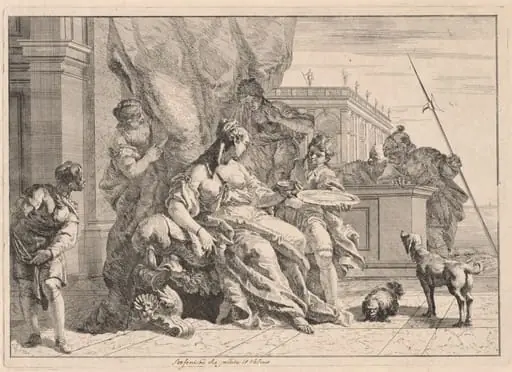 Sofonisba (or Artemisia)
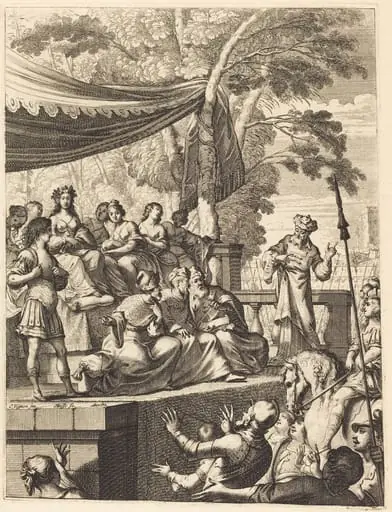 Illustration to Jean Desmarets' "L'Ariane"
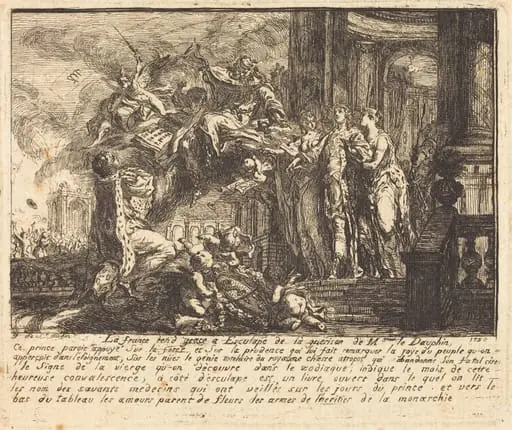 Allegory of the Dauphin's Convalescence (Allegorie sur la convalescence du Dauphin)
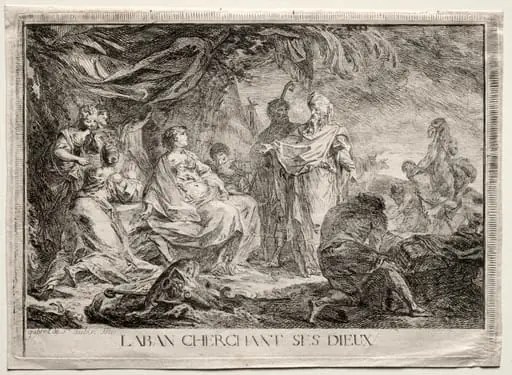 Laban Searching for His Household Gods
 Frontispiece: Aidé de la sagesse, on se sauve de l'amour dans les bras de la raison
 Paul before Félix (Large Plate)