Artwork
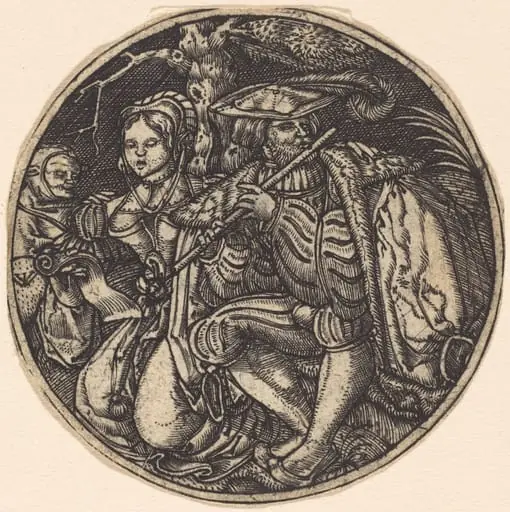
Bagpipe Player with His Lover
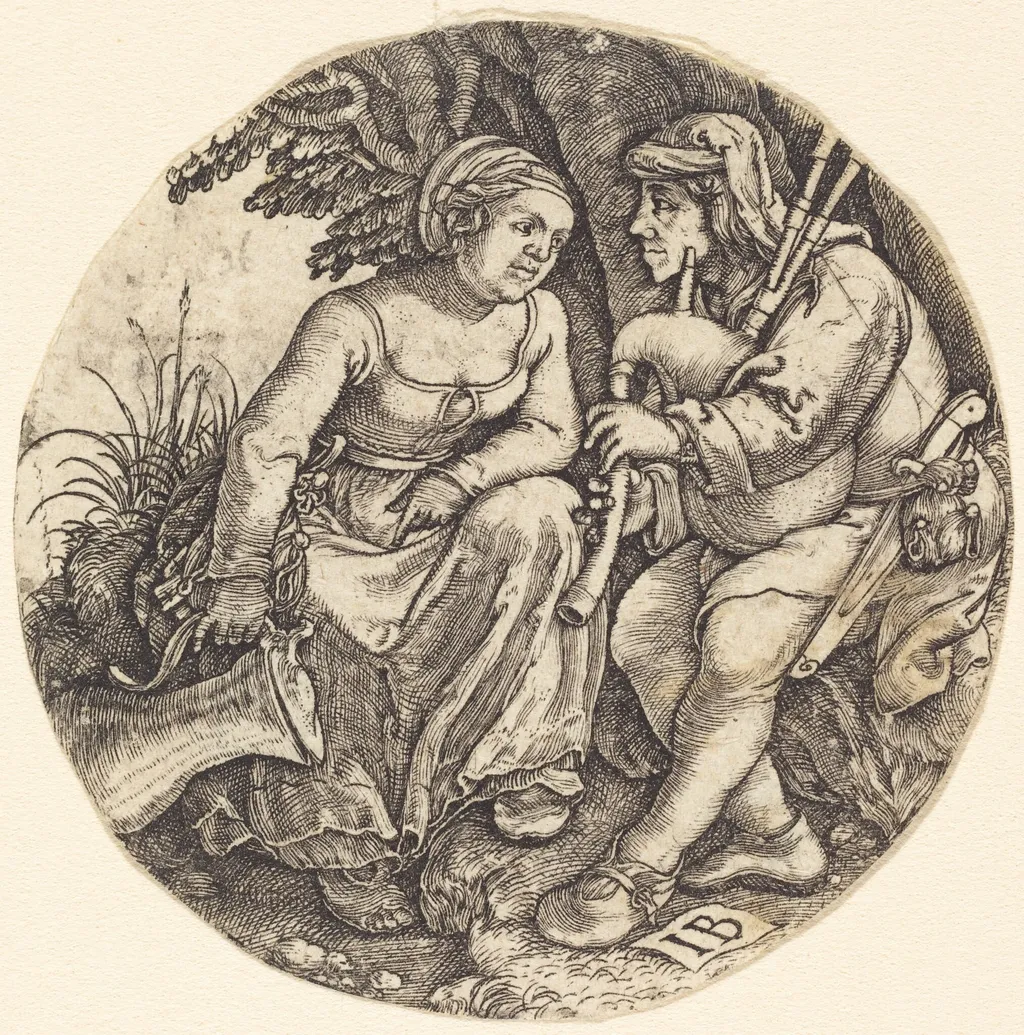
Bagpipe Player with His Lover is an ink print by the Renaissance artist Master IB. It dates from 1516 and is held in the collection of the National Gallery of Art.
About this work
Overview
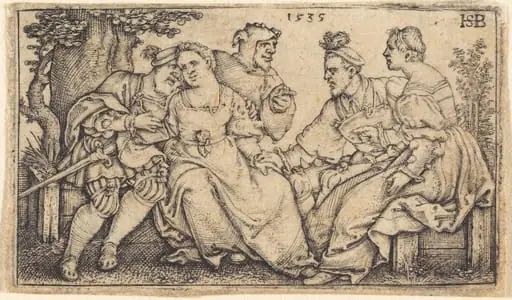
Created in 1516, this black-and-white engraving by Master IB depicts a solitary moment between two figures in a natural setting.
Created in 1516, this black-and-white engraving by Master IB depicts a solitary moment between two figures in a natural setting. Rendered with fine, precise lines, the scene captures a quiet intimacy without overt narrative. The use of cross-hatching to model form and atmosphere reflects the technical sophistication of early 16th-century printmaking, emphasizing texture and spatial depth through tonal variation rather than color.
Subject & Meaning
A figure on the left plays a bagpipe while cradling a small dog; beside them, another person, cloaked and staffed, holds a bird and leans inward. Their expressions are subdued, suggesting contemplation rather than celebration. The pairing of musical instrument, animal, and bird may imply themes of companionship, domesticity, or rural life, though no explicit symbolism is confirmed. The closeness of their posture conveys a silent, unspoken bond.
Technique & Style
The artist employs meticulous cross-hatching to build volume and shadow, giving the figures and foliage a tactile, three-dimensional presence. Fine, interwoven lines define the folds of clothing, the texture of fur, and the density of the woodland backdrop. The absence of color and the reliance on line alone reflect the conventions of Northern European engraving, where precision and detail were valued over dramatic contrast or embellishment.
History & Provenance
Attributed to Master IB, an anonymous printmaker active in the early 1500s, the work is one of several engravings linked to a small circle of Northern artists. No documented ownership history exists prior to modern collections, and the artist’s identity remains uncertain. The print likely circulated among educated patrons who appreciated refined graphic art, though its original purpose—decorative, devotional, or illustrative—is unknown.
Context
Produced during the Northern Renaissance, the engraving reflects a growing interest in intimate, secular scenes alongside religious and mythological subjects. Artists increasingly turned to everyday life, capturing quiet moments with psychological nuance. The detailed natural setting aligns with contemporary trends in landscape depiction, while the focus on two individuals suggests a shift toward personal, rather than public, themes in visual culture.
Legacy
Though not widely known today, this engraving exemplifies the quiet mastery of early printmakers who used line to evoke emotion and atmosphere. It contributes to the broader understanding of how non-elite subjects were rendered with dignity in Renaissance graphic arts. Its preservation in institutional collections underscores its value as a document of technical skill and subtle human observation from a period often dominated by grander narratives.
Artist & collection