Artwork
Marcus Curtius
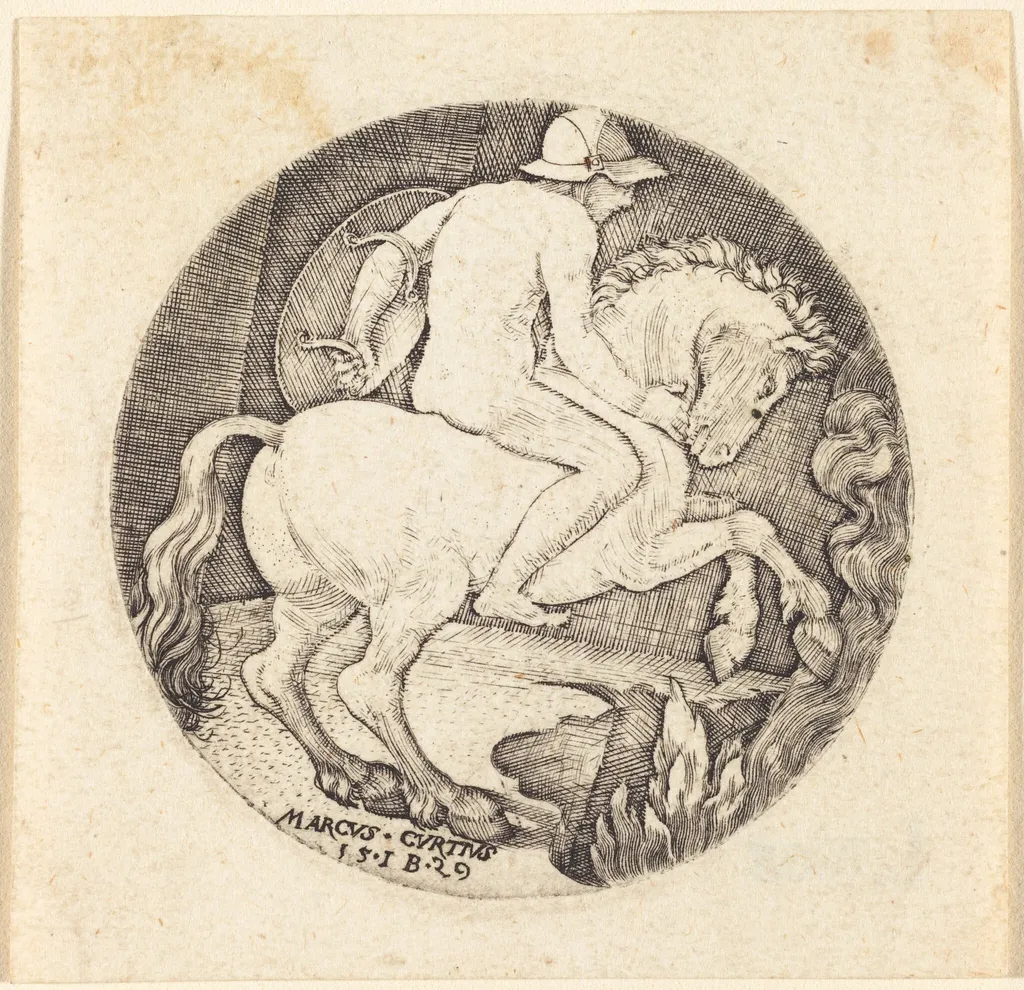
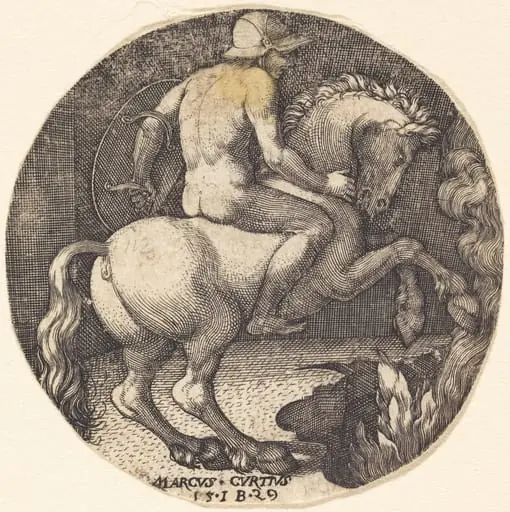
Marcus Curtius is an ink print by the Renaissance artist Master IB. It dates from 1529 and is held in the collection of the National Gallery of Art.
About this work
This black-and-white engraving shows a man in a wide-brimmed hat, holding a baby in one arm and a scroll in the other.
This black-and-white engraving shows a man in a wide-brimmed hat, holding a baby in one arm and a scroll in the other. His face is serious, and his curly hair and beard are drawn with tight lines. The background is mostly empty, with a few faint shapes that look like a building or curtain behind him.
The artist used small, repeated lines to build up shadows and textures—this is called cross-hatching. The signature at the bottom reads *Master IB 1529*, showing this was made over 500 years ago.
Try looking up cross-hatching to see how this technique works in other prints.
Overview
Created in 1529, the black‑and‑white print titled Marcus Curtius is attributed to an anonymous artist known only as Master IB. Executed as an engraving, the work presents a solitary figure rendered in fine line work, set against a largely unadorned background. The composition is signed at the lower edge, confirming both the maker’s moniker and the date of production.
Subject & Meaning
The central figure is a man wearing a broad‑brimmed hat, his expression solemn, his curly hair and beard delineated with tight incisions. He cradles an infant in one arm while clutching a scroll in the other, suggesting a narrative of guardianship or scholarly duty. The sparse setting leaves the viewer to focus on the symbolic juxtaposition of youth and learning.
Technique & Style
Master IB employs dense cross‑hatching, a method of overlapping parallel lines, to generate tonal variation and texture across the figure’s clothing, hair, and facial features. This repetitive line work creates subtle shadows that model the form without the use of tonal washes, characteristic of early 16th‑century Northern European engraving practices.
History & Provenance
The engraving bears the inscription *Master IB 1529* at its base, anchoring it firmly in the early Renaissance period. No further documentation of ownership or exhibition history is recorded, and the work remains attributed solely to the enigmatic Master IB, whose identity continues to be a subject of scholarly speculation.
Artist & collection


![Statue of Alexander and Bucephalus [recto], by Hubert Robert](https://artifactworldgallery.com/img/hubert-robert--statue-of-alexander-and-bucephalus-recto--d9a688cc8df08f18-w320.webp)