Artwork
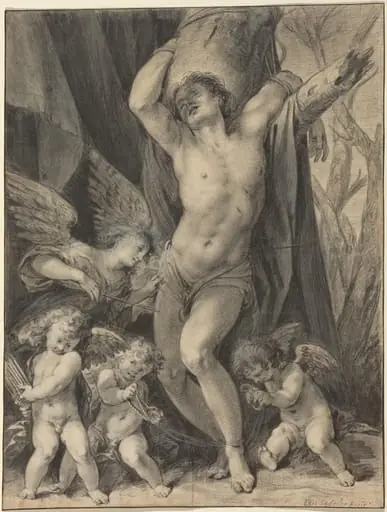
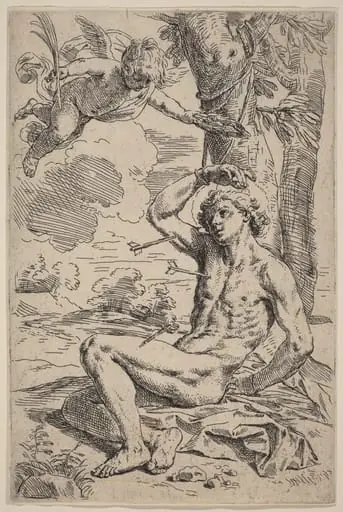
The Martyrdom of Saint Sebastian
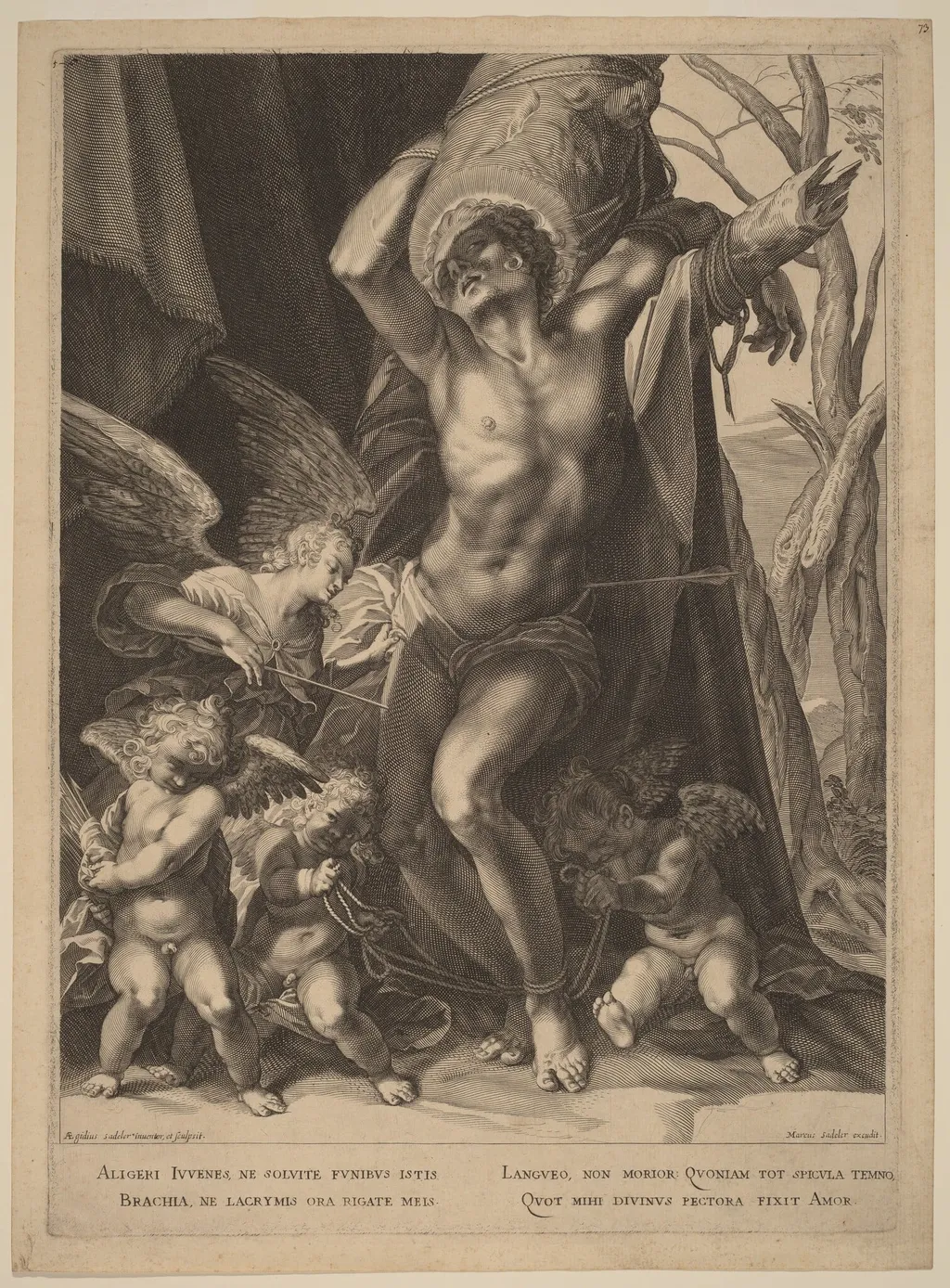
The Martyrdom of Saint Sebastian is an ink print by the Baroque artist Aegidius Sadeler II. It dates from 1620 and is held in the collection of the National Gallery of Art.
About this work
Overview
Sadeler, a Flemish artist working in Prague under the Habsburg court, specialized in reproductive prints that circulated religious imagery across Europe.
Created around 1620 by Aegidius Sadeler II, this engraving on laid paper depicts the execution of Saint Sebastian, a Christian martyr. Sadeler, a Flemish artist working in Prague under the Habsburg court, specialized in reproductive prints that circulated religious imagery across Europe. The work is part of a broader tradition of devotional prints produced during the early Baroque period, intended for private contemplation and spiritual instruction.
Subject & Meaning
The scene portrays Saint Sebastian bound to a tree, his body pierced by multiple arrows, a traditional representation of his martyrdom. Surrounding him are small, winged figures—angels or souls—some weeping, others holding instruments of his torture. Their presence underscores the sacred nature of his suffering, framing his death not merely as violence but as a moment of divine witness and spiritual transcendence within Catholic devotional practice.
Technique & Style
Sadeler employed fine, precise lines to carve intricate details into a metal plate, transferring the image onto damp laid paper through pressure. The composition uses deep chiaroscuro to heighten emotional intensity: shadows cling to the tree’s bark and the saint’s musculature, while the clustered figures are rendered with delicate, almost fragile strokes. The contrast between the robust human form and the ethereal, diminutive angels creates a tension between earthly agony and celestial presence.
History & Provenance
The print was made during Sadeler’s tenure at the imperial court in Prague, where he reproduced works by leading painters for a learned, Catholic clientele. As part of a prolific printmaking family, he helped distribute religious imagery across Central Europe. While the specific early ownership of this impression is undocumented, its survival in multiple institutional collections suggests it was widely circulated and preserved as a devotional object.
Context
In the early 17th century, Catholic regions responded to the Reformation by promoting visual narratives of martyrdom to reinforce faith. Engravings like this one served as accessible, reproducible tools for spiritual education. Sadeler’s work aligned with Counter-Reformation ideals, emphasizing the physicality of suffering as evidence of divine grace. The detailed, emotionally charged style reflects the influence of Northern Mannerism and Italianate dramatic composition.
Legacy
Sadeler’s engraving contributed to the standardization of Saint Sebastian’s iconography in print culture. Though later artists would reinterpret the subject with greater naturalism or theatricality, this work exemplifies the precision and emotional restraint characteristic of early Baroque reproductive prints. Its endurance in museum collections attests to its role as a key artifact in the transmission of religious imagery before the rise of mass media.
Artist & collection
Artist
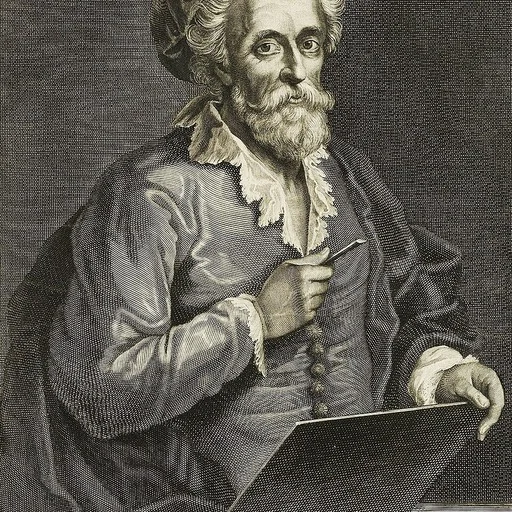
Aegidius Sadeler or Aegidius Sadeler II (1570–1629) was a Flemish engraver who was principally active at the Prague court of Rudolf II, Holy Roman Emperor and his successors.