Artwork
The Lonely Tower
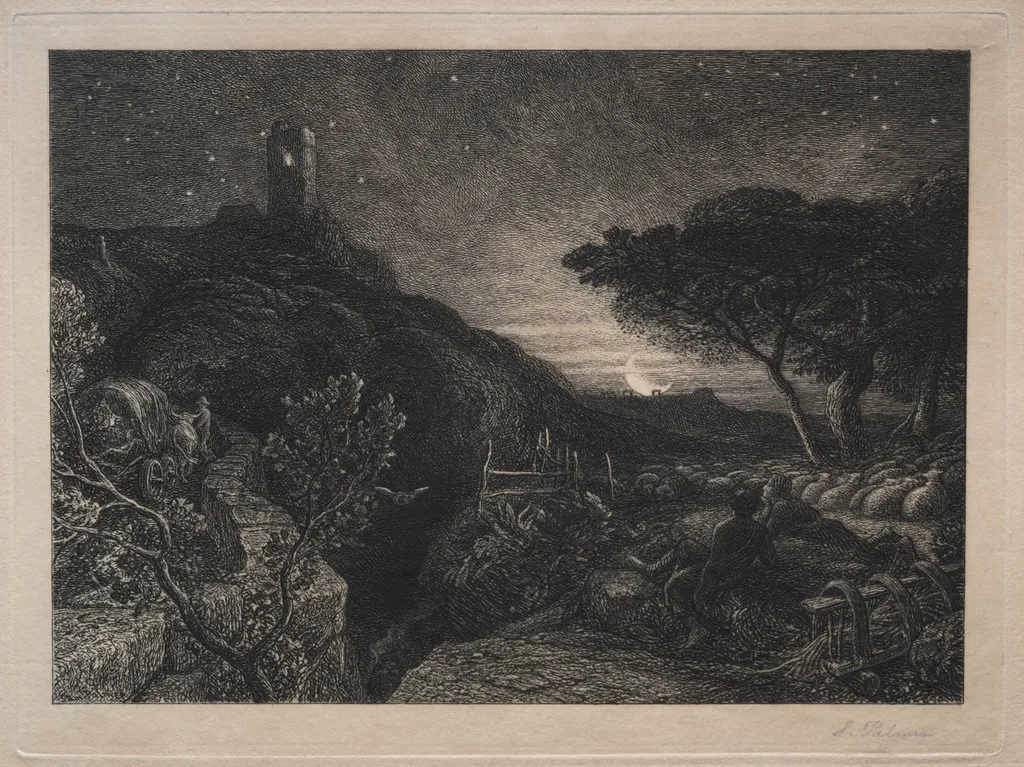
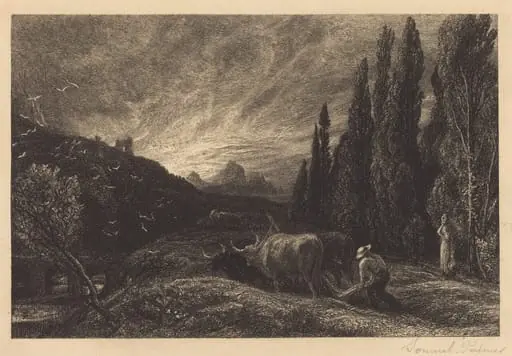
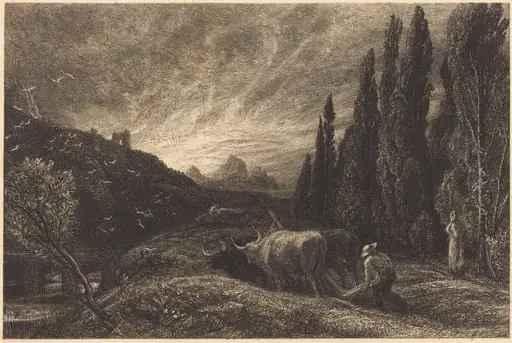
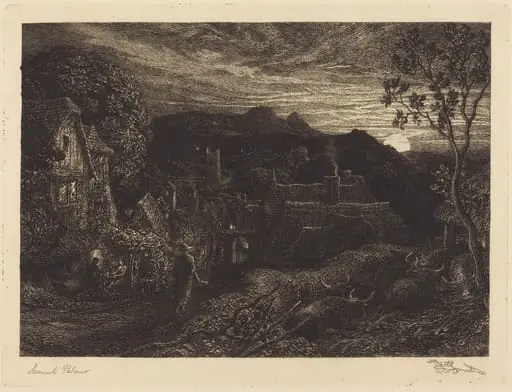
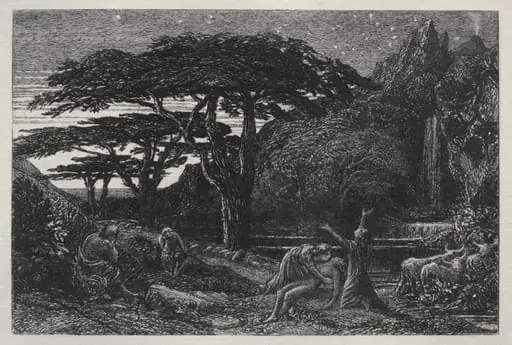
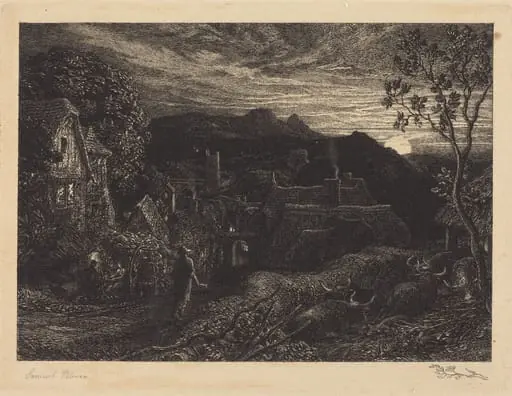
The Lonely Tower is a print by the Impressionist artist Samuel Palmer. It dates from 1879 and is held in the collection of the Cleveland Museum of Art.
About this work
Overview
The print captures a quiet, nocturnal landscape with minimal detail, emphasizing mood over narrative.
Created in 1879, *The Lonely Tower* is a black-and-white etching by British artist Samuel Palmer. It belongs to a late phase of his career, following his earlier visionary works. The print captures a quiet, nocturnal landscape with minimal detail, emphasizing mood over narrative. Palmer’s use of fine lines and tonal contrast defines the scene’s stillness and isolation, reflecting his enduring interest in the spiritual dimensions of nature.
Subject & Meaning
A solitary tower rises on a hill, faintly illuminated from within, surrounded by dense, twisted trees and rocky terrain. A small hut anchors the lower right, while birds glide silently overhead. The absence of human figures and the tower’s ambiguous function invite contemplation. The scene suggests solitude, perhaps spiritual yearning or the persistence of memory in a withdrawn world, consistent with Palmer’s lifelong engagement with mystical pastoralism.
Technique & Style
Palmer employed etching to achieve deep chiaroscuro, using dense ink lines and carefully controlled washes to model shadow and light. The moon’s glow emerges through subtle negative space, while the forest floor is rendered in intricate, tangled strokes. The contrast between the tower’s faint inner light and the surrounding darkness creates a sense of quiet mystery. His technique avoids realism, favoring symbolic form and emotional resonance over topographical accuracy.
History & Provenance
Produced in the final decade of Palmer’s life, *The Lonely Tower* reflects his retreat from public acclaim and return to intimate, personal subjects. It was likely printed in a small edition, typical of his later prints, and circulated among private collectors and fellow artists. The work remained largely outside mainstream exhibitions, preserving its quiet, introspective character away from commercial pressures.
Context
Palmer’s late work emerged after the decline of the Shoreham group, a circle of artists inspired by William Blake. Though Romantic ideals had waned in Victorian art, Palmer continued exploring nature as a vessel for inner experience. *The Lonely Tower* aligns with a broader 19th-century interest in solitude and the sublime, yet resists the grandeur of landscape painting in favor of intimate, nocturnal stillness.
Legacy
Though not widely known during his lifetime, Palmer’s later prints, including *The Lonely Tower*, gained recognition in the 20th century for their emotional depth and technical restraint. They influenced later British printmakers drawn to poetic landscape and symbolic form. The work endures as a quiet testament to an artist who found meaning in isolation, long after the art world had moved on.
Artist & collection
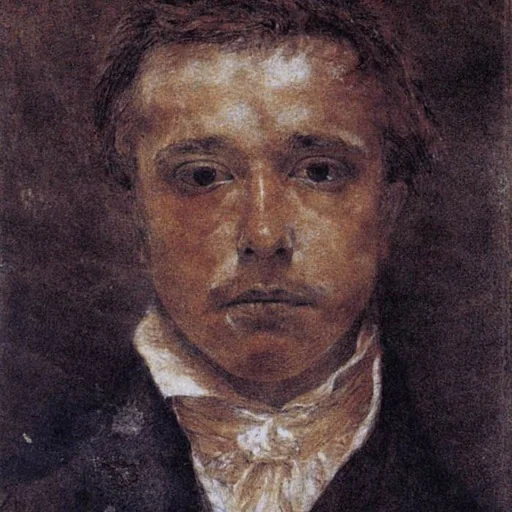
Artist
Samuel Palmer Hon.RE (Hon. Fellow of the Society of Painter-Etchers) (27 January 1805 – 24 May 1881) was a British landscape painter, etcher and printmaker. He was also a prolific writer. Palmer was a key figure in…