Artwork
The Early Ploughman
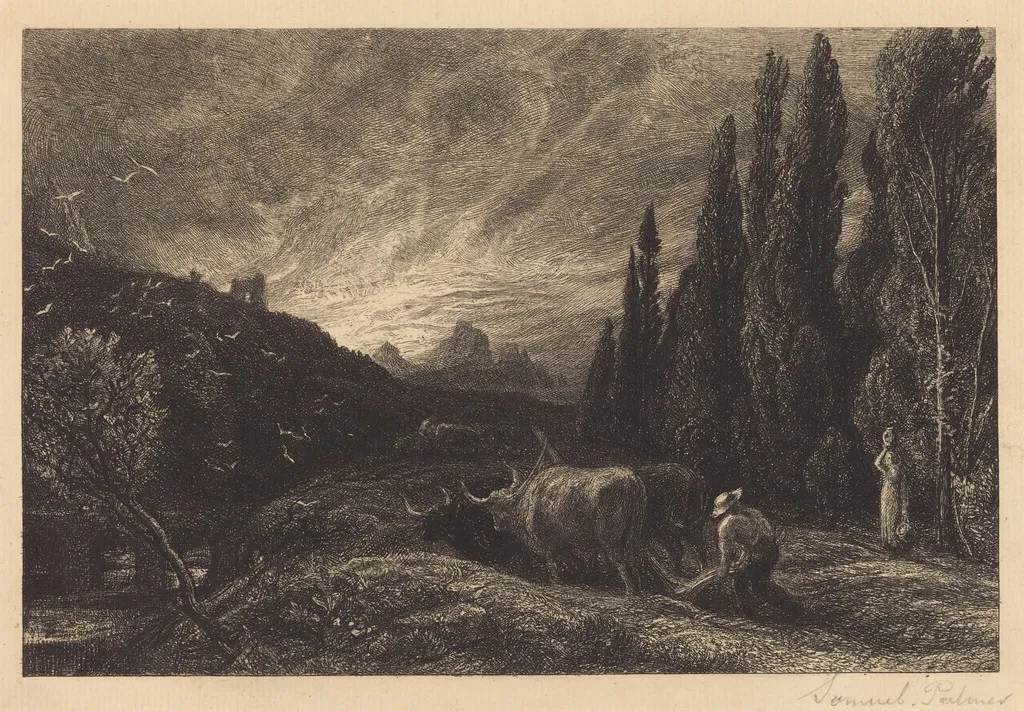
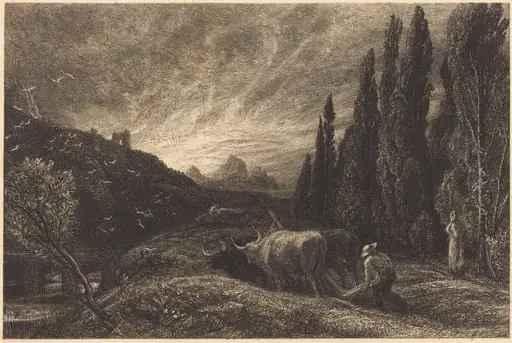
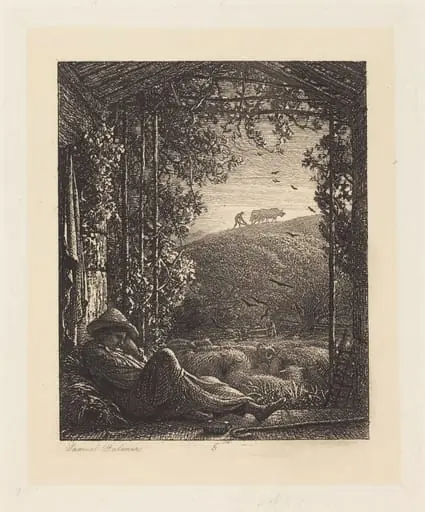
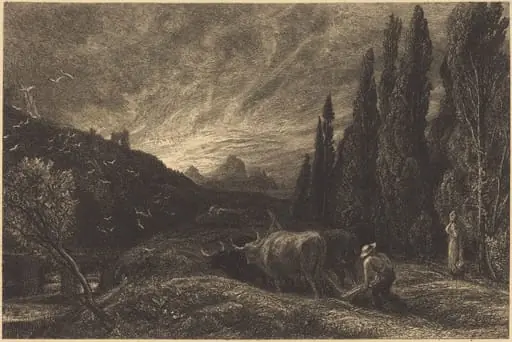
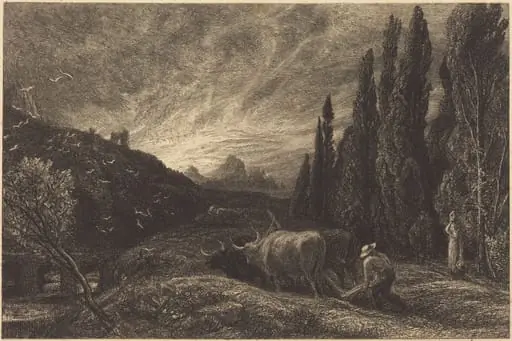
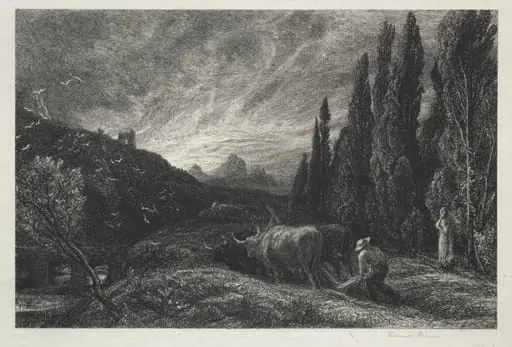
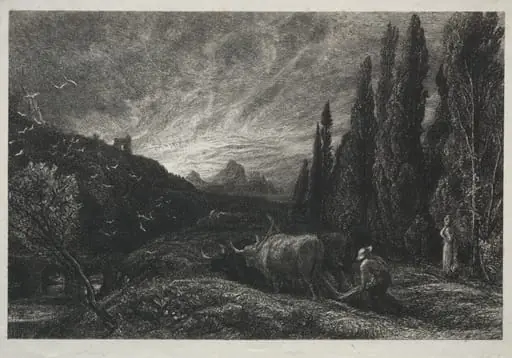
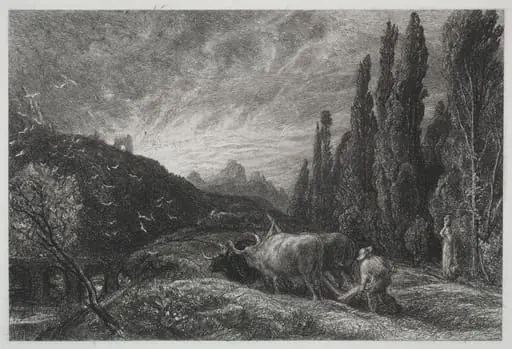
The Early Ploughman is an ink print by the Impressionist artist Samuel Palmer. It dates from 1861 and is held in the collection of the National Gallery of Art.
About this work
Overview
Though produced late in his career, the work continues his lifelong focus on rural England and the quiet rhythms of agricultural life.
Created in 1861, *The Early Ploughman* is an etching on laid paper by the British artist Samuel Palmer. Though produced late in his career, the work continues his lifelong focus on rural England and the quiet rhythms of agricultural life. Unlike his earlier visionary landscapes, this piece grounds its poetic tone in observed reality, using the precision of etching to capture subtle textures and spatial depth.
Subject & Meaning
The print centers on a solitary ploughman at work in a field, his labor harmonized with the surrounding landscape. Rolling hills, scattered trees, and a distant structure frame the scene without intrusion. The presence of birds in flight and the soft modeling of light suggest a moment of stillness amid routine toil. The image conveys dignity in labor, not as idealized myth but as a quiet, enduring facet of rural existence.
Technique & Style
Palmer employed etching to achieve fine gradations of tone and delicate line work, enhancing the texture of soil, foliage, and sky. The use of laid paper, with its subtle watermark and fibrous surface, complements the organic feel of the scene. His approach avoids dramatic contrasts, favoring muted chiaroscuro to evoke morning light and atmospheric haze, reinforcing the scene’s calm, unhurried mood.
History & Provenance
Made in 1861, the print belongs to Palmer’s later period, following his retreat from the mystical symbolism of his Shoreham years. It reflects a shift toward more grounded, observational work, influenced by his continued study of English countryside and earlier printmakers like Dürer. The etching was likely produced for private circulation, consistent with Palmer’s modest publication habits during his later decades.
Context
In mid-19th century Britain, industrialization reshaped rural life, prompting artists to reconsider the value of agrarian traditions. Palmer’s etching aligns with a broader cultural interest in rural authenticity, though it avoids overt social commentary. His work stands apart from urban Realism, instead offering a contemplative vision rooted in personal memory and regional landscape.
Legacy
Though less widely known than his earlier visionary works, *The Early Ploughman* exemplifies Palmer’s sustained commitment to landscape as a vessel for quiet reflection. It influenced later British printmakers interested in intimate, non-dramatic rural scenes. The etching remains a quiet testament to his ability to transform ordinary moments into enduring visual poetry.
Own this work as a print
Artist & collection
Artist
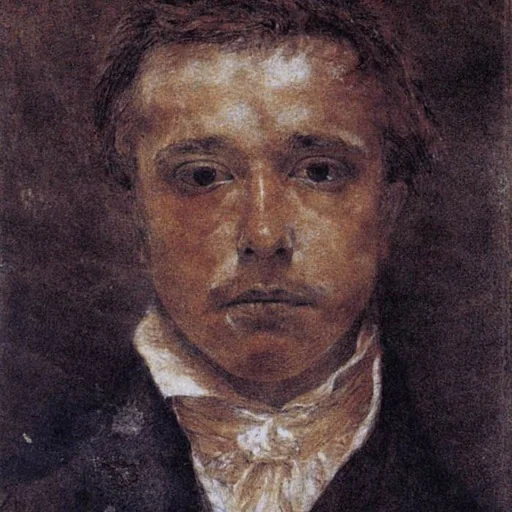
Samuel Palmer Hon.RE (Hon. Fellow of the Society of Painter-Etchers) (27 January 1805 – 24 May 1881) was a British landscape painter, etcher and printmaker. He was also a prolific writer. Palmer was a key figure in…