Artwork
Harvest Celebration
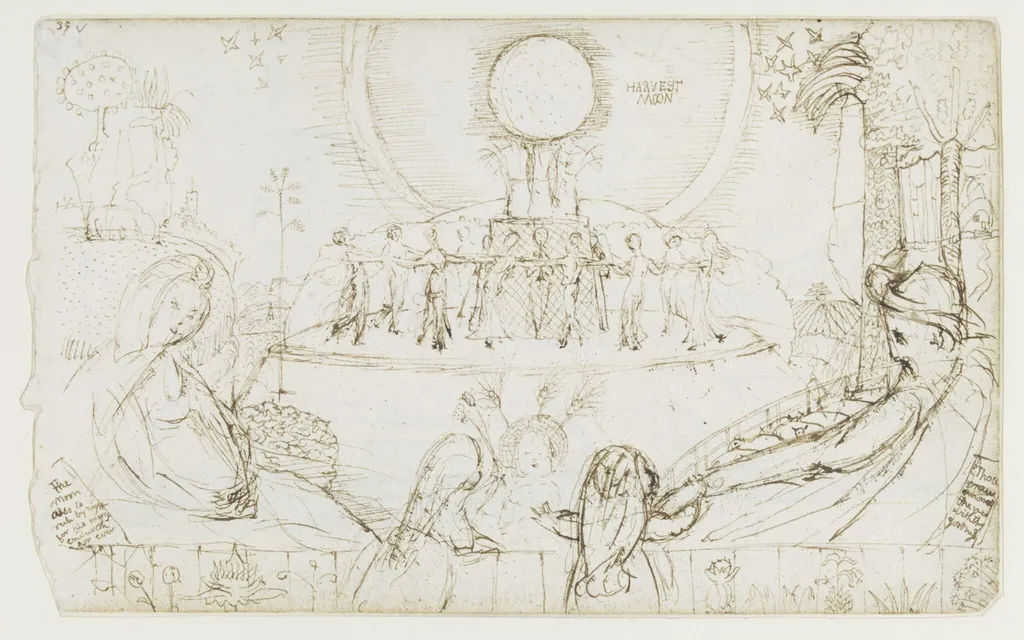
Harvest Celebration is a drawing by the Romanticist artist Samuel Palmer. It dates from 1824 and is held in the collection of the Victoria and Albert Museum.
About this work
Overview
Executed on the second leaf of a sketchbook, it portrays a group of figures gathered around a hay rick, their forms rendered with delicate, flowing lines.
Created in 1824, this ink drawing by Samuel Palmer captures a quiet rural celebration under a full harvest moon. Executed on the second leaf of a sketchbook, it portrays a group of figures gathered around a hay rick, their forms rendered with delicate, flowing lines. The composition balances stillness and motion, with the moon casting a luminous glow over the scene. Palmer later gave the sketchbook to George Richmond, and it eventually passed to A. H. Palmer, preserving its intimate provenance.
Subject & Meaning
The scene depicts a communal harvest observance, with women dancing in a circle around a stacked hay rick, a symbol of agricultural abundance. Figures stand and sit in quiet contemplation, suggesting reverence rather than revelry. The presence of a tall, scythe-bearing figure evokes seasonal transition, while the inscription 'Harvest Moon' anchors the moment in time. Palmer’s intent, as noted in his journal, was to express spiritual simplicity through humble, childlike observation of nature’s cycles.
Technique & Style
Palmer employed fine, layered ink lines to model form and atmosphere, using cross-hatching and stippling to create depth and luminosity. The sky is alive with swirling branches and scattered stars, while shadows are built through subtle gradations rather than bold contrasts. The soft, rhythmic contours suggest spontaneity, yet the precision of detail reveals disciplined technique. This approach reflects his early engagement with the linear clarity of Dürer and the visionary intensity of Blake.
History & Provenance
The drawing originates from a small sketchbook Palmer compiled in 1824, shortly after meeting William Blake. He later presented the book to his friend George Richmond, a fellow artist. Upon Richmond’s death, the sketchbook entered the collection of A. H. Palmer, likely a relative. The verso of the sheet contains preparatory studies of tree trunks, indicating the drawing’s role as both finished work and artistic exercise within a private, evolving practice.
Context
Created during Palmer’s formative years in the village of Shoreham, this work emerges from a period of intense spiritual and artistic exploration. Influenced by Blake’s mystical vision and Dürer’s meticulous draftsmanship, Palmer sought to merge natural observation with symbolic meaning. The drawing reflects a broader Romantic interest in rural life as a site of transcendence, countering industrial modernity with an idealized, timeless agrarian rhythm.
Legacy
Though not widely exhibited in his lifetime, this drawing exemplifies Palmer’s early contribution to British Romantic drawing. Its intimate scale and poetic tone influenced later generations of artists drawn to lyrical landscape and spiritual symbolism. The sketchbook’s survival and documented provenance offer rare insight into his creative process, positioning it as a key document in understanding the development of visionary art in early 19th-century England.
Artist & collection
Artist
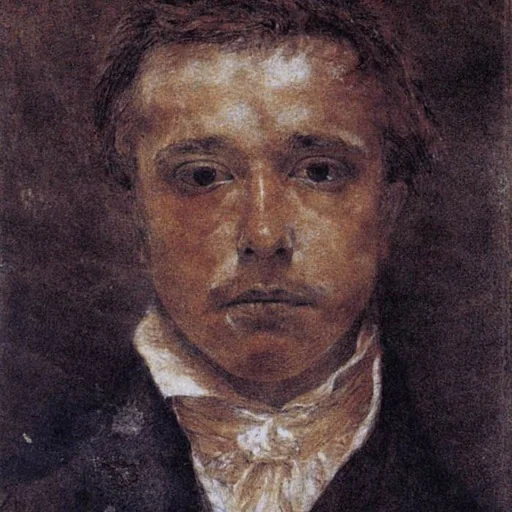
Samuel Palmer Hon.RE (Hon. Fellow of the Society of Painter-Etchers) (27 January 1805 – 24 May 1881) was a British landscape painter, etcher and printmaker. He was also a prolific writer. Palmer was a key figure in…

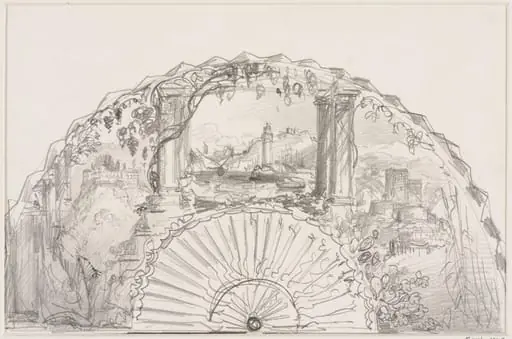 Fan design
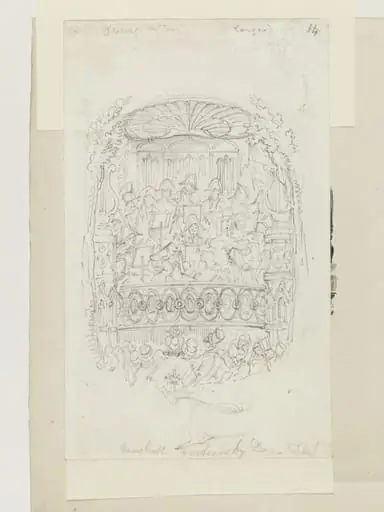 Vauxhall Gardens by Day
![Figure Studies [verso], by Valentine Cameron Prinsep](https://artifactworldgallery.com/img/valentine-cameron-prinsep--figure-studies-verso--ecadfdfaae5c079d-w320.webp) Figure Studies [verso]
Figure Studies [verso]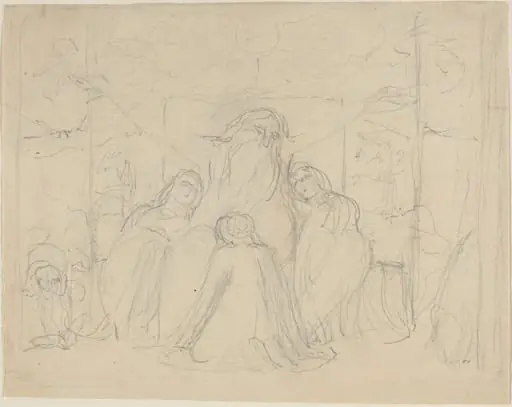 Job and His Daughters
![Studies of Crowing Rooster and Reclining Figures [recto and verso], by John Flaxman](https://artifactworldgallery.com/img/john-flaxman--studies-of-crowing-rooster-and-reclining-figures-recto-and-v--6ae88f69b8f5a01b-w320.webp) Studies of Crowing Rooster and Reclining Figures [recto and verso]
Studies of Crowing Rooster and Reclining Figures [recto and verso]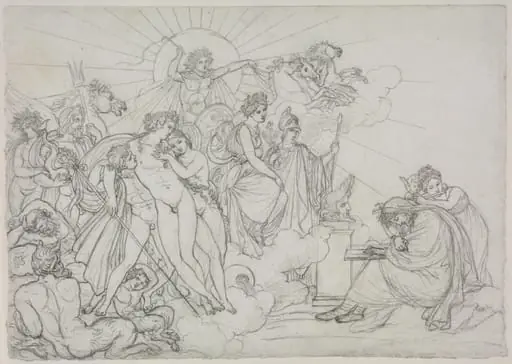 Invocation to the Divinities who preside over Agriculture from Virgil's "Georgics"
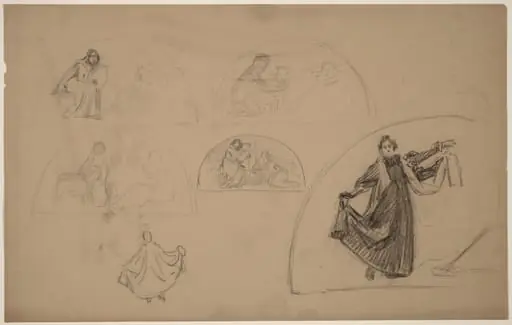 Studies for a Lunette
![Studies for a Monument with Angels Reaching Down to a Praying Figure [recto and verso], by John Flaxman](https://artifactworldgallery.com/img/john-flaxman--studies-for-a-monument-with-angels-reaching-down-to-a-prayin--9d789ab993a76a50-w320.webp) Studies for a Monument with Angels Reaching Down to a Praying Figure [recto and verso]
Studies for a Monument with Angels Reaching Down to a Praying Figure [recto and verso]![Sketch of a Swordsman Standing Over His Defeated Opponent [verso], by William Blake](https://artifactworldgallery.com/img/william-blake--sketch-of-a-swordsman-standing-over-his-defeated-opponent-ve--cd6502ff4c55c41a-w320.webp) Sketch of a Swordsman Standing Over His Defeated Opponent [verso]
Sketch of a Swordsman Standing Over His Defeated Opponent [verso]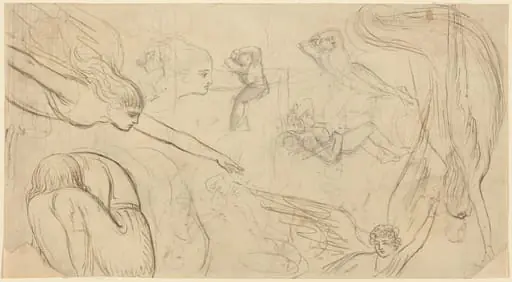 Sheet of Studies with Angels and Cowering Figures (Illustration for Macklin's Bible?)
![A Resurrection Scene (The Gambols of Ghosts) [recto], by William Blake](https://artifactworldgallery.com/img/william-blake--a-resurrection-scene-the-gambols-of-ghosts-recto--f5621911b14e7435-w320.webp) A Resurrection Scene (The Gambols of Ghosts) [recto]
A Resurrection Scene (The Gambols of Ghosts) [recto] Taormina "Antichita" Giovanni Panarello