Artwork
The Virgin and Child with John the Baptist
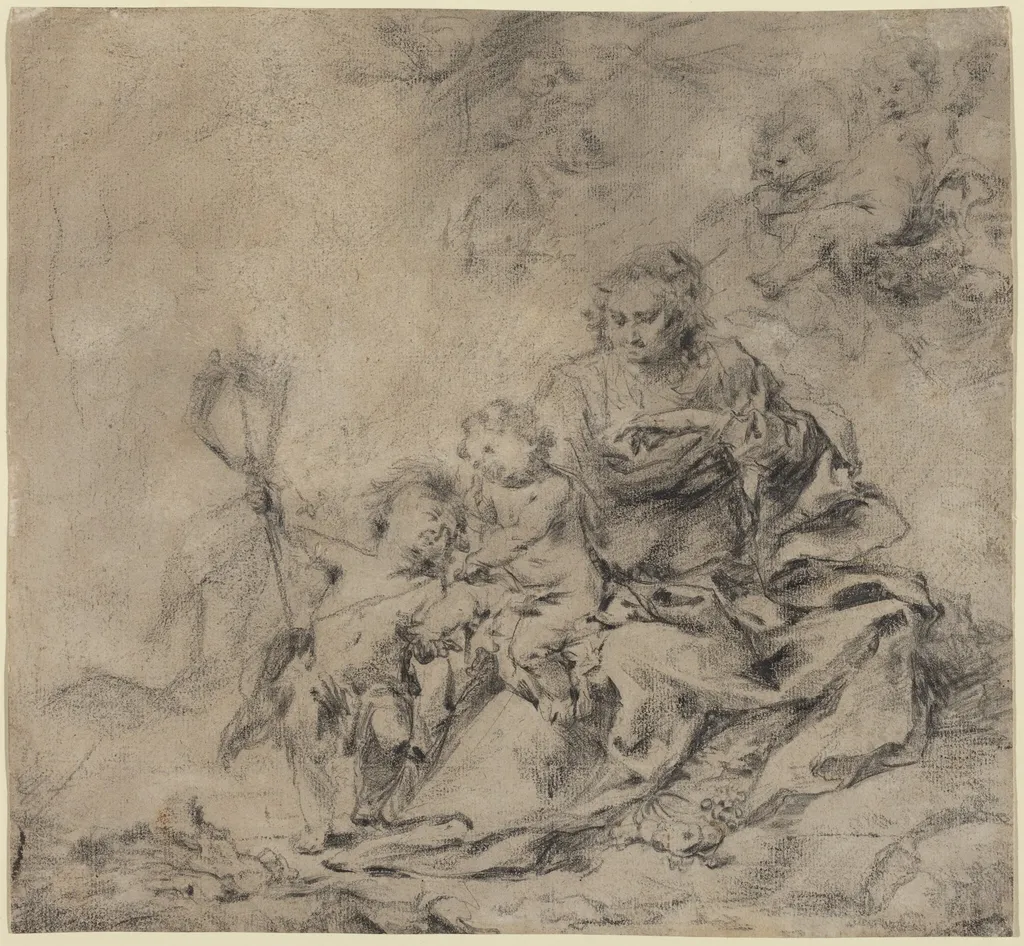
The Virgin and Child with John the Baptist is a chalk drawing by the Renaissance artist Cornelis Schut I. It dates from 1626 and is held in the collection of the National Gallery of Art.
About this work
Overview
Cornelis Schut I produced a drawing titled *Virgin and Child with John the Baptist* in 1626. Executed in black chalk on laid paper, the work presents a compact grouping of three figures against a loosely rendered landscape. The composition is informal, reflecting the artist’s preparatory approach rather than a finished painted piece.
Subject & Meaning
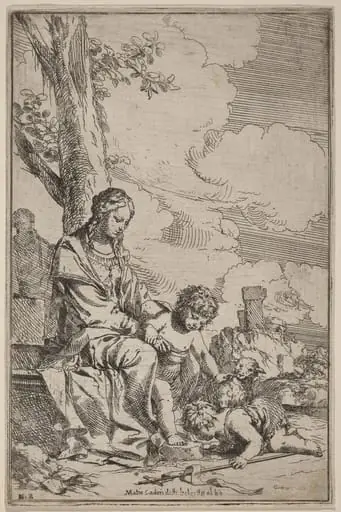
The scene depicts the Virgin Mary holding the infant Jesus, while a youthful John the Baptist stands beside them, his hand gesturing outward. The trio’s close arrangement emphasizes their relational bond and the theological connection between the infant Christ and his future forerunner, John.
Technique & Style
Schut employed only black chalk, allowing the paper’s grain to remain visible and giving the drawing a raw, sketch‑like quality. The lines are swift and somewhat irregular, especially in the background where branches and rocks are suggested with brief, scratchy strokes rather than detailed modeling.
History & Provenance
Created as a study for a larger composition, the drawing was not intended for public display. Its survival as a standalone work provides insight into Schut’s preparatory methods during the early seventeenth century, a period when artists frequently produced such monochrome sketches before committing to oil.
Context
In the 1620s, Flemish artists often used chalk studies to plan complex religious subjects. Schut’s drawing aligns with this practice, contrasting with the soft, blended techniques of sfumato that were popular elsewhere in Europe at the time.
Artist & collection


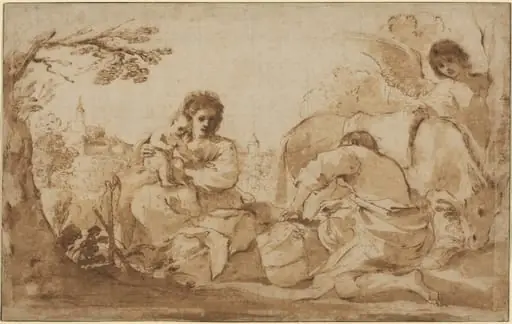 The Rest on the Flight into Egypt
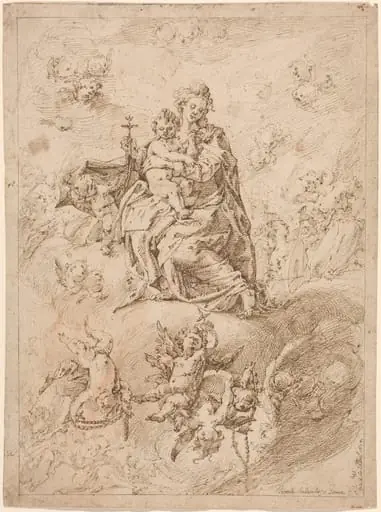 The Madonna of the Rosary
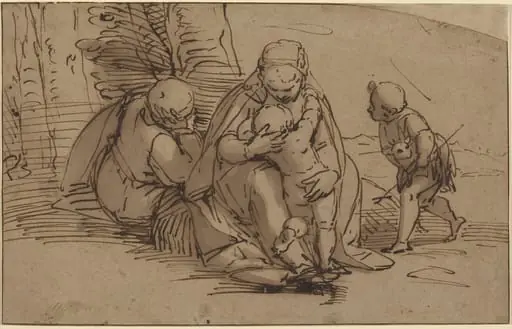 Holy Family with Infant Saint John
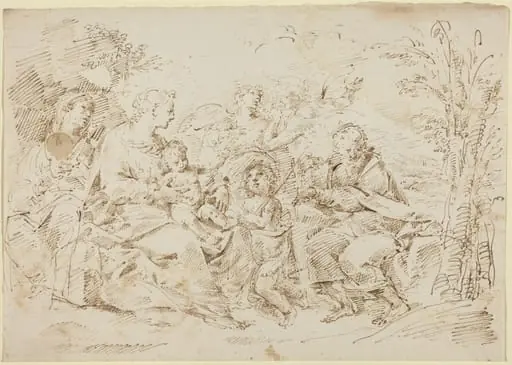 Holy Family with St. Elizabeth, St. John the Baptist, and Two Angels in a Landscape
![God the Father and Angels Adoring the Madonna and Child [recto], by Giovanni Domenico Tiepolo](https://artifactworldgallery.com/img/giovanni-domenico-tiepolo--god-the-father-and-angels-adoring-the-madonna-and-child-rect--594c8aeda933276d-w320.webp) God the Father and Angels Adoring the Madonna and Child [recto]
God the Father and Angels Adoring the Madonna and Child [recto] Two Seated Women
 The Temptation of Christ in the Desert
![Holy Family [recto], by Donato Creti](https://artifactworldgallery.com/img/donato-creti--holy-family-recto--7e3a584f7b6c5852-w320.webp) Holy Family [recto]
Holy Family [recto] The Virgin and Infant Jesus with Saints
 The Finding of Moses
 Charity with Faith and Hope
 The Virgin and Child with Saint John the Baptist