Artwork
Philip II, King of Spain
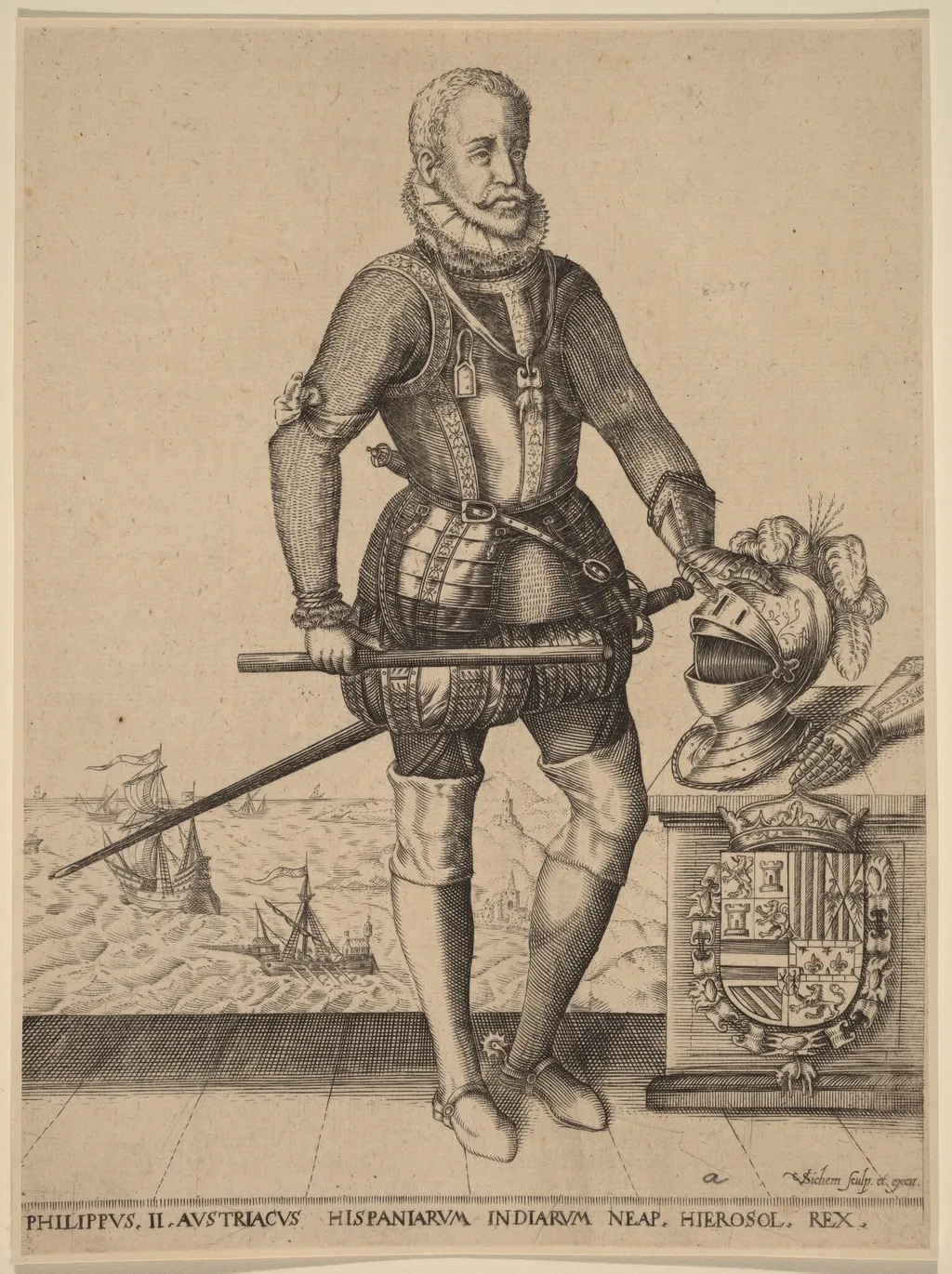
Philip II, King of Spain is an ink print by the Renaissance artist Christoffel van Sichem I. It dates from 1585 and is held in the collection of the National Gallery of Art.
About this work
Overview
As a reproductive print, it served to circulate the monarch’s image across Europe, reinforcing his political stature through visual repetition.
This 1585 engraving by Christoffel van Sichem I depicts Philip II of Spain in formal attire, rendered through fine line work typical of Northern European printmaking. The image is a portrait intended to convey authority and royal presence, with attention concentrated on the king’s likeness and regalia. As a reproductive print, it served to circulate the monarch’s image across Europe, reinforcing his political stature through visual repetition.
Subject & Meaning
Philip II is portrayed with a stern, composed expression, reflecting his role as a devout Catholic monarch ruling a vast empire. His elaborate garments and ornate jewelry are not merely decorative but symbolic of imperial power and dynastic continuity. The absence of contextual elements directs focus entirely to the ruler, emphasizing his singular importance and the solemnity of his position.
Technique & Style
Van Sichem employed precise engraving techniques to render textures of fabric, lace, and metal with meticulous detail. Shading is achieved through controlled cross-hatching, giving volume to the king’s face and hands while maintaining clarity. The plain background isolates the figure, a convention in portraiture that prioritizes the subject’s presence over narrative or setting, aligning with contemporary Northern European print traditions.
History & Provenance
Created in 1585, the engraving emerged during a period of intense political and religious conflict in Europe. As a reproductive print, it likely circulated among nobility and diplomats to affirm Philip’s authority. Van Sichem, active in the Dutch Republic, produced numerous royal and ecclesiastical portraits, suggesting this work was commissioned or adapted from an existing model, possibly a painting or another print.
Context
In the late 16th century, engraved portraits were vital tools for political communication, especially when the subject could not be seen in person. Philip II’s reign coincided with the Dutch Revolt and the Spanish Armada, making his image a potent symbol of centralized power. Van Sichem’s work reflects the broader trend of using print media to project monarchical legitimacy across territories under Spanish influence.
Legacy
Christoffel van Sichem I’s engraving of Philip II contributes to a broader corpus of early modern royal portraiture that shaped public perception of European rulers. While not widely known today, such prints were instrumental in standardizing the visual language of monarchy. Their preservation in institutional collections underscores their role as historical documents of power, identity, and representation.
Artist & collection