Artwork
A whirlwind of dust, India
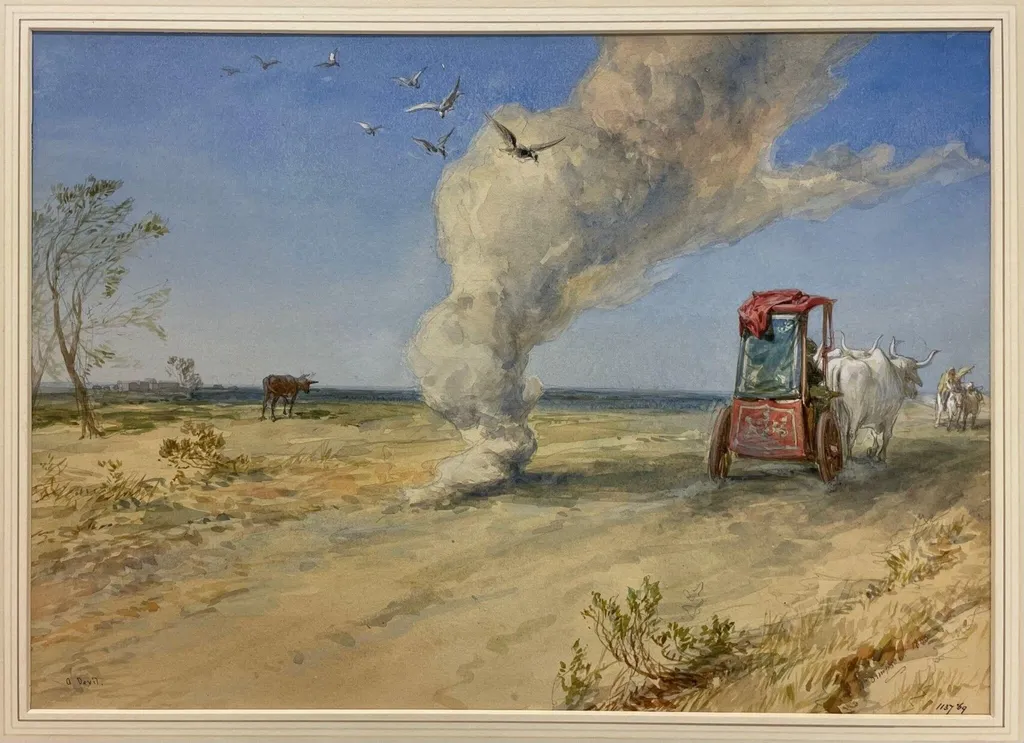
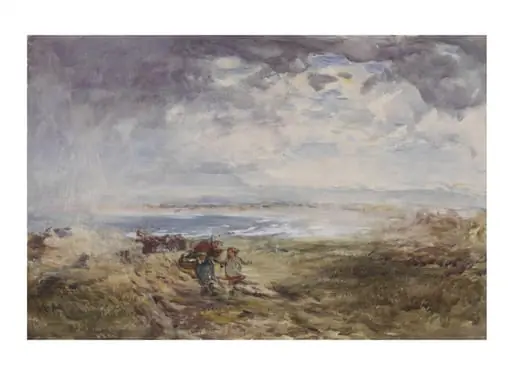
A whirlwind of dust, India is a paint painting by the British Romanticist artist William Simpson. It dates from 1866 and is held in the collection of the Victoria and Albert Museum.
About this work
A swirling funnel of dust rises over a flat Indian plain in 1866. The sky is pale, the ground a dull green. A few faint figures stand in the distance, barely visible.
Simpson used quick pencil sketches on site, then finished this in watercolor back in London. He worked fast to catch the heat and motion.
Look up Simpson, William RI FRGS next.
Overview
William Simpson’s 1866 watercolor titled “A devil” captures a dust storm sweeping across a flat Indian plain. The composition shows a pale sky above a muted green ground, with a faint funnel of swirling dust rising and a few indistinct figures in the distance.
Subject & Meaning
The work depicts a common meteorological phenomenon in arid parts of the Indian subcontinent, where sudden dust devils can dominate the landscape. By naming the piece “A devil,” Simpson emphasizes the sudden, almost mischievous power of the wind.
Technique & Style
Simpson produced rapid pencil sketches during his Indian travels, then returned to London to render the scene in watercolor. The medium allows him to layer translucent washes, creating a luminous atmosphere that conveys both heat and motion.
History & Provenance
Commissioned by the London lithography firm Day and Sons after his Crimean War reportage, Simpson visited Calcutta in 1859 and toured the region surrounding Delhi. The sketches and journal entries he kept there formed the basis for this painting, completed three years after his return to England.
Context
The piece belongs to a series documenting sites linked to the 1857 Indian Rebellion, a period when British artists were tasked with recording the empire’s territories. Simpson’s work reflects the Victorian fascination with exotic landscapes and the imperial desire to catalogue distant environments.
Artist & collection