Artwork
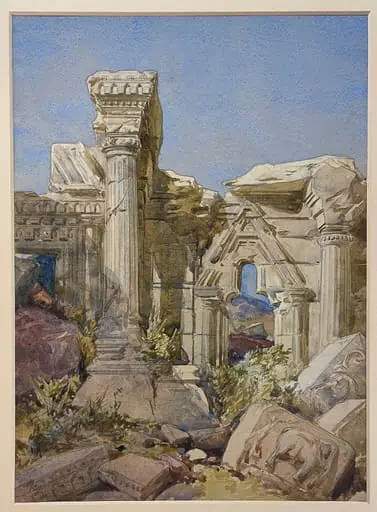
Ruins at Kannauj, India
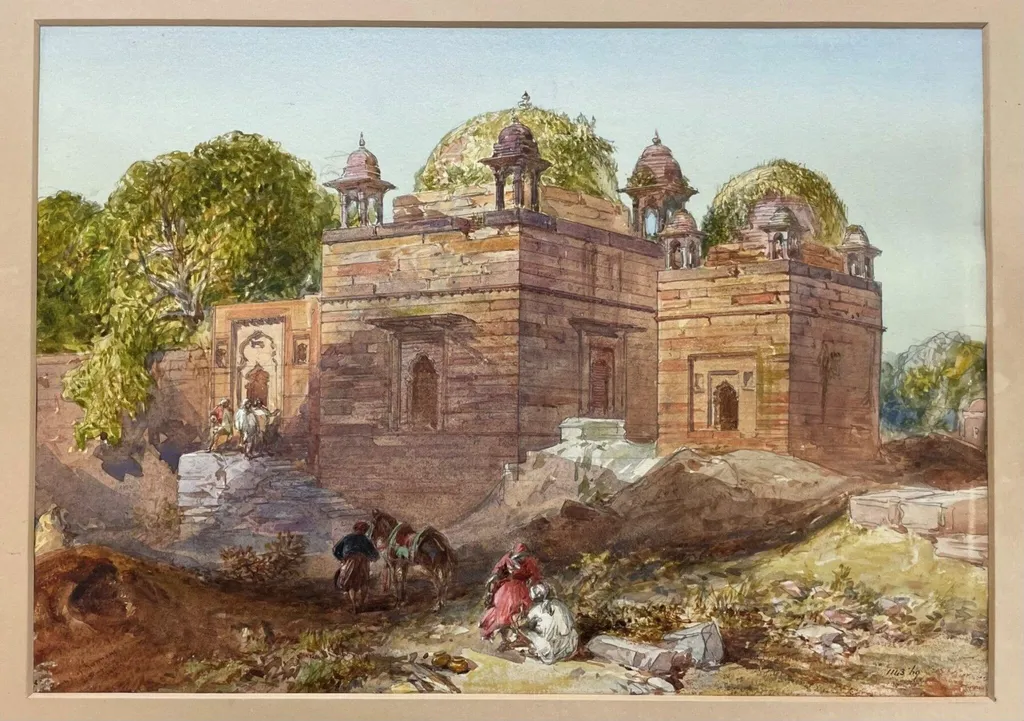
Ruins at Kannauj, India is a paint painting by the Impressionist artist William Simpson. It dates from 1864 and is held in the collection of the Victoria and Albert Museum.
About this work
This watercolor shows ruined brick walls and a crumbling tower under a gray sky. One narrow archway stands in the middle. A few leafless trees lean against the old stones.
Simpson made these sketches after the 1857 Indian Revolt. The British East India Company once ruled here. His quick pencil lines later became this careful watercolor.
Look up Simpson, William RI FRGS next.
Overview
William Simpson, a British artist known for his documentary work during the Crimean War, traveled to India in 1859 to record sites linked to the 1857 uprising.
William Simpson, a British artist known for his documentary work during the Crimean War, traveled to India in 1859 to record sites linked to the 1857 uprising. Commissioned by the London firm Day and Sons, he produced rapid pencil sketches across northern India, later refining them into detailed watercolors after returning to England. The painting of Kannauj’s ruins was completed in 1864, reflecting his practice of transforming on-site observations into polished studio works.
Subject & Meaning
The painting depicts the remnants of a once-significant Mughal-era site in Kannauj, now reduced to weathered brick walls and a lone arched structure beneath a muted sky. Leafless trees frame the decay, reinforcing a mood of abandonment. Though not overtly political, the image quietly evokes the aftermath of the 1857 Revolt, when British control reasserted itself over former centers of indigenous power, leaving architectural traces as silent witnesses.
Technique & Style
Simpson’s method combined spontaneous pencil sketches made on location with deliberate watercolor execution in his London studio. The final work features soft washes of gray and ochre, with precise linear detail in the architecture. The composition emphasizes ruin and stillness, using minimal color and restrained tonality to convey atmospheric melancholy rather than dramatic spectacle.
History & Provenance
The painting originated as part of a series commissioned by Day and Sons to document sites associated with the 1857 Revolt. Simpson’s fieldwork in India between 1859 and 1862 provided the basis for works exhibited and published upon his return. The Kannauj watercolor was finished in 1864 and likely entered private or institutional collections in Britain, where it was valued as both topographical record and romanticized antiquarian imagery.
Context
Simpson’s Indian works emerged during a period of intensified British colonial documentation. The 1857 Revolt had shaken imperial confidence, and visual records of ruined sites served to frame the past as conquered and contained. His depictions of Kannauj and other locations aligned with Victorian tastes for picturesque decay, blending ethnographic interest with a nostalgic view of empire’s historical layers.
Legacy
Simpson’s Indian watercolors remain important as visual archives of post-revolt landscapes, offering insight into how British artists interpreted colonial ruins. While romanticized, they preserve architectural details now altered or lost. His method—rapid sketching followed by studio refinement—became a model for later colonial artists, influencing how India’s heritage was visually recorded and consumed in Europe.
Artist & collection

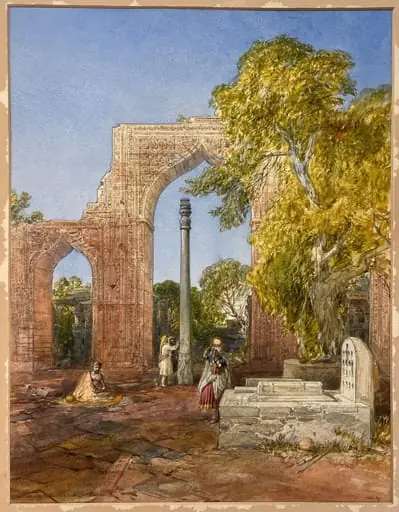 Iron Laht at the Kootub, Old Delhi
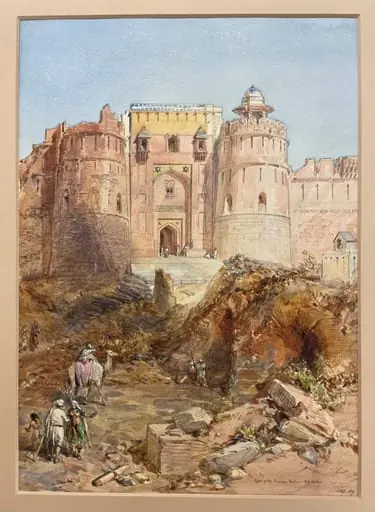 Gate of Purana Qila, Old Delhi
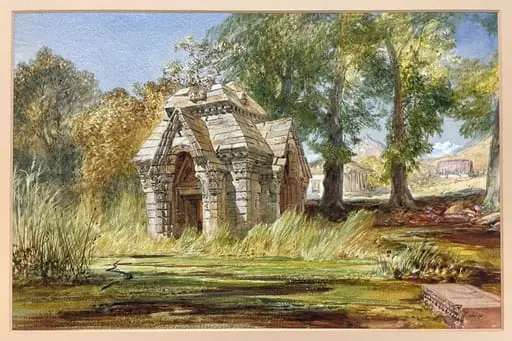 Pandrethan temple, Srinagar
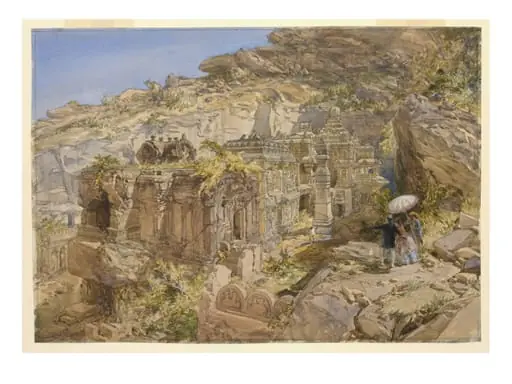 Kailasanatha temple, Ellora
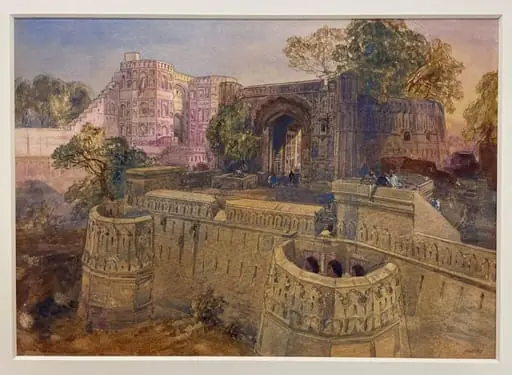 Taxali Darwaza, Lahore
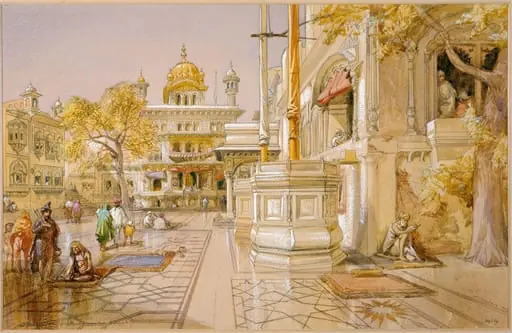 Akal Boonga at the Golden temple. Umritsar. Punjaub
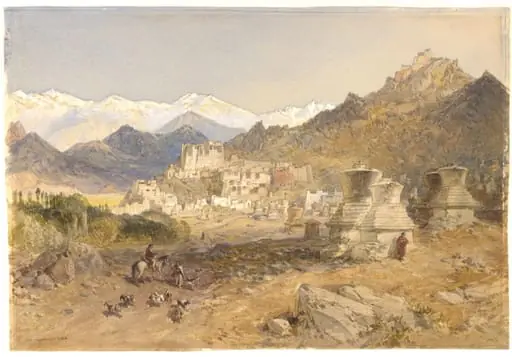 The Palace at Leh with stupas in the foreground
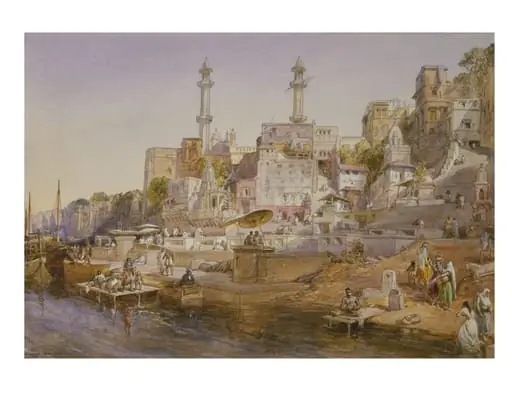 The Mosque of Aurangzeb and Panchganga Ghat from the Ganges, Benares.
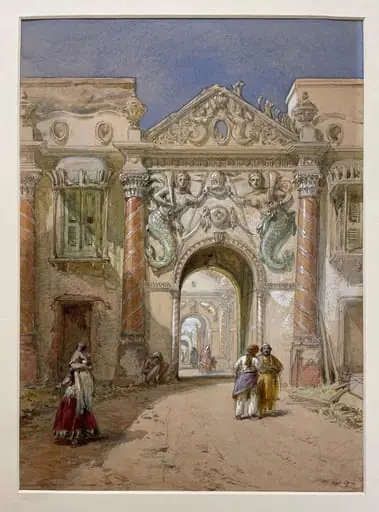 Mermaid gate, Kaiserbagh, Lucknow
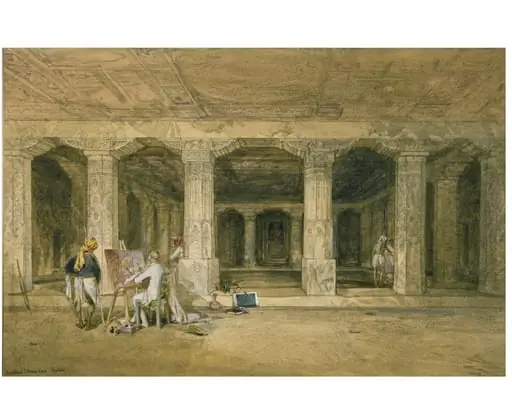 Buddhist vihara cave, Ajanta