Artwork
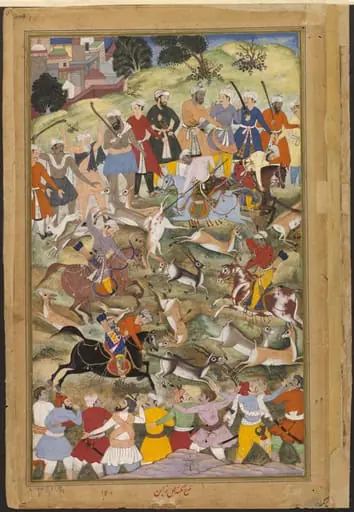
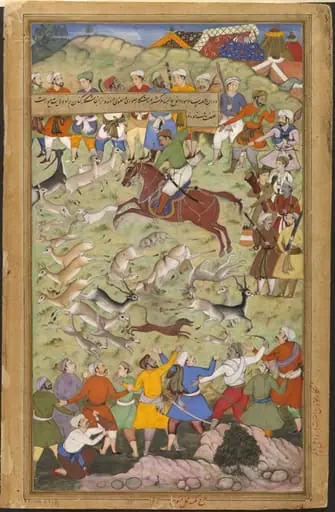
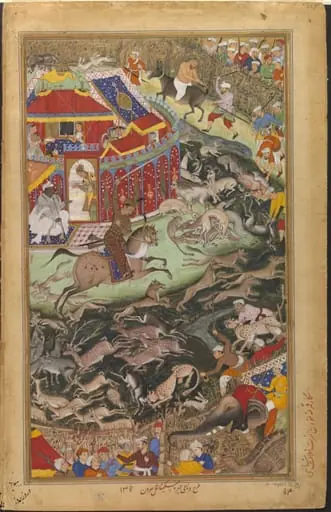
Akbar assists in capturing a cheetah
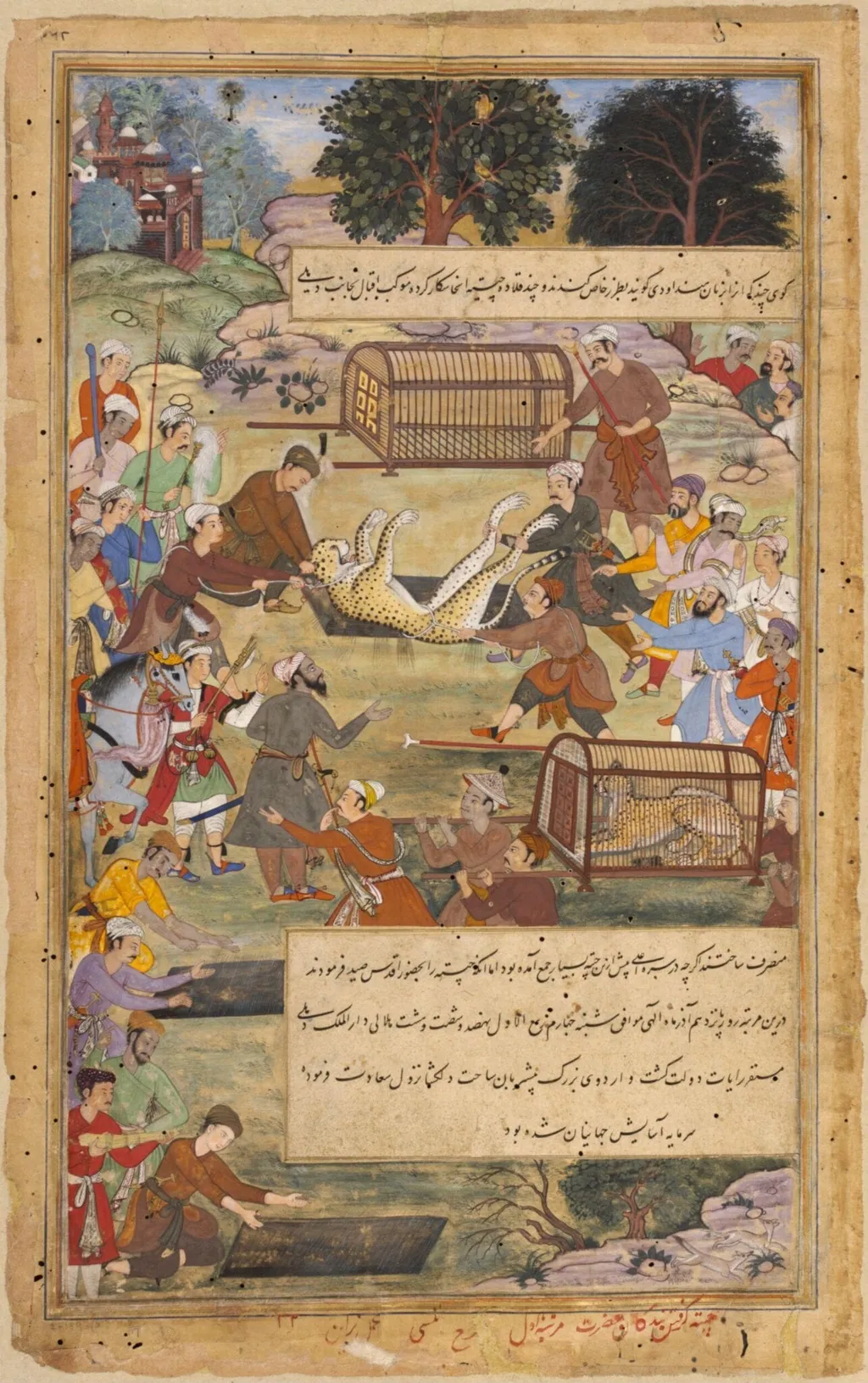
Akbar assists in capturing a cheetah is a paint painting by the Mughal Painting artist Tulsi. It dates from 1592 and is held in the collection of the Victoria and Albert Museum.
About this work
Overview
Created between 1592 and 1594, it was produced by a team of artists in the imperial atelier.
This painting is part of the Akbarnama, an official chronicle of Emperor Akbar’s reign, commissioned by the emperor and compiled by his court historian Abu’l Fazl. Created between 1592 and 1594, it was produced by a team of artists in the imperial atelier. The scene illustrates Akbar observing the capture of cheetahs—an unusual hunting practice in Hindustan—rendered with precision and vivid color by the artist Tulsi.
Subject & Meaning
The scene captures Akbar watching laborers dig concealed pits to trap wild cheetahs without injury, a technique noted for its difficulty and skill. The emperor’s composed stance contrasts with the active labor of his attendants, emphasizing his role as observer and patron rather than participant. The act symbolized imperial control over nature and the refinement of royal sport, aligning with the Mughal ideal of ordered power.
Technique & Style
The artist Tulsi employed fine brushwork and luminous pigments to distinguish figures and landscape. Akbar’s red robe stands out against earth tones, drawing attention to his stillness amid motion. The composition balances spatial depth with decorative detail, reflecting the Mughal synthesis of Persian elegance and Indian naturalism. Facial expressions and body language convey individual roles without theatricality.
History & Provenance
The Akbarnama manuscript remained in the imperial library after Akbar’s death, passing to his successors Jahangir and Shah Jahan. It remained in royal hands until the 19th century, when portions were dispersed. The Victoria and Albert Museum acquired this folio in 1896 from the estate of Major General John Clarke, who had served in Oudh and collected Indian manuscripts during his tenure.
Context
Cheetah hunting was a rare and prestigious activity in Mughal India, requiring specialized knowledge and coordination. Unlike lion or tiger hunts, cheetah capture involved stealth and precision, making it a subject of particular interest in court chronicles. The inclusion of this scene in the Akbarnama reflects its symbolic value as an expression of imperial expertise and the empire’s engagement with the natural world.
Legacy
The painting endures as a rare visual record of a specific hunting practice rarely depicted in Mughal art. Its survival within the Akbarnama manuscript, and its later preservation in a major museum, underscores its historical and artistic significance. The work continues to inform studies of Mughal court culture, artistic collaboration, and the representation of nature in imperial imagery.
Artist & collection
Artist
Tulsi painted delicate scenes from the Mughal court in the late 1500s. His brush traced Akbar’s hunts, portraits, and battles—like *Sultan Adam* and *Akbar assists in capturing a cheetah*—full of fine fabrics and sharp…