Artwork
Shuja'at Khan and Asaf Khan
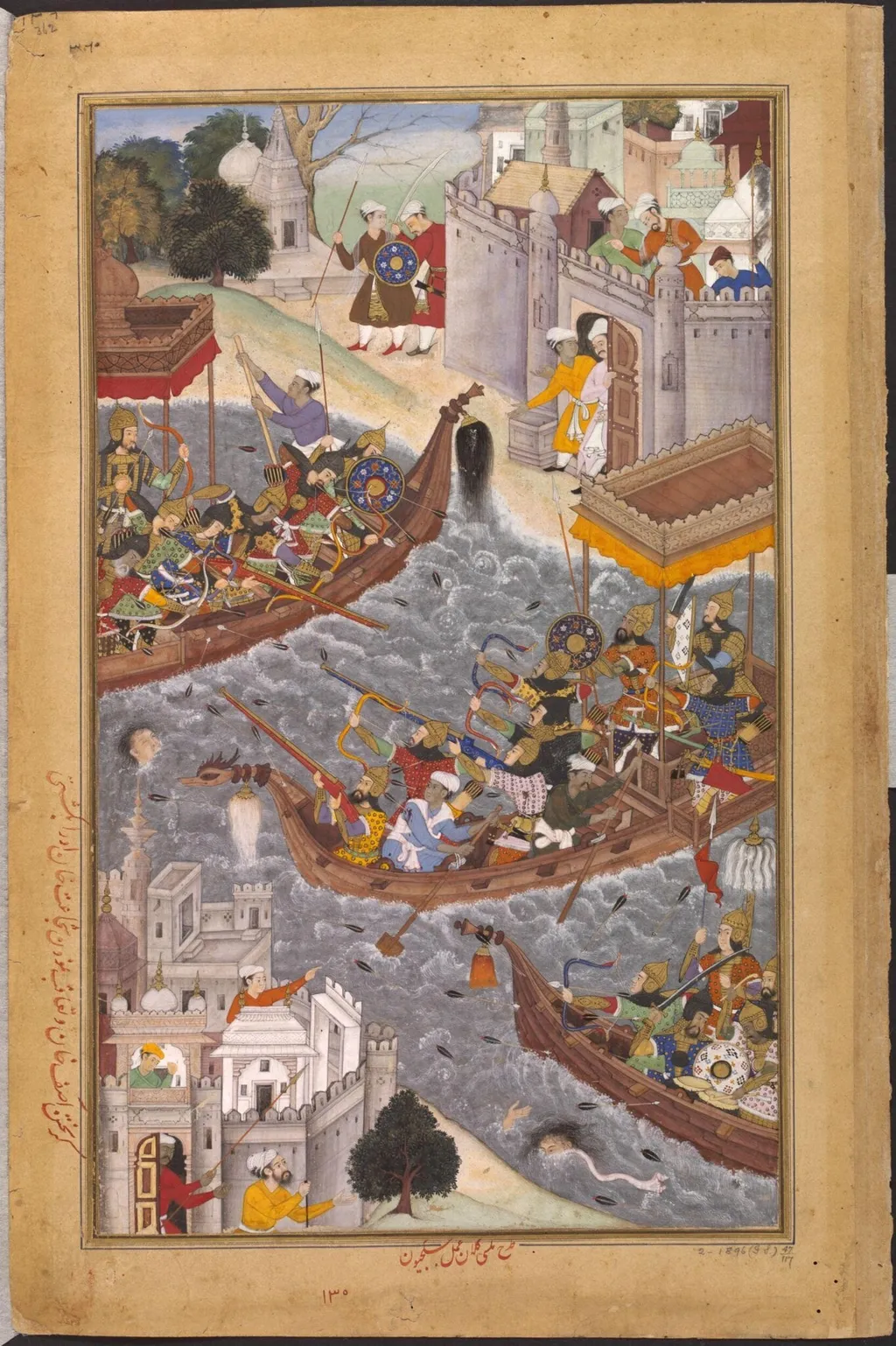
Shuja'at Khan and Asaf Khan is a paint painting by the Mughal Painting artist Tulsi. It dates from 1592 and is held in the collection of the Victoria and Albert Museum.
About this work
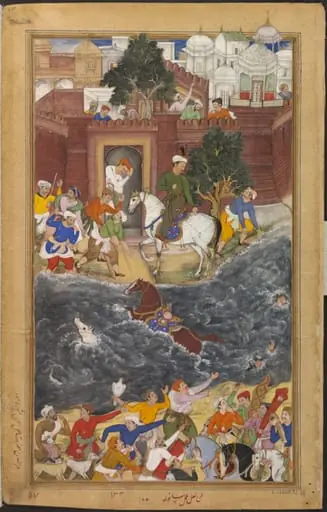
The artist used bright colors to show the water’s ripples and the men’s clothes.
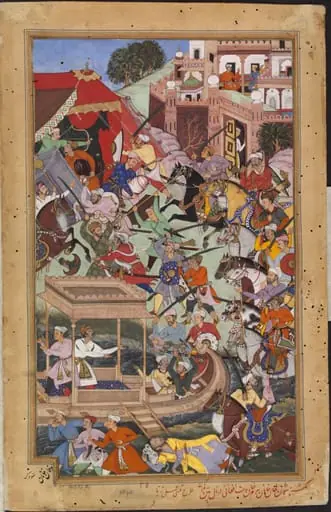
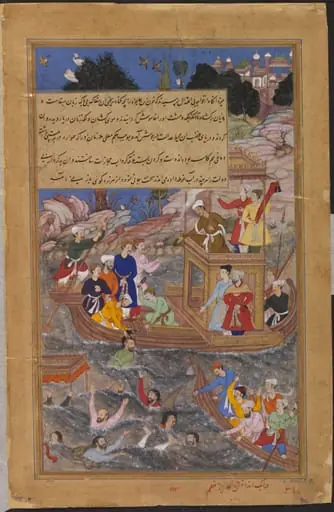
This painting shows two men on horses racing across a river.
One man flees while the other gives chase.
The artist used bright colors to show the water’s ripples and the men’s clothes.
The chase happened in 1565, but the painting was made later.
The artist Tulsi worked for the Mughal emperor Akbar.
The text of the Akbarnama doesn’t explain why the men were running.
Look up the Victoria and Albert Museum to see more Mughal art.
Overview
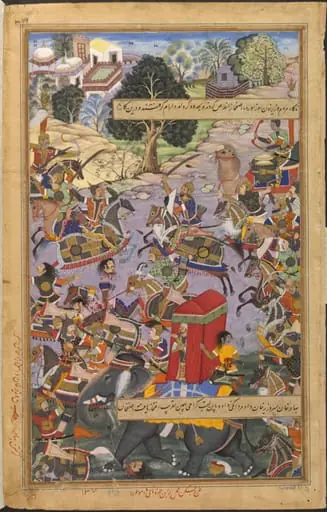
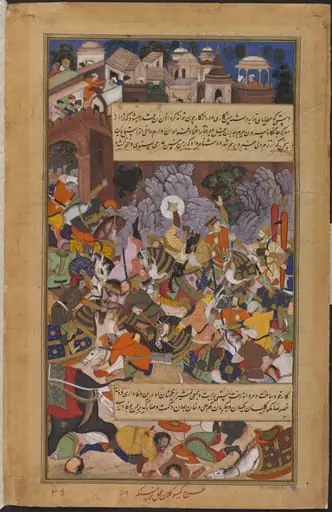
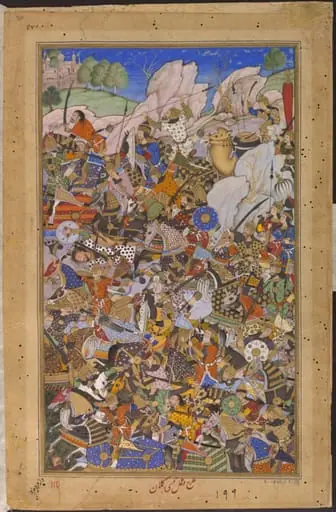
The miniature illustrates a dramatic pursuit along the Ganges, where Shuja’at Khan, a Mughal general, chases Asaf Khan, the emperor Akbar’s vizier, who is attempting to flee on horseback. Rendered in vivid pigments, the scene captures the river’s rippling surface and the motion of the riders, emphasizing the urgency of the encounter.
Subject & Meaning
The narrative records a 1565 episode in which Asaf Khan, accused of withholding spoils from a successful campaign, tries to escape across the river with his followers. Shuja’at Khan’s forces intercept him, leading to a fierce confrontation. Although Asaf Khan ultimately evades capture, he later seeks and receives imperial pardon in 1567.
Technique & Style
Executed by court painters Tulsi the Elder and Jagjivan, the work belongs to the early illustrated phase of the Akbarnama. The artists employ bright, saturated colours to delineate water, clothing, and horses, while fine line work defines the figures’ gestures. Red ink signatures beneath the image identify the contributors, a practice typical of royal commissions.
History & Provenance
The miniature forms part of a V&A‑held copy of the Akbarnama, the official chronicle commissioned by Emperor Akbar and composed by Abu’l‑Fazl between 1590 and 1596. This particular manuscript was likely illustrated around 1592–1595, making it one of the earliest illustrated editions, and it remained in the imperial library after Akbar’s death before entering the museum’s collection.
Context
The Akbarnama served to document and legitimize Akbar’s reign, combining historical narrative with lavish visual documentation. The inclusion of this chase scene reflects the Mughal court’s interest in portraying military authority, loyalty, and the resolution of internal dissent, while also showcasing the artistic capabilities of the empire’s leading painters.
Artist & collection
Artist
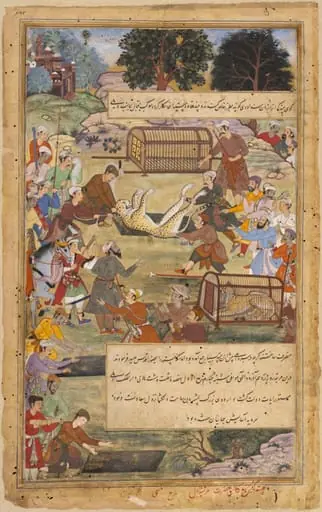
Tulsi painted delicate scenes from the Mughal court in the late 1500s. His brush traced Akbar’s hunts, portraits, and battles—like *Sultan Adam* and *Akbar assists in capturing a cheetah*—full of fine fabrics and sharp…