Artwork
Mariam Makani
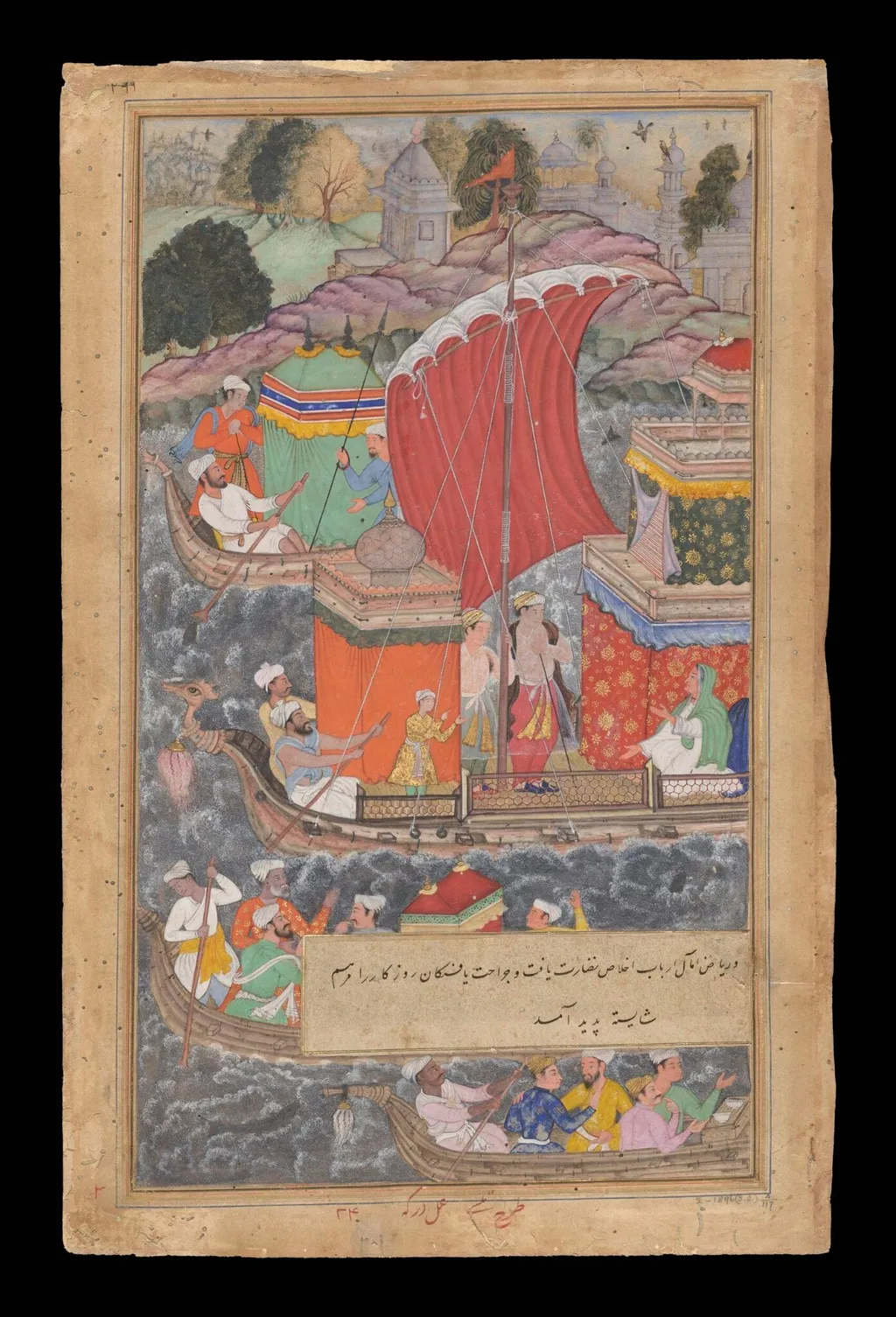
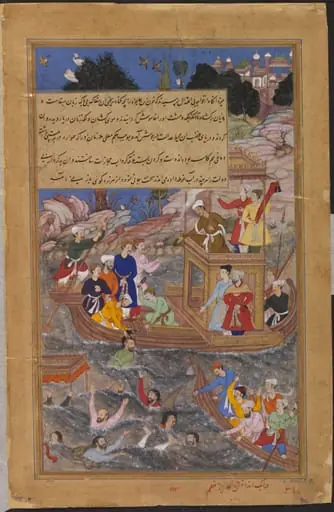
Mariam Makani is a paint painting by the Mughal Painting artist Tulsi. It dates from 1592 and is held in the collection of the Victoria and Albert Museum. The work is a miniature painting created for the illustrated version of the Akbarnama, the official chronicle of Emperor Akbar’s reign.
About this work
The scene comes from Akbar’s royal history, though the chronicles don’t mention her—just the journey itself.
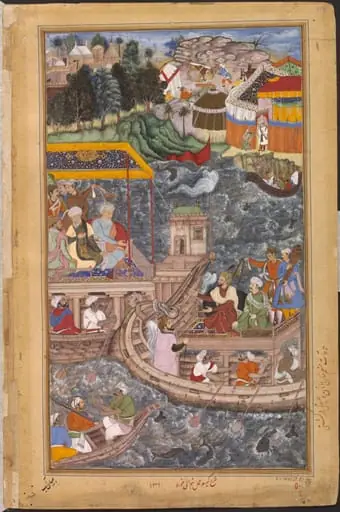
This painting shows a single royal woman in a boat on a river. She sits under a red canopy, dressed in white, with a calm river and distant boats behind her. The scene comes from Akbar’s royal history, though the chronicles don’t mention her—just the journey itself.
The artist Tulsi painted this for a royal book around 1590. Only one woman appears here, likely guarding the women’s quarters. It matches another painting of the emperor’s trip, but this one focuses just on her.
Check out another boat scene by Tulsi at the Victoria and Albert Museum.
Overview
The work is a miniature painting created for the illustrated version of the Akbarnama, the official chronicle of Emperor Akbar’s reign. Executed around 1590–1594 by the court artist Tulsi, it portrays a single royal woman travelling by river from Delhi to Agra. The figure is seated beneath a red canopy, dressed in white, while a tranquil river stretches behind her and other vessels can be seen in the distance.
Subject & Meaning
The lone female figure is likely the guardian of the zenana, the women’s quarters of the palace, a role that would have accompanied royal journeys. Her presence is not mentioned in the textual chronicle, but the inclusion of a guardian was customary. The red canopy and the two‑tier structure on the central boat suggest a connection to the emperor’s mother, whose status is signified by the extra tier and the royal colour red.
Technique & Style
Rendered in the Mughal miniature tradition, the painting combines delicate brushwork with a vivid palette. The use of red for the canopy and curtains highlights the figure’s importance, while the fine detailing of the boat and surrounding water reflects the collaborative studio practice of Akbar’s court, which employed dozens of artists to produce richly illustrated manuscripts.
History & Provenance
The Akbarnama was compiled by the historian Abu’l‑Fazl between 1590 and 1596 and illustrated shortly thereafter. After Akbar’s death, the manuscript passed through the libraries of his successors Jahangir and Shah Jahan. In 1896 the Victoria and Albert Museum acquired the volume from Mrs Frances Clarke, the widow of Major General Clarke, who had served as Commissioner in Oudh.
Context
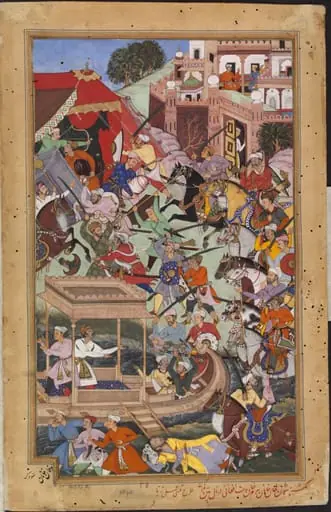
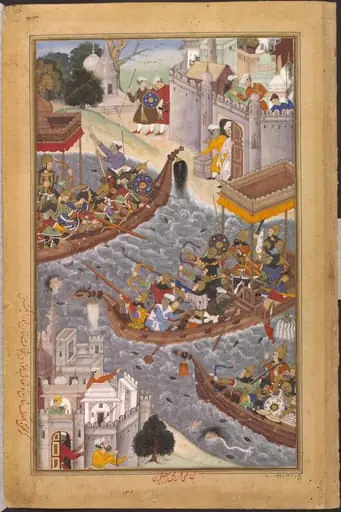
The scene corresponds to a larger composition (IS.2:3‑1896) that records the imperial fleet’s December 1560 river journey. While that larger work shows multiple boats, including the emperor’s, this miniature isolates the female attendant, emphasizing the role of women’s quarters in royal travel and the hierarchical organization of the Mughal court.
Artist & collection
Artist
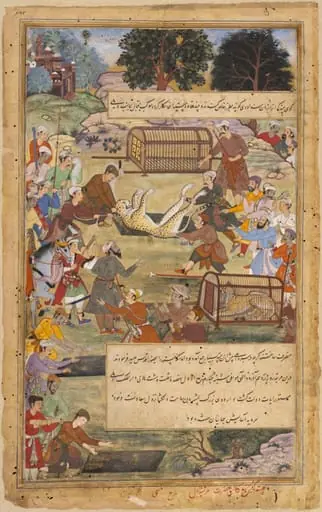
Tulsi painted delicate scenes from the Mughal court in the late 1500s. His brush traced Akbar’s hunts, portraits, and battles—like *Sultan Adam* and *Akbar assists in capturing a cheetah*—full of fine fabrics and sharp…