Artwork
Khusrau, the King of Kings, pays homage to the pious daughter of Khassa, from a Tuti-nama (Tales of a Parrot): Fifty-first Night
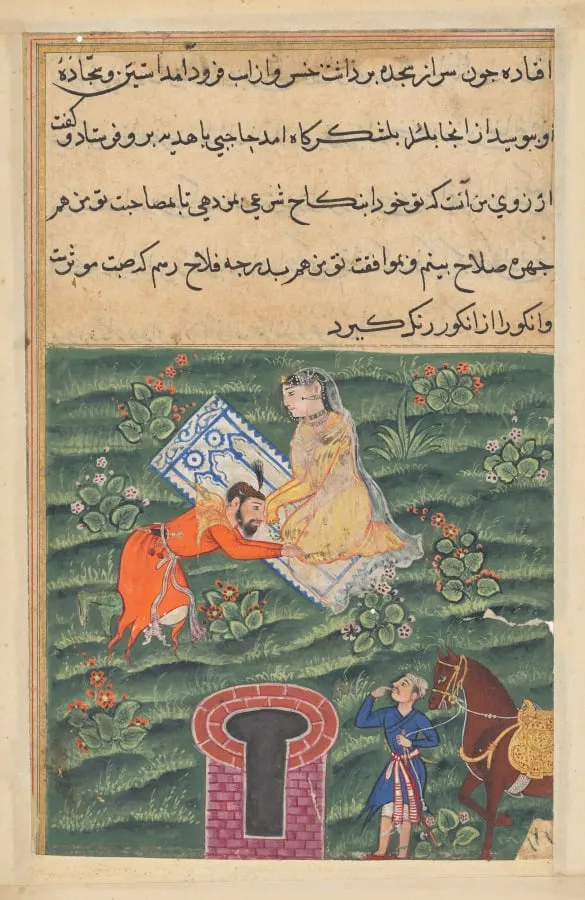
Khusrau, the King of Kings, pays homage to the pious daughter of Khassa, from a Tuti-nama (Tales of a Parrot): Fifty-first Night is an unspecified painting by the Mughal Painting artist Unknown. It dates from 1560 and is held in the collection of the Cleveland Museum of Art. The painting illustrates a scene from a Mughal manuscript of the Tuti‑nama, a collection of parrot tales composed for Emperor Akbar.
About this work
You see a king kneeling before a woman in a red robe, while servants and soldiers stand around them in a desert landscape with a brick well.
You see a king kneeling before a woman in a red robe, while servants and soldiers stand around them in a desert landscape with a brick well.
This painting comes from a book of parrot tales written for Emperor Akbar. The story shows a woman’s faith saving her after she’s left to die. The artist made the desert feel alive with tiny plants and animals—even a scorpion near the well.
To see more paintings like this, look up Mughal India, court of Akbar (reigned 1556–1605).
Overview
The painting illustrates a scene from a Mughal manuscript of the Tuti‑nama, a collection of parrot tales composed for Emperor Akbar. In the composition, a kneeling king offers homage to a woman in a red robe beside a modest brick well, while attendants and soldiers observe the encounter within a stark desert setting.
Subject & Meaning
The narrative depicts Khusrau discovering the abandoned daughter of Khassa, who has survived in the desert through her steadfast piety. Moved by her devotion, the king proposes marriage and exacts retribution on those who mistreated her, underscoring themes of faith, compassion, and royal justice.
Technique & Style
Executed in the refined Mughal miniature tradition, the work combines delicate brushwork with vibrant pigments. The artist renders the arid landscape with meticulous attention to minute flora and fauna—tiny plants, insects, and a scorpion near the well—creating a lively environment that contrasts with the human drama.
History & Provenance
The image originates from a deluxe illustrated manuscript created during the reign of Akbar (1556–1605). The Tuti‑nama was compiled for the emperor’s court, reflecting the period’s patronage of literary and artistic projects that blended Persian storytelling with Indian visual culture.
Context
Set within the broader Mughal court culture, the scene reflects the empire’s interest in moral exempla and the propagation of virtuous conduct. The depiction of a ruler humbled before a pious woman aligns with contemporary ideals of just governance and the moral authority of religious devotion.
Legacy
As part of the Tuti‑nama corpus, the painting contributes to our understanding of Mughal narrative art and its role in courtly education. Its detailed naturalism and narrative clarity continue to inform studies of the visual strategies employed by Mughal artists to convey complex moral stories.
Artist & collection

 Domestic Scene
 Giacomo and Cardinal Marco, investing Andrea, Abbot of San Zeno, with his Benefice
 The Nymph of Fontainebleau
 Portrait of a Woman
 Madonna and Child with Saints in the Enclosed Garden
 Venus and Minerva
 Family Group of Four on Sofa
 Wall painting from Room H of the Villa of P. Fannius Synistor at Boscoreale
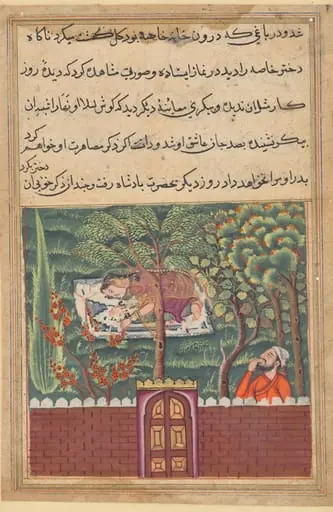 Khulasa, a vizier, sees the daughter of Khassa, another vizier, and covets her, from a Tuti-nama (Tales of a Parrot): Fifty-first Night
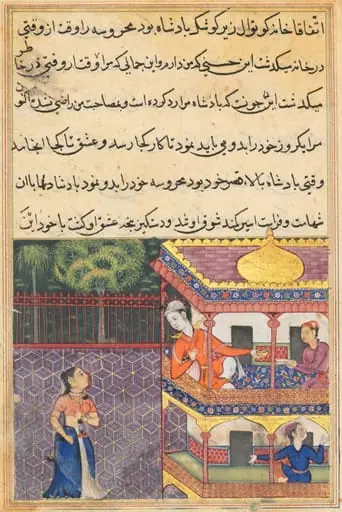 The king of Zabul sees Mahrusa from his palace balcony, from a Tuti-nama (Tales of a Parrot): Thirty-sixth Night
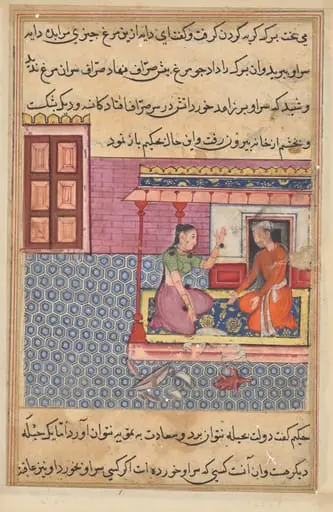 The pious man’s wife offers the seven-colored bird as food to her lover, but not finding its head, he breaks the pot and bowl in anger, from a Tuti-nama (Tales of a Parrot): Fifty-second Night
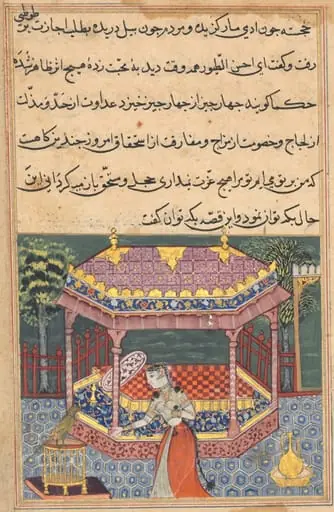 The parrot addresses Khujasta at the beginning of the thirty-seventh night, from a Tuti-nama (Tales of a Parrot)
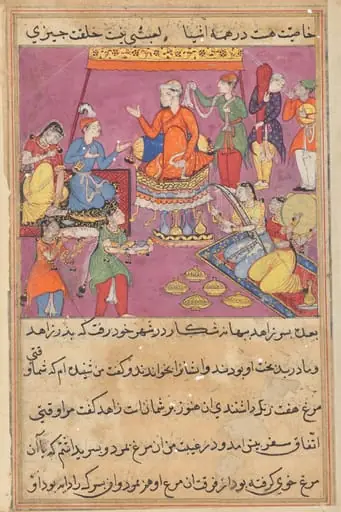 The king gives his daughter in marriage to the pious man’s son, from a Tuti-nama (Tales of a Parrot): Fifty-second Night
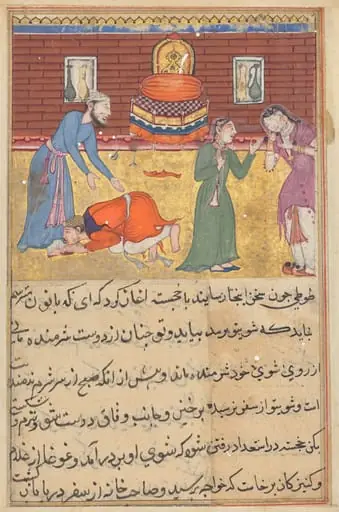 The pious man’s son, now a king, reveals himself to his father; his nurse upbraids his unfaithful mother, from a Tuti-nama (Tales of a Parrot): Fifty-second Night
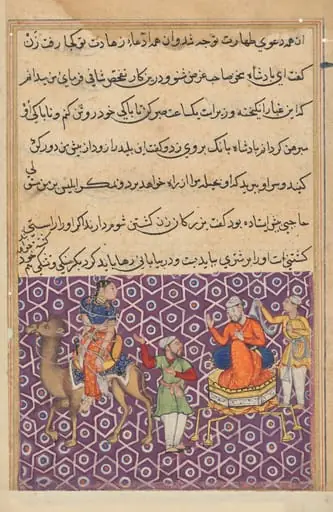 King Bahram, who has married Khassa’s daughter, has her tied to a camel to be abandoned in the desert as a result of false accusations made by Khulasa, from a Tuti-nama (Tales of a Parrot): Fifty-first Night
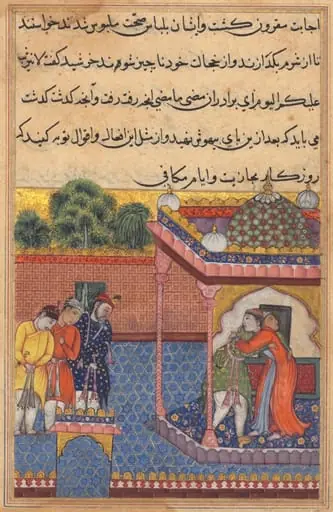 Khurshid reunited with her husband Utarid, from a Tuti-nama (Tales of a Parrot): Thirty-second Night
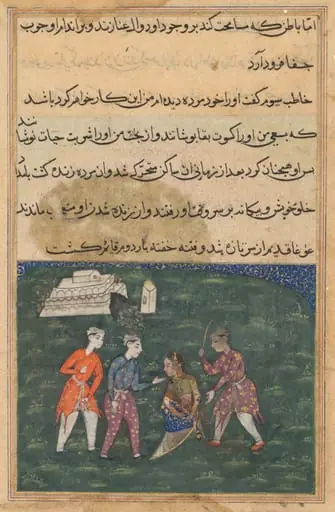 The third suitor strikes the devotee’s daughter and thus restores her to life, from a Tuti-nama (Tales of a Parrot): Twentieth Night
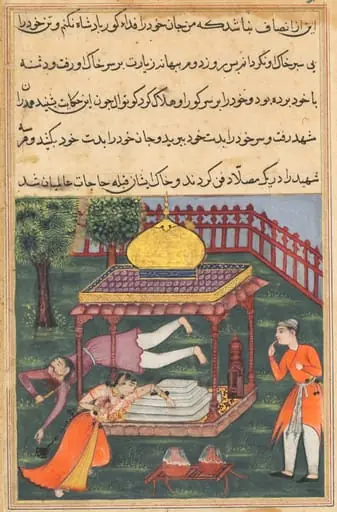 Mahrusa kills herself at the tomb of the king of Zabul, and her husband does likewise, from a Tuti-nama (Tales of a Parrot): Thirty-sixth Night
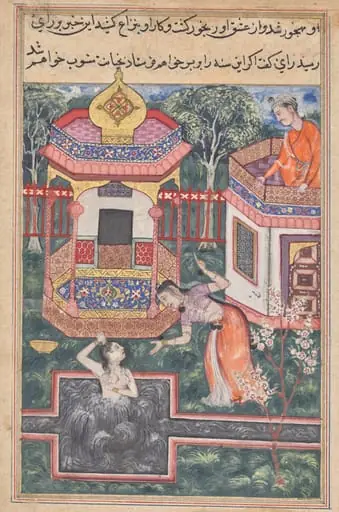 The son of the king of Babylon sees the Brahman transformed into a woman bathing and falls in love with her, from a Tuti-nama (Tales of a Parrot): Thirty-fifth Night