Artwork
The merchant’s daughter meets the gardener, from a Tuti-nama (Tales of a Parrot): Twelfth Night
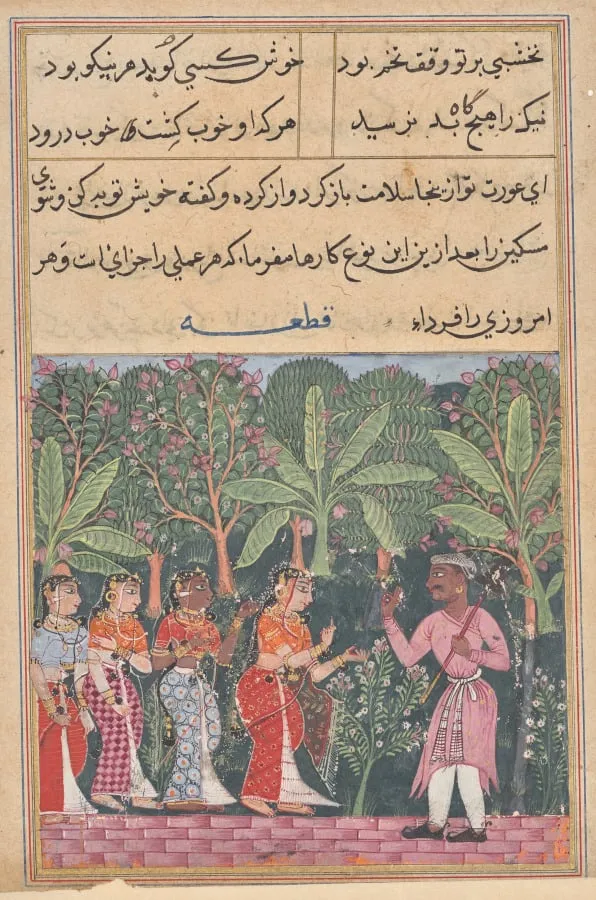
The merchant’s daughter meets the gardener, from a Tuti-nama (Tales of a Parrot): Twelfth Night is an unspecified painting by the Mughal Painting artist Unknown. It dates from 1560 and is held in the collection of the Cleveland Museum of Art. This small, vibrant painting depicts a scene from the Tuti-nama, a collection of 52 tales.
About this work
Artists kept old Persian styles—figures in sharp profile, stiff clothes, and bold gestures—even while working for the Mughal court.
You see a small, bright painting of a rich merchant’s daughter talking to a gardener in a walled garden. Trees are flat shapes, and everyone stands in a single line, like actors on a stage.
The story comes from a book of 52 parrot tales read right to left. Artists kept old Persian styles—figures in sharp profile, stiff clothes, and bold gestures—even while working for the Mughal court.
Look up *mughal india, court of akbar (reigned 1556–1605)* to see more of these lively miniatures.
Overview
This small, vibrant painting depicts a scene from the Tuti-nama, a collection of 52 tales. It shows a merchant's daughter conversing with a gardener within a walled garden.
Subject & Meaning
The image illustrates the twelfth night of the Tuti-nama's stories, which are meant to be read from right to left. The narrative is presented through the interaction between the merchant's daughter and the gardener.
Technique & Style
The painting features flat, bold tree shapes and figures arranged in a single horizontal band, with angular and expressive gestures. The women's figures, shown in profile with stiff garments, reflect pre-Mughal artistic influences.
Context
Created for the Mughal court, likely during the reign of Akbar (1556–1605), this work blends older Persian styles with emerging Mughal artistic elements.
Artist & collection

 Domestic Scene
 Giacomo and Cardinal Marco, investing Andrea, Abbot of San Zeno, with his Benefice
 The Nymph of Fontainebleau
 Portrait of a Woman
 Madonna and Child with Saints in the Enclosed Garden
 Venus and Minerva
 Family Group of Four on Sofa
 Wall painting from Room H of the Villa of P. Fannius Synistor at Boscoreale
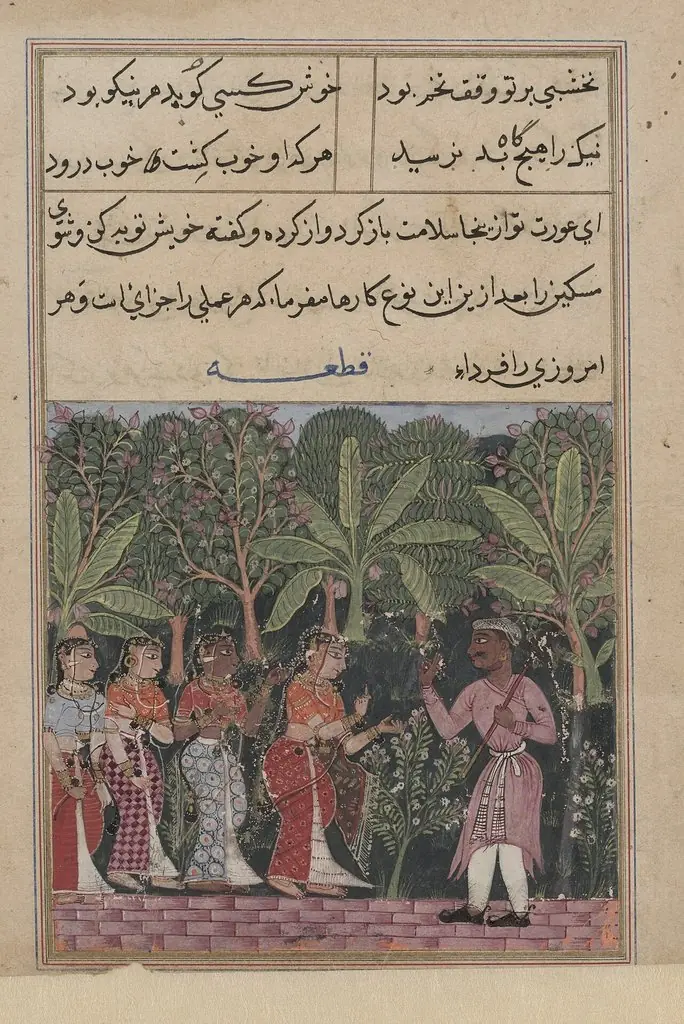 The merchant’s daughter meets the gardener, from a Tuti-nama (Tales of a Parrot): Twelfth Night
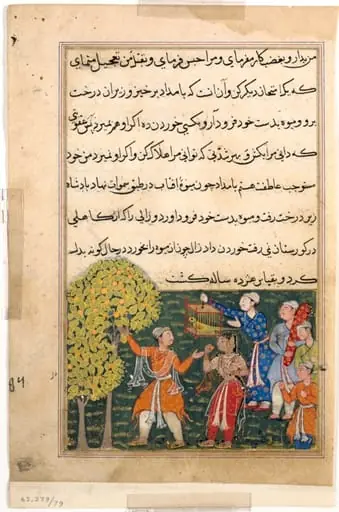 The king plucks fruit from the Tree of Life with his own hands and feeds it to a lady, from a Tuti-nama (Tales of a Parrot): Ninth Night
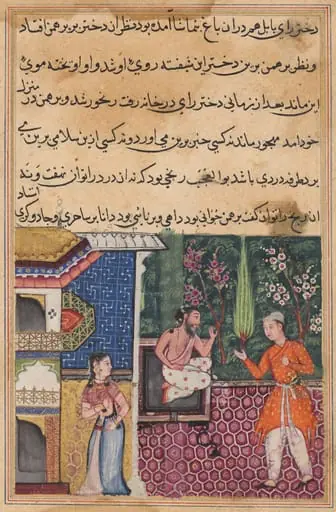 The Brahman gives an account of his falling in love with the king of Babylon’s daughter to his friend, the magician, from a Tuti-nama (Tales of a Parrot): Thirty-fifth Night
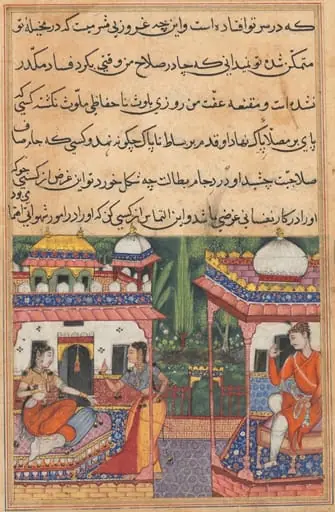 Kaiwan sends a message of love to Khurshid, wife of his brother Utarid who is away on a journey, from a Tuti-nama (Tales of a Parrot): Thirty-second Night
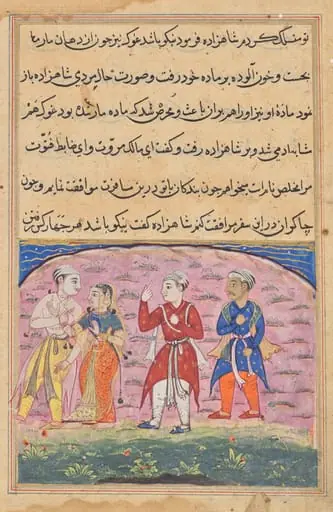 The prince and Nikfal are joined by Khalis and the Mukhlis who are the grateful snake and frog in human form, from a Tuti-nama (Tales of a Parrot): Eighteenth Night
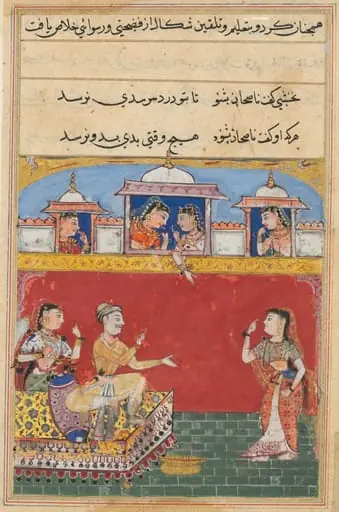 The daughter-in-law returns from her misadventure, feigning insanity, from a Tuti-nama (Tales of a Parrot): Sixteenth Night
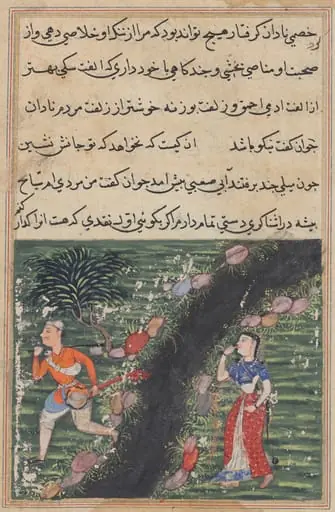 The vagabond crosses a stream with the possessions of the daughter-in-law of the king of Banaras and absconds, from a Tuti-nama (Tales of a Parrot): Sixteenth Night
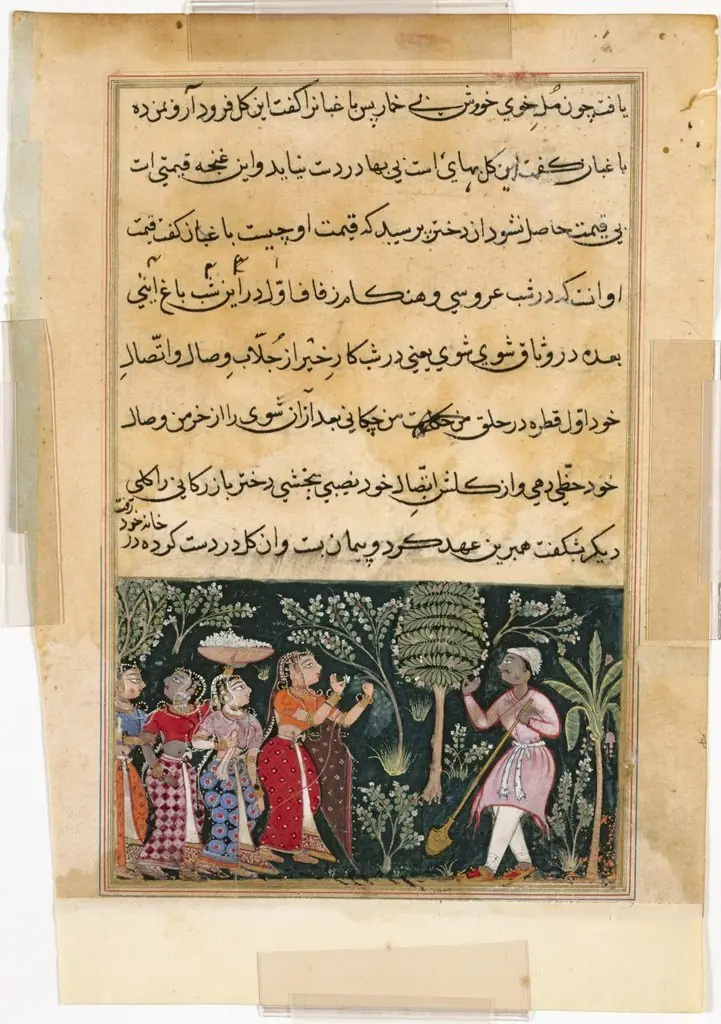 The daughter of the merchant of Mazanderan asks the gardener for the rose, from a Tuti-nama (Tales of a Parrot): Twelfth Night
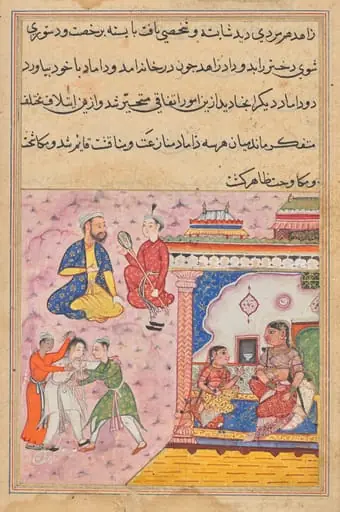 Three suitors fight amongst themselves for the hand of the devotee’s daughter, from a Tuti-nama (Tales of a Parrot): Twentieth Night
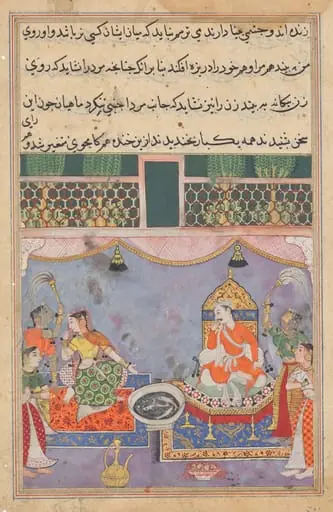 Kamjuy, the wife of the Raja, averts her face from the fishes, from a Tuti-nama (Tales of a Parrot): Twenty-third Night