Artwork
The prince, having deprived the snake of its natural food, a frog, feeds it with a piece of his own flesh, from a Tuti-nama (Tales of a Parrot): Eighteenth Night
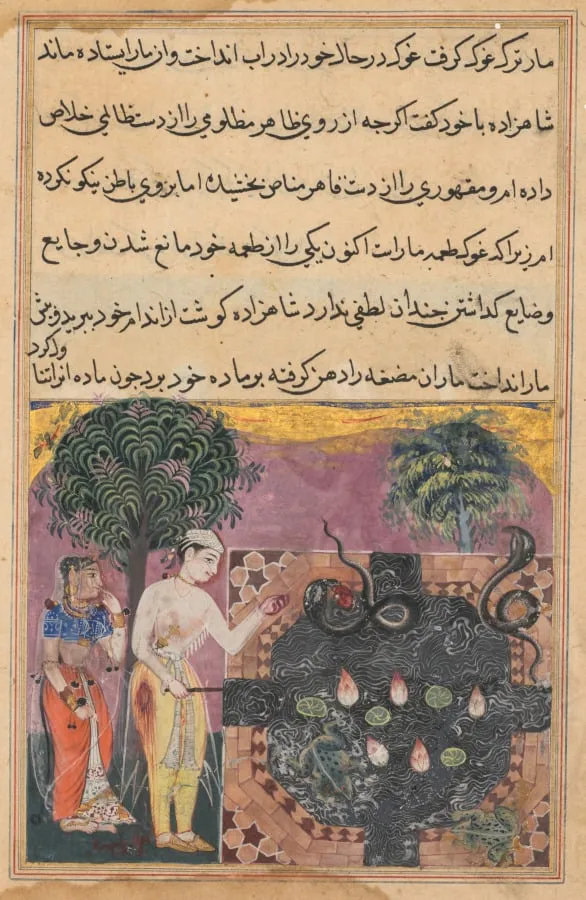
The prince, having deprived the snake of its natural food, a frog, feeds it with a piece of his own flesh, from a Tuti-nama (Tales of a Parrot): Eighteenth Night is an unspecified painting by the Mughal Painting artist Unknown. It dates from 1560 and is held in the collection of the Cleveland Museum of Art. The painting illustrates a scene from a 16th‑century Indian collection of parrot tales.
About this work
The prince’s act is extreme—cutting his flesh to repay the snake—but the scene is calm, almost matter-of-fact, with bright colors and careful details.
A prince kneels by a tiled pool, offering a piece of his own arm to a coiled cobra. The snake’s last meal, a frog, swims free in the water below.
This painting tells a story from a 16th-century Indian book of parrot tales, meant to teach lessons about kindness and debt. The prince’s act is extreme—cutting his flesh to repay the snake—but the scene is calm, almost matter-of-fact, with bright colors and careful details.
To see more stories like this, look up Mughal India, court of Akbar (reigned 1556–1605).
Overview
The painting illustrates a scene from a 16th‑century Indian collection of parrot tales. A kneeling prince stands beside a tiled pool, offering a slice of his own arm to a coiled cobra that has just released a frog back into the water. The composition is rendered in vivid hues, with the geometric tiles and calm atmosphere emphasizing the narrative moment.
Subject & Meaning
The episode conveys a moral lesson on generosity and reciprocity. After the prince rescues the frog from the snake’s jaws, he sacrifices a piece of his flesh to feed the cobra, prompting the frog’s and snake’s wives to urge their husbands to repay the kindness. The story underscores the virtue of self‑offering and the expectation of gratitude.
Technique & Style
Executed with precise brushwork, the artist employs a flattened perspective that looks down onto the tiled pool, creating a bird’s‑eye view. Bright, saturated colours delineate the figures and the intricate tile pattern, while the calm rendering of the characters lends a narrative clarity typical of Mughal court paintings.
Context
The work derives from the Tuti‑nama, a Persian‑influenced anthology of moral tales popular in Mughal India during Emperor Akbar’s reign (1556‑1605). Such illustrations were used in courtly manuscripts to educate elite audiences about ethical conduct through allegorical stories.
Legacy
The painting exemplifies the synthesis of Persian literary tradition with Indian artistic conventions that characterized Mughal visual culture. Its didactic content and refined execution continue to inform studies of how narrative art functioned as moral instruction in early modern South Asia.
Artist & collection

 Domestic Scene
 Giacomo and Cardinal Marco, investing Andrea, Abbot of San Zeno, with his Benefice
 The Nymph of Fontainebleau
 Portrait of a Woman
 Madonna and Child with Saints in the Enclosed Garden
 Venus and Minerva
 Family Group of Four on Sofa
 Wall painting from Room H of the Villa of P. Fannius Synistor at Boscoreale
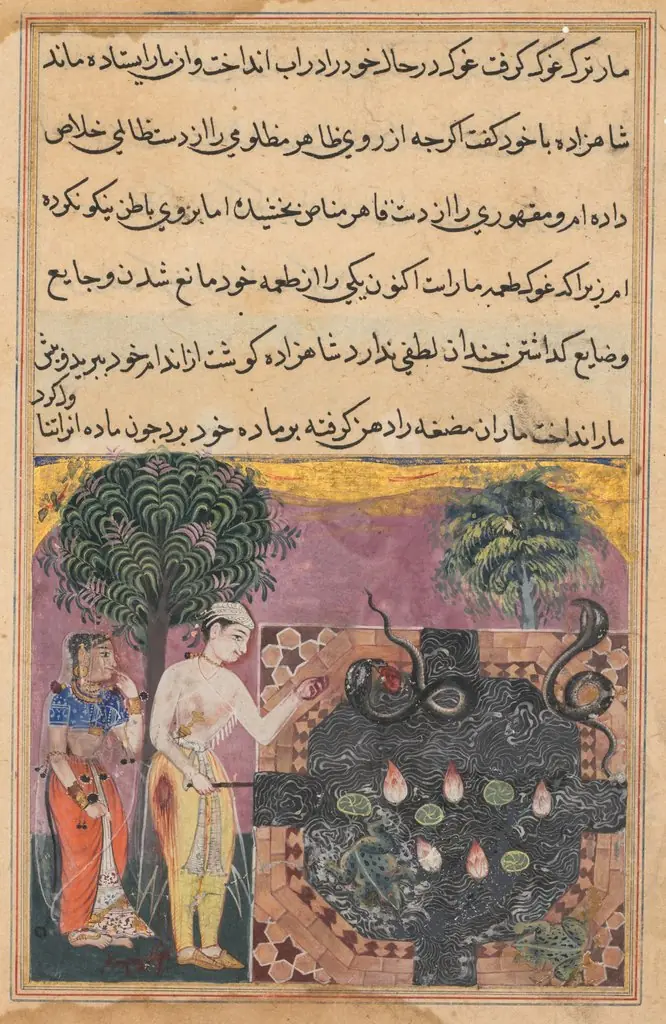 The prince, having deprived the snake of its natural food, a frog, feeds it with a piece of his own flesh, from a Tuti-nama (Tales of a Parrot): Eighteenth Night
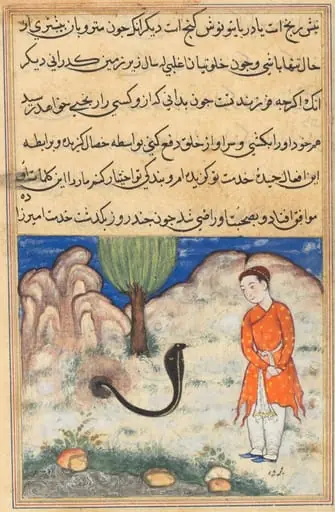 The prince, a son of the ruler of Sistan, enters the service of a snake, from a Tuti-nama (Tales of a Parrot): Thirty-seventh Night
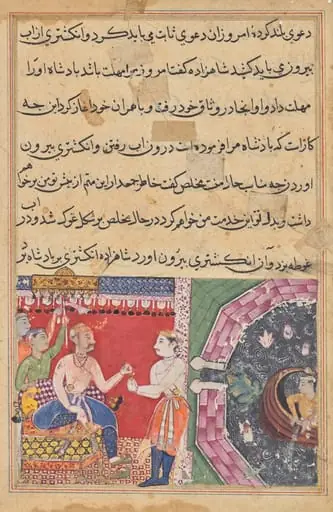 The prince, with the help of Mukhlis who changes into a frog, recovers the ring lost in the sea, and returns it to the king, from a Tuti-nama (Tales of a Parrot): Eighteenth Night
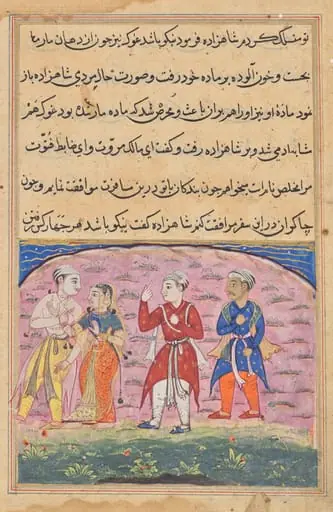 The prince and Nikfal are joined by Khalis and the Mukhlis who are the grateful snake and frog in human form, from a Tuti-nama (Tales of a Parrot): Eighteenth Night
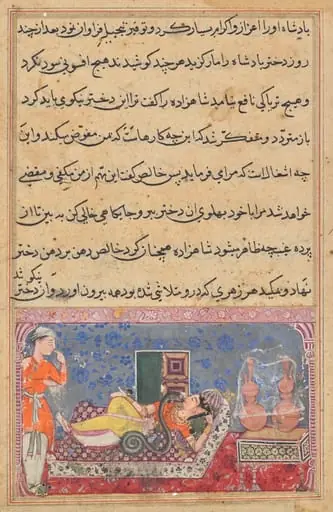 Khalis repays the prince for his kindness by changing into a snake and sucking the poison from the king’s daughter, from a Tuti-nama (Tales of a Parrot): Eighteenth Night
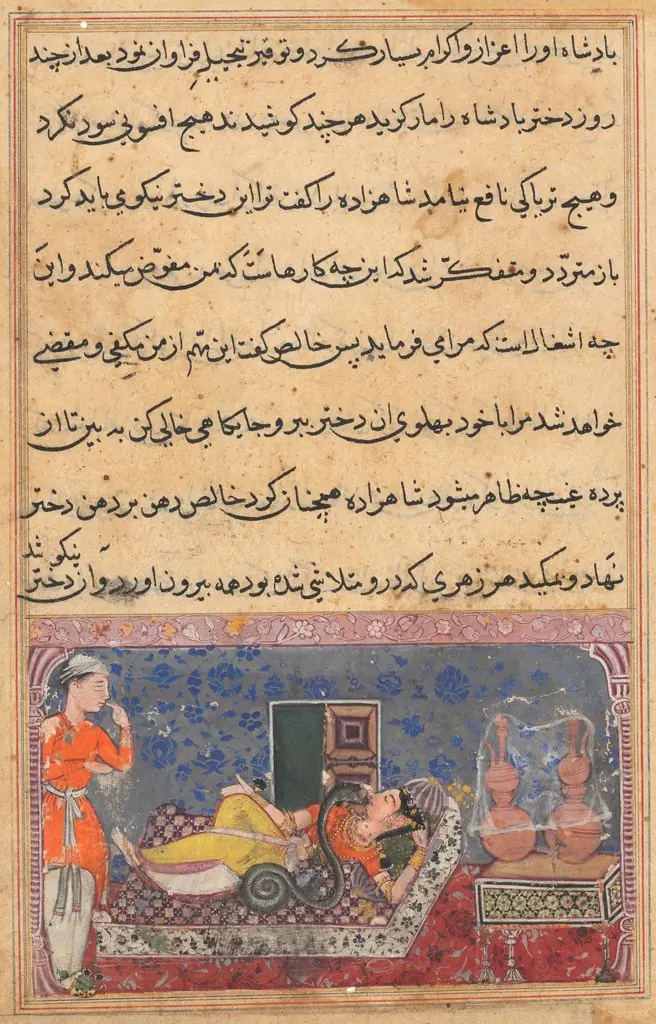 Khalis repays the prince for his kindness by changing into a snake and sucking the poison from the king’s daughter, from a Tuti-nama (Tales of a Parrot): Eighteenth Night
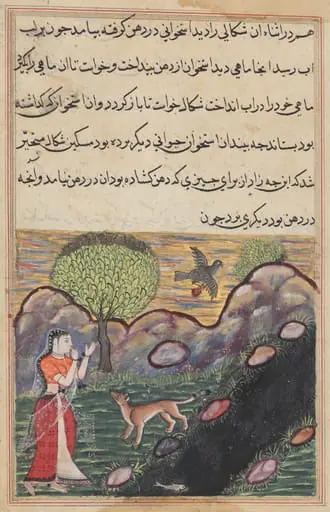 The daughter-in-law of the king of Banaras sees the jackal deprived of its food by a bird, as it unsuccessfully attempts to catch a fish, from a Tuti-nama (Tales of a Parrot): Sixteenth Night
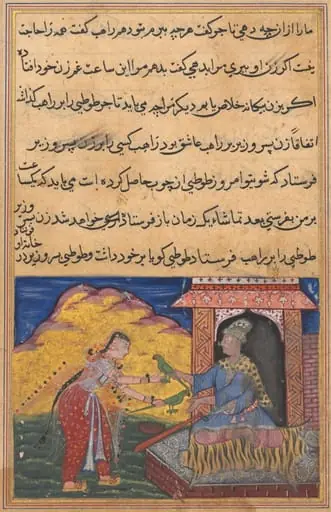 The wife of the son of the vizier brings the magic wooden parrot to her lover, the monk, who exchanges it for the replica, from a Tuti-nama (Tales of a Parrot): Tenth Night
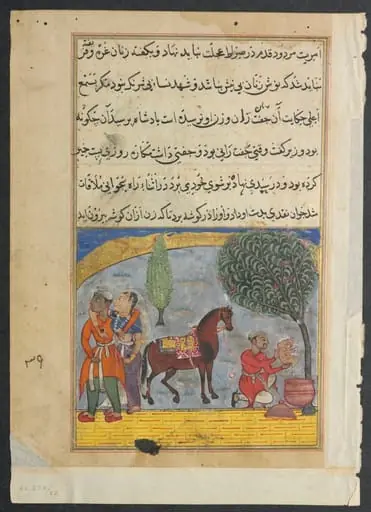 The lover’s son makes an elephant of the pastry dough carried by the unfaithful wife and puts it in her basket, from a Tuti-nama (Tales of a Parrot): Eighth Night
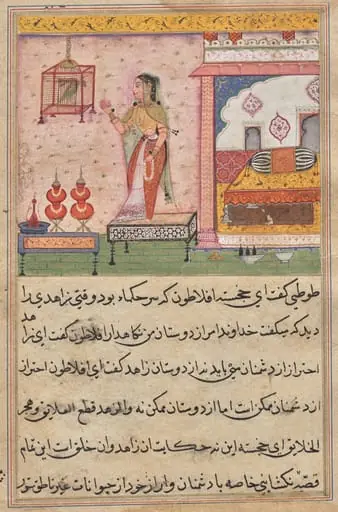 The Parrot Addresses Khujasta at the Beginning of the Twenty-third Night, from a Tuti-nama (Tales of a Parrot)
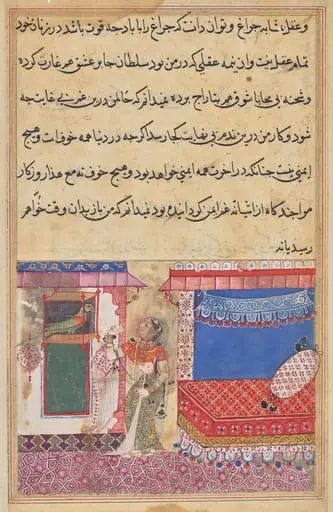 The Parrot Addresses Khujasta at the Beginning of the Eighteenth Night, from a Tuti-nama (Tales of a Parrot)